



TransUnion: Auto Originations Fall for Third Consecutive Quarter
First-quarter auto loan originations declined 2.9% from the year-ago period to 6.73 million in the first quarter, the third consecutive quarter of year-over-year declines and the first decline in origination growth in any first quarter since 2010. Officials attribute the drop to the subprime retreat.

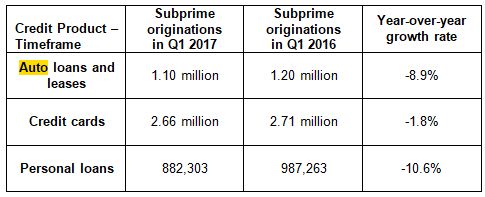
CHICAGO — Subprime originations registered their first decline since 2012, according to TransUnion’s quarterly Industry Insights Report. It found that 4.63 million subprime consumers originated an auto loan or lease, personal loan, or credit card in the first quarter, down from 4.89 million in the first quarter of 2016.
The firm attributed the decline to a combination of factors, including funding issues among fintech finance sources and tightening underwriting standards due to the recent uptick in delinquencies. The latter is especially true in the auto finance industry, where the delinquency rate increased 10.8% from a year ago to 1.23% in the second quarter.
“Immediately following the recession, many lenders pulled back on subprime originations to control delinquency. As the economy recovered, lenders loosened their underwriting standards and allowed more subprime consumers greater access to credit,” said Ezra Becker, senior vice president of research and consulting for TransUnion. “It appears that this trend may now be changing, though it is a much different environment than what we observed just after the recession. The economy is performing well, and after several years of increased subprime lending, some lenders may simply be taking a pause.”
In the first quarter, subprime personal loan originations declined 10.6% year over year, compared to a positive annual growth rate of 11% in first quarter of 2016. This marked three straight quarters of year-over-year declines in originations, as more than 100,000 fewer subprime consumers opened a personal loan in 2017’s opening quarter vs. the year-ago period.
In the credit card segment, subprime originations declined by 1.8% to start 2017, the second consecutive quarter of decline. Since 2014, subprime originations had increased at a rapid rate, averaging a growth of 29.2% in the first quarters of 2014, 2015, and 2016. In this year’s opening quarter, subprime originations declined at nearly the same rate as total originations (down 1.9%).
As for the auto finance arena, the firm noted that the slight rise in delinquencies was expected after several years of finance sources offering more financing opportunities to nonprime consumers. Officials noted, however, that delinquencies remain at low levels.
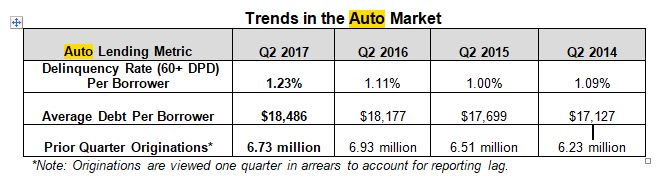
Auto originations in the first quarter declined 2.9% from the year-ago period to 6.73 million, marking the third consecutive quarter of year-over-year declines in auto loan originations and the first decline in origination growth in any first quarter since 2010.
“Lenders have also raised concerns about the downward pressure on used-car values, and we are beginning to see this impact origination growth,” added Brian Landau, senior vice president and automotive business leader for TransUnion.
Despite this decline total auto balances reached a new high of $1.145 trillion in the first quarter — a 6.9% increase from the year-ago period.
“A combination of factors has influenced the decline in subprime personal loan originations. For example, fintech lenders faced funding challenges in Q2 2016,” said Becker. “After years of growth in auto lending for subprime consumers, not surprisingly we observed an uptick in auto delinquency. Higher delinquency rates have long been anticipated as the result of that credit expansion. The reduction in subprime auto lending is a natural reaction to the emergence of that increased delinquency.”
More F&I

F&I Sales Give Dealers First-Half Lift
Product business shored up total profits to avoid an overall revenue tanking as product penetrations held steady, StoneEagle reported.
Read More →
Targeted Training Drives Results
Today’s technology, instead of threatening F&I managers, can actually make them better, according to an industry veteran who’s watched market setbacks roil the unprepared.
Read More →
Just Do It
F&I managers need training, but instead of resisting application or expecting perfection, they should improve by simply acting on what they learn.
Read More →
Dealer Lender Preferences Revealed
When lenders provide consistent, fast service, their overall satisfaction scores with dealers greatly improve, according to JD Power research.
Read More →
Leading with Purpose
In this video, Trent White explains how understanding your people’s 'why' is a key leadership responsibility of F&I professionals and how that mindset drives dealership engagement, trust and performance.
Read More →
Integrating Nontraditional F&I Products
The niche presents a strategic advantage for auto dealerships as they move to adapt to fast-changing consumer expectations in today’s market.
Read More →
Trust Is Personal
Technology, no matter how efficient, can’t replace what the human F&I manager can do, which is to bridge the divide between cyberspace and the in-store experience.
Read More →
Amplify 2026 Billed as Turning Innovation Into Results
Reynolds and Reynolds says its annual retail summit will connect dealers with practical strategies, peer insight, and technology-driven ideas.
Read More →
Own Your Outcome: F&I in the Digital Customer Journey
Finance has historically been the last step in the car-buying process, but it doesn’t have to be. The customer’s journey starts long before they arrive at the dealership, and so should F&I’s involvement.
Read More →
Tariffs Could Raise Insurance Premiums
As U.S. import tariffs affect repair costs, consumers might find it more affordable to replace a damaged vehicle, according to recent Insurify tariff analysis.
Read More →