



US, Canadian Dealers Strong as Disruptors Advance in Global Auto Finance Report
FICO’s second annual survey of auto finance customers finds the United States and Canada atop the dealer-arranged financing rankings even as the number of auto loans originated online jumped from 5% to 13% year-over-year.


FICO’s Ken Kertz told F&I and Showroom that reducing friction in the instore sales and financing processes could help dealers maintain their enviable shares of the U.S. and Canadian auto finance markets.
Photos courtesy FICO
SAN JOSE, Calif. — Analytics software and credit-decisioning solutions provider FICO has released its 2019 Global Consumer Survey of Vehicle Finance Perceptions. The wide-ranging study included 2,000 recent auto loan and lease consumers in the United States, Canada, and Mexico as well as the UK, Australia and New Zealand, Chile, Germany, and Spain.
The authors’ stated intent was to gauge perceptions of the auto finance industry amidst numerous seismic shifts, including the rise of digital sales and F&I platforms and alternatives to traditional vehicle ownership.
They found that, despite those disruptions, auto dealers around the world — and particularly in the U.S. and Canada — are holding their own even as consumer-facing options proliferate. Canada leads the world in dealers’ share of the auto finance market with 66% of all loans in 2018, trailed closely by the U.S. at 63%; both sit well above the global average of 56%.
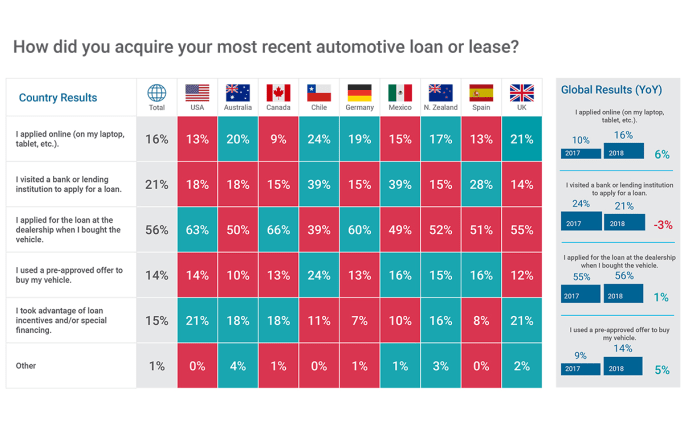
Canada (66%) and the U.S. (63%) both exceeded the global average of 56% of surveyed consumers who said they acquired their most recent loan by applying at the dealership.
For dealers, “It’s good news overall,” said FICO’s senior manager of solution marketing, Mica DuBois, in an interview with F&I and Showroom. “While online is gaining traction, dealers are still the No. 1 channel.”
The same is true worldwide, where car buyers applied for loans online at a 16% clip, led by Chile at 24% and Australia at 20%. In Australia, only 50% of originations were initiated by dealers; in Chile, dealer-arranged financing accounted for only 39% of new auto loans, by far the lowest score among the nine nations surveyed.
U.S. consumers also listed the dealership as their first choice (40%) for their next auto loan, followed by an outside lending institution (32%) and applying online (28%). Remarkably, 58% of Canadian consumers said they would start their next financing journey at the dealership, far outpacing those who plan to go online (17%).
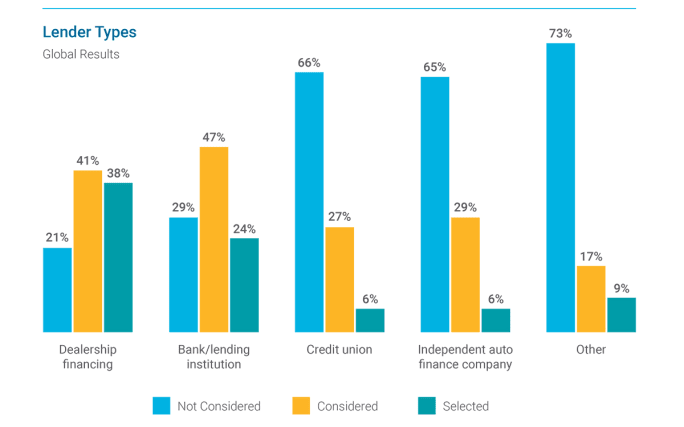
Worldwide, 47% of car buyers and lessees considered third-party lenders first. But only 24% of those sources captured their business, compared with dealer-arranged financing’s 38% global market share.
To retain their still-dominant position in the auto finance market, dealers in every market may wish to focus on reducing “friction” throughout their instore processes, said Ken Kertz, senior director of FICO’s auto and motorized division.
“Many lenders feel we’re only three to five years out from going fully digital,” Kertz told F&I and Showroom. "The theme we hear constantly is consumers want less choice, not more, so making the process simpler and driving out some of the friction will build clarity and trust in the purchase.”
To read the report in its entirety, click here.
More Auto Finance

Interest Rates Further Squeeze Auto Consumers
Last month’s hike and a potential second increase this month add to a growing list of inflation woes that could continue to dent overall car sales.
Read More →
Mind Your Process
Consistent steps taken in various aspects of the F&I office can make valuable differences over time, similar to an outline for a best-selling book.
Read More →
Top Five Credit Application Fraud Flags
Compliance audits regularly reveal bad habits that can lead to fraud charges and should have been stamped out decades ago.
Read More →
More Auto Loans for the Taking in August
Riskier categories were on the uptick for the month as lenders loosened access in several areas while balancing out the exposure in another, Cox Automotive reported.
Read More →
July Was Hot for Auto Borrowers
Credit proved readily available for many, but most loans left buyers in negative territory, Cox Automotive said.
Read More →
Dealer Lender Preferences Revealed
When lenders provide consistent, fast service, their overall satisfaction scores with dealers greatly improve, according to JD Power research.
Read More →
Auto Refi Savings Surge
Consumers with 84-month auto loan terms who refinanced saved the most on monthly payments, according to a new report by auto refinancing provider Caribou.
Read More →
Subaru Enters Lending Business
The automaker follows other brands in adding captive financing in the U.S., and says the move will strengthen its position here.
Read More →
Positive Equity Reaches Record High
Mainstream vehicle owners who bought a car seven years ago are likely to have positive equity when trading in for a new vehicle, according to second-quarter Edmunds data.
Read More →
Dealerships Are Paying the Price for Extended Car Loans
Growing negative-equity scenarios mean such lengthy terms should be addressed in a forward-looking way to make them work for the dealer and the consumer down the road.
Read More →