



The Difference Is in the Details
Focusing on finer points can help F&I bear more of the weight of post-pandemic profit deflation.

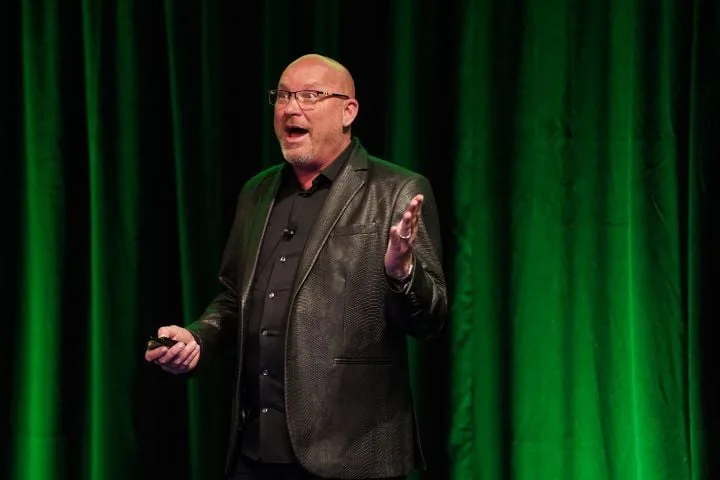
'“F&I subconsciously binds that customer to our dealership, and it can happen in so many different ways,.' Dupaquier says.
In the F&I office, it’s really all about the little things, Tony Dupaquier seemed to be saying when he addressed a roomful of F&I pros at the latest Bobit Dealer Group Agent Summit.
Though finance-and-insurance sales are essential in helping dealerships transition away from the halcyon days of record profits that the pandemic indirectly brought to the industry, some of the small ways it does so can be overlooked. Dupaquier sought to remedy that.
The red soles of his Christian Louboutin shoes, which were covered in small spikes, revealed themselves as he paced across the stage in a meeting room at the Cosmopolitan in Las Vegas. Otherwise dressed entirely in black, he said afterward that some members of the audience happened to notice the colorful detail, and that’s exactly the point he seemed to be making in his talk.
F&I is “the last impression” the customer has of a dealership, said the North American training director for iA American Warranty Group. “We need to do everything we can.”
If that last experience at the dealership is positive, it acts as a kind of sealant, or binding agent, he said, connecting the customer to the business out of loyalty and thereby making for a long journey rather than a short trip.
F&I plays such a “critical role” in the dealership, he said, and should focus on the ownership experience to attract the customer back to the store.
Fine Details
One of the seemingly smallest things F&I sales staff can do toward that end, Dupaquier said, is to stop pointing out that service contracts they sell are valid for use at other authorized facilities unless the buyer lives hundreds of miles from the dealership.
Though that’s true and a valuable feature, it shouldn’t serve as a selling point because it could obviously drive repeat business away from the selling dealer. Conversely, every time a customer makes a claim on a contract at the selling dealership, that store makes more money.
“F&I subconsciously binds that customer to our dealership, and it can happen in so many different ways,” he said.
Other adjustments include resisting the tendency to mentally or otherwise dismiss customers struggling with credit issues.
“There should be a personal relationship during that transition,” Dupaquier said, adding that “we all know salespeople who don’t do a very good job following up.”
The F&I office should also get a complete, accurate picture of each customer before he or she enters, and no customer should have to wait too long.
“That helps create that final impression,” he said. “The longer they have to wait, they’re looking on their phone, they’re thinking about it.”
F&I sales, at least the base presentation, should also be practiced regularly, and role-playing exercises can help make the right moves natural, Dupaquier continued.
“Presentations need to be short, sweet and to the point.”
Details That Produce
Operating on the belief that numbers paint reality, Dupaquier presented a series of iA American statistics that illustrate the revenue-producing power of certain product sales.
Of customers who buy vehicle service contracts, he said 55% return to the originating dealer. But disappearing deductibles actually make customers reappear, he pointed out. For VSC customers with a $100 disappearing deductible – waived if the originating dealer performs a repair – that share climbs to 60%. With a $200 disappearing deductible, it’s all the way to 80%.
Dupaquier demonstrated other dramatic data: 89% of dent-and-ding customers, 58% of windshield coverage customers, and 81% of tire-and-wheel customers return to the originating dealer. He said such repairs are also done alongside other work once the car’s in the service center, adding to the revenue for the dealership.
Road hazard coverage, for one, is an “easy upsell,” he said.
“When there’s a zero-dollar deductible and they can have the repair done at any authorized facility, we’re pushing more business away. … The more service contract sales, the better retention,” said Dupaquier, who pointed out for the benefit of his audience that iA American’s national training center is in Las Vegas.
One Last Detail
Then he transitioned to a subject that may have been somewhat controversial in a room full of F&I salespeople but that could bring significant returns: limited integration of F&I and the service drive.
Dupaquier emphasized the limited scope he proposed when he broached the idea but nevertheless drove home the point that it’s an opportunity that shouldn’t be discounted. He said service advisers should be educated about F&I products and might pitch a windshield policy or the like but that they shouldn’t try to sell service contracts because that doesn’t work well.
His alternative recommendation: teeing up F&I sales in the service drive via the person who’s typically the most unassuming service employee – the cashier.
“All they do all day long is get barked at by people for something that’s not their fault, and they sit there with a smile,” Dupaquier said. “That’s a special person.”
The cashier should be trained with an introduction to F&I that tells them what to look for on each service ticket, starting with base factory warranty claims, then moving to oil changes. Once a person’s warranty ends, the cashier could say to the customer something like, “Do you have any coverage? I’m seeing repairs getting more and more expensive,” he said.
What’s more, the cashier can recount real-life experiences of customers who have checked out with expensive bills because they had no such coverage, pointing out repairs that used to come with minor fees recently ballooning in cost.
The cashier can then be compensated with a flat amount for all viable opportunities for the F&I office to close the deal. That’s because if F&I failed to do so and the cashier therefore got no commission, they’d stop teeing up, Dupaquier suggested.
Then service advisers might see the cashier’s successes and start making their own gentle pitches.
At the same time, newer F&I recruits could cruise the service drive on slow mornings to chat with customers.
Dupaquier was clearly confident about a simple idea that he said could make a big difference, but a man in the audience expressed some doubt when he asked him if the concept had been proven.
“Proven. I don’t do theory in group,” the speaker replied. “The most successful I’ve seen are smaller stores with one cashier.”
Hannah Mitchell is executive editor for Bobit Dealer Group. A former daily newspaper journalist, her first car was a hand-me-down Chevrolet Nova.
Originally posted on Agent Entrepreneur
More F&I

AI: Facilitator, Not Fixer, in F&I
The dealerships that thrive in the years ahead will be those that embrace technology while continuing to invest in the people who make customer interactions count.
Read More →
Modern Technology Objection Handling
In this video, Trent White shares how to confidently handle technology-based objections by helping customers understand the value of protection, even with modern vehicle technology.
Read More →
Consistency at Scale: Driving F&I Performance
With 75 rooftops across the Sunshine State, Morgan Auto Group has proven to Floridians that it knows a thing or two about driving performance in a competitive market. But it didn’t start at the top.
Read More →
Gitty Up on GAP
The foundational finance-and-insurance product hasn’t kept up with the latest conditions for auto dealers. Is the time ripe?
Read More →
How AI-Powered Coaching Is Transforming F&I Performance
See how AI-powered coaching can turn F&I customer conversations into actionable insights that support compliance, performance and profitability
Read More →
Sell Value, Build Trust
In this video, Trent White explains why selling on value, not fear, builds lasting customer trust, reduces cancellations, and drives long-term success.
Read More →
F&I Sales Give Dealers First-Half Lift
Product business shored up total profits to avoid an overall revenue tanking as product penetrations held steady, StoneEagle reported.
Read More →
Targeted Training Drives Results
Today’s technology, instead of threatening F&I managers, can actually make them better, according to an industry veteran who’s watched market setbacks roil the unprepared.
Read More →
Double the Change, Double the Chance
When an F&I manager gets a customer refusal, it’s a wise move to tweak more than one thing in the product offering.
Read More →
Just Do It
F&I managers need training, but instead of resisting application or expecting perfection, they should improve by simply acting on what they learn.
Read More →