



Black Book: Weekly Market Updates
Days-to-turn for used retail listings have slightly increased and now sits just above 38 days, which is still lower than what is typically expected.

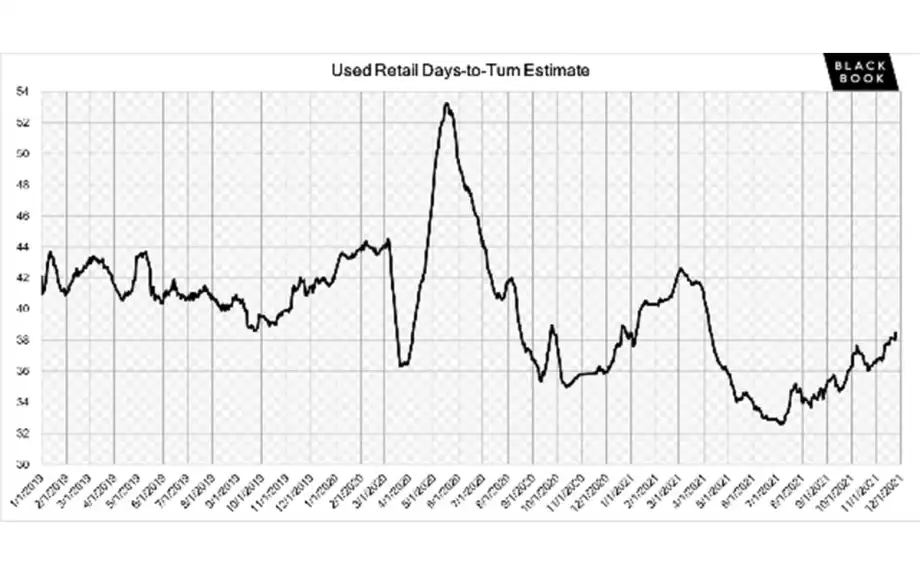
Days-to-turn for used retail listings have slightly increased and now sits just above 38 days, which is still lower than what is typically expected.
BLACK BOOK – Wholesale Prices, Week Ending November 27th
Activity on the lanes slowed down last week, with the Thanksgiving holiday reducing the availability of inventory and number of buyers actively bidding. Some consignors are known to save their inventory for after the holiday, so we anticipate an increase in volume on the lanes this week.
This Week Last Week 2017-2019 Average (Same Week)
Car segments +0.13% +0.70% -0.47%
Truck & SUV segments +0.21% +0.61% -0.54%
Market +0.18% +0.64% -0.52%
Car Segments
On a volume-weighted basis, the overall Car segment increased +0.13%. For reference, the previous week, cars increased by +0.70%.
Compact (+0.26%) and Full-Size (+0.25%) Car segments reported gains, but these gains were reduced compared to the prior week that reported increases of +0.76% and +0.53%, respectively.
After eight weeks of increases, Sporty Cars reported a minimal decline of -0.05%. By comparison, the same week in 2019 reported a decline of -0.76%.
Truck / SUV Segments
The volume-weighted, overall Truck segment increased +0.21%, compared to the prior week’s increase of +0.61%.
Full-Size Vans had the largest segment increase last week with a gain of +1.37%.
Compact Vans (+1.21%) also reported a large increase. This segment has now had increases in forty-one out of the last forty-three weeks.
Full-Size Pickups increased for an eleventh week in a row for an average weekly increase of +0.23%.
Weekly Wholesale Index
Calendar year 2020 ended with used wholesale prices at elevated levels. With economic patterns (including the automotive market) driven by the pandemic, normal seasonal patterns (e.g., 2019 calendar year) in the wholesale market were not observed for most of the year. We saw a similar picture in 2009, at the end of the Great Recession. Calendar year 2021 has not had typical seasonality patterns as the market has had rapid increases in wholesale values for the majority of the year. After reaching record heights at the end of June, wholesale prices began to decline at a rate higher than the typical seasonal decline through July and most of August. As we moved into the Fall season, wholesale prices began to show positive movement once again and reached the highest point of the year last week again, at 1.49.
The graph below looks at trends in wholesale prices of 2-6-year-old vehicles, indexed to the first week of the year.
Retail (Used and New) Insights
GMC announced deliveries of the Hummer Edition 1 – the all-electric truck variant with a 329-mile range – will begin this month.
Nissan unveils $18B electric-style strategy called “Nissan Ambition 2030” with 23 new electrified vehicles, including 15 EVs, across Nissan and Infiniti brands.
Genesis revealed their Electrified GV70 at the Auto Guangzhou show – the luxury crossover boasts a peak output of 483 hp.
Porsche announced plans to develop a new PHEV flagship model that is “part sedan, part crossover” with 3 rows.
Tesla is scheduled to start production of the Model Y at their new Berlin giga factory this month.
Kia revealed the second-generation Niro at the Seoul Mobility Show – the crossover is now available as a hybrid or full EV.
Rivian plans to begin deliveries of their seven-passenger 2022 R1S electric SUV in January.
An independent test by InsideEVs found that the Lucid Air charges more quickly than Tesla’s Model S or Porsche’s Taycan.
Used Retail Prices
With the proliferation of ‘no-haggle pricing’ for used-vehicle retailing, asking prices accurately measure trends in the retail space. Retail demand slowed down at the end of last year, and thus resulted in declining retail asking prices for the last several weeks of 2020. As demand rebounded, retail prices have lagged slightly behind wholesale prices, but March had an accelerated growth in retail prices. In April and May, retail prices picked up speed as demand accelerated, fueled by stimulus payments, tax season, and shortages of new inventory. During the third quarter, retail prices continued to rise at a slower rate but have since picked up. After continued strong increases, the retail listing price index has increased to just over 33% above where we started the year.
This analysis is based on approximately two million vehicles listed for sale on US dealer lots. The graph below looks at 2-6-year-old vehicles.
Inventory
Used Retail
As we head into the last month of the year, used retail listings have stabilized around 17% below where we started the year. Generally, at this time of year, used retail listing volume is expected to increase as new models are launched and incentive spend increases. The graph below shows that the current volume is less than what was seen in both CY19 and CY20. With significantly reduced new inventory volume and decreasing used inventory, it is no surprise that there are fewer retail listings available overall.
Days-to-turn for used retail listings have slightly increased and now sits just above 38 days, which is still lower than what is typically expected.
Wholesale
December is typically a busy month in the lanes with sellers trying to offload unnecessary vehicles and buyers trying to stock up on inventory in time for the holidays. While some new inventory is trickling in from manufacturers, used inventory will still play a pivotal role as we close out calendar year 2021. Inventory scarcity has continued to cause bidding wars across the country among franchise dealers, independent dealers, and rental companies. Wholesale values and floors were on the upswing before Thanksgiving and may pick back up again soon, now that that holiday has passed.
The weekly estimated average sales rate declined to 67% this week, after remaining stable at the 70% mark for the past 2 weeks in a row. This time last year, the estimated average weekly sales rate was around 54%, so while floor prices have continued to rise, buyers continue to purchase vehicles at auction at a higher rate.
The overall wholesale market for 2-8-year-old vehicles increased by +0.18% last week, and 0-2-year-old vehicles increased +0.14%.
More Auto Finance

Interest Rates Further Squeeze Auto Consumers
Last month’s hike and a potential second increase this month add to a growing list of inflation woes that could continue to dent overall car sales.
Read More →
Mind Your Process
Consistent steps taken in various aspects of the F&I office can make valuable differences over time, similar to an outline for a best-selling book.
Read More →
Top Five Credit Application Fraud Flags
Compliance audits regularly reveal bad habits that can lead to fraud charges and should have been stamped out decades ago.
Read More →
More Auto Loans for the Taking in August
Riskier categories were on the uptick for the month as lenders loosened access in several areas while balancing out the exposure in another, Cox Automotive reported.
Read More →
July Was Hot for Auto Borrowers
Credit proved readily available for many, but most loans left buyers in negative territory, Cox Automotive said.
Read More →
Dealer Lender Preferences Revealed
When lenders provide consistent, fast service, their overall satisfaction scores with dealers greatly improve, according to JD Power research.
Read More →
Auto Refi Savings Surge
Consumers with 84-month auto loan terms who refinanced saved the most on monthly payments, according to a new report by auto refinancing provider Caribou.
Read More →
Subaru Enters Lending Business
The automaker follows other brands in adding captive financing in the U.S., and says the move will strengthen its position here.
Read More →
Positive Equity Reaches Record High
Mainstream vehicle owners who bought a car seven years ago are likely to have positive equity when trading in for a new vehicle, according to second-quarter Edmunds data.
Read More →
Dealerships Are Paying the Price for Extended Car Loans
Growing negative-equity scenarios mean such lengthy terms should be addressed in a forward-looking way to make them work for the dealer and the consumer down the road.
Read More →