



Character Development
Chris ‘Captain Credit’ Cochran struck gold for Haddad Dealerships with a social media promotion that grew into a standalone special finance department.

The “Captain Credit” Facebook page has garnered 349 friends since Haddad Dealerships’ finance director, Chris Cochran, launched it in 2008.
With only six years in the business, you might suspect that Chris Cochran’s rapid ascent from sales associate to finance director for all three stores in the Pittsfield, Mass.-based Haddad Dealerships family was a matter of good luck, a bad economy or both. Cochran won’t deny that timing played a part, but most of his success is the result of hard work and one very good idea.
It almost didn’t happen. A Pittsfield native, Cochran first sold cars for owner George Haddad before starting college in 2000. After graduating, he left New England to study chiropractic medicine at a school in Iowa. Unfortunately, funds ran out before he could complete his degree, and he soon found himself back in his hometown.
Cochran decided to get back into the car business. He first worked at a local used-car lot, then put in a call to Haddad when he heard they were hiring. He was hired as an F&I manager at Haddad Toyota in August 2006 before being promoted to general sales manager at the Subaru store. And when the opportunity came to direct F&I for all three dealerships from the Toyota franchise, Cochran didn’t hesitate.
“I wanted to be in the finance department,” he says. “F&I is fast-paced. It requires cognitive thinking.”
Trial By Fire
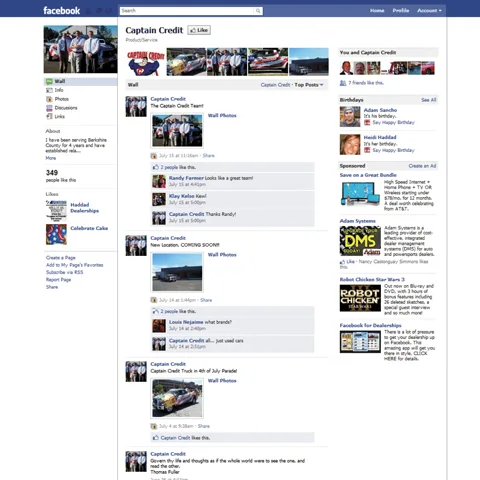
The initial success of “Captain Credit” was enough to convince management to create a separate ad budget and, in the coming months, a separate lot for subprime sales.
Cochran moved into the F&I office in the summer of 2007, just months before the credit crisis would derail the industry. A year earlier, Haddad was booking used units at 150 percent loan to value. By 2008, they were lucky to still be in business. Cochran says the key to survival was the dealer group’s three principal lenders: Toyota Motor Credit, Hyundai Motor Finance and a local credit union.
“They saw us through,” Cochran says. “But even working in the finance office, my income was capped on others’ motivations.”
He felt that Haddad was missing out by not marketing to the subprime segment. As the economic picture worsened, he decided to take matters into his own hands. With no marketing budget to work with, Cochran turned to Facebook.
He created a page around a cartoon superhero he named “Captain Credit.” His primary superpower? Getting subprime customers approved for loans. “It was quick,” Cochran says. “Suddenly, we were selling four or five cars a month because of Captain Credit.”[PAGEBREAK]

Cochran is flanked by F&I manager Ken Kaczenski (left) and sales manager Doug Hakkinen on the Haddad Toyota lot. An adjacent lot, the former home of a GMC franchise, was recently leased by Haddad Dealerships to serve as a standalone used-car lot for Captain Credit customers.
Building On Success
With his no-cost social media campaign bringing in new customers, Cochran was able to convince management to give him a marketing budget. He spent the money on billboards and bus, radio and newspaper ads, and, finally, a full vinyl wrap on his Toyota Tundra. Before long, Captain Credit was moving 15 units per month at an average of $2,100 per deal, including up to $900 on the back end.
Cochran didn’t take his hit campaign for granted. He immersed himself in the world of special finance, reaching out to lenders such as AmeriCredit Corp., Exeter Finance Corp., Auto-Use and Santander. He also sought out new ideas online, which is how he found trainer, consultant and F&I and Showroom contributor Rob Hagen.
“Up to that point, it was trial and error,” Cochran says. “Then I started e-mailing Rob, just asking questions and picking his brain.”
Hagen remembers the exchanges well. “Dealers need a way other than price to market themselves against their competition,” he says. “Chris markets Haddad’s reputation and their position in the community.”
Hagen and David Johnson, co-founders of Next Generation Dealer Services, were among the first trainers to push social media as a dealer marketing tool. He believes the format will prove to be especially effective among credit-challenged car buyers.
“Historically, those customers have visited the dealership for more information,” Hagen says. “By spending time with people, you kept them from visiting other dealerships. Now, they can connect with dealers like Chris on Facebook. They can ask questions about credit repair, payments, vehicles, etc. They view him as an authority and want to do business with him.”
Cochran took the advice to heart. “It’s not advertising,” he says. “We’re not tracking leads. The point is to have a presence, to be there when your friends and their friends need a car.”
With 349 friends as of press time, word will likely continue to spread quickly.
Moving Up the Ranks
Captain Credit now represents 10 percent of Haddad Dealerships’ revenue. That’s a respectable figure for many special finance departments, but not good enough for Cochran. His goal is to get to 30 percent.
The first step will be moving from his office inside Haddad Toyota to an adjacent lot, the former home of a GMC dealer. “We’ll move in as soon as we get the license,” Cochran says. “We won’t call it ‘Captain Credit,’ because we don’t want to discourage walk-in traffic, but it will be ‘The Home of Captain Credit.’”
Cochran envisions a lot filled with rows of special finance units. And like a first-year college football coach drawing up plays for his predecessor’s recruits, Cochran is moving whatever metal the dealerships have on hand. That includes high-mileage trade-ins and off-lease units that Haddad would have sent directly to wholesale in years past. Ultimately, he wants complete control of the inventory.
“What I really want at the new lot is a service tech dedicated to Captain Credit,” Cochran says. “Reconditioning, repair, whatever it takes to stock the lot.”
At September’s 2011 Industry Summit, Chris Cochran will join “Mad” Marv Eleazer’s panel of top F&I professionals, and Next Generation Dealer Services’ David Johnson will be on hand to lead a social media workshop. Visit www.IndustrySummit.com for details.
More F&I

AI: Facilitator, Not Fixer, in F&I
The dealerships that thrive in the years ahead will be those that embrace technology while continuing to invest in the people who make customer interactions count.
Read More →
Modern Technology Objection Handling
In this video, Trent White shares how to confidently handle technology-based objections by helping customers understand the value of protection, even with modern vehicle technology.
Read More →
Consistency at Scale: Driving F&I Performance
With 75 rooftops across the Sunshine State, Morgan Auto Group has proven to Floridians that it knows a thing or two about driving performance in a competitive market. But it didn’t start at the top.
Read More →
Gitty Up on GAP
The foundational finance-and-insurance product hasn’t kept up with the latest conditions for auto dealers. Is the time ripe?
Read More →
How AI-Powered Coaching Is Transforming F&I Performance
See how AI-powered coaching can turn F&I customer conversations into actionable insights that support compliance, performance and profitability
Read More →
Sell Value, Build Trust
In this video, Trent White explains why selling on value, not fear, builds lasting customer trust, reduces cancellations, and drives long-term success.
Read More →
F&I Sales Give Dealers First-Half Lift
Product business shored up total profits to avoid an overall revenue tanking as product penetrations held steady, StoneEagle reported.
Read More →
Targeted Training Drives Results
Today’s technology, instead of threatening F&I managers, can actually make them better, according to an industry veteran who’s watched market setbacks roil the unprepared.
Read More →
Double the Change, Double the Chance
When an F&I manager gets a customer refusal, it’s a wise move to tweak more than one thing in the product offering.
Read More →
Just Do It
F&I managers need training, but instead of resisting application or expecting perfection, they should improve by simply acting on what they learn.
Read More →