



China at the Wheel
A growing force in the automotive industry can’t be ignored.

Today 64% of vehicles sold in China – a market now double the size of the U.S. – are manufactured and sold by domestic Chinese brands, up from 36% in 2020.
Pexels/Aditya Agarwal
China is rapidly redefining the global automotive industry, and potentially the U.S. market.
It’s the largest auto retail market in the world, surpassing the U.S. in 2009 (see chart). Now Chinese OEMs are on the verge of becoming the world’s largest automakers. Today China represents 40% of global auto production relative to the 10% U.S. share. The country leverages its superior cost efficiencies, government-backed initiatives and aggressive expansion strategies to accelerate its global market share gains.
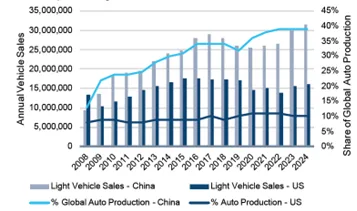
Sources: China Association of Automobile Manufacturers, CEIC, Macrobond, Automotive News, Kerrigan Advisors’ Research & Analysis
Kerrigan Advisors
Today 64% of vehicles sold in China – a market now double the size of the U.S. – are manufactured and sold by domestic Chinese brands, up from 36% in 2020. By contrast, legacy automakers have seen their market share decline to just 36%. The rapid ascent of China’s domestic brands in China, at the expense of imports, signals a potential reshuffling of the global auto industry, with Chinese manufacturers poised to extend their market dominance beyond their home market.
The financial ramifications to legacy OEMs of lost market share in the world’s largest auto market are becoming increasingly apparent. Seventy percent of OEM executives surveyed by Kerrigan Advisors now have concerns about the financial impact of Chinese OEMs’ rising global market share. This is perhaps not surprising when considering how the automakers that suffered the most significant declines in Chinese market share had historically relied on China for a meaningful percentage of their global sales.
OEMs’ concern about the financial impact of their Chinese counterparts are becoming a reality as their earnings are now being negatively impacted by the lost sales. One of the most striking examples is General Motors, which recorded a $5 billion restructuring charge in the fourth quarter of 2024 due to the deterioration of its Chinese business. To put this into perspective, GM’s China charge represents 70% of the company’s 2024 net income, underscoring the financial gravity of the shifting competitive realities.
As legacy OEMs experience the financial fallout from their shrinking China presence, they have concerns about Chinese OEMs entering the lucrative U.S. market, the only major auto retail market in the world where Chinese OEMs are absent. This makes the U.S. a highly attractive auto retail market for legacy OEMs. However, 76% of U.S. auto executives surveyed by Kerrigan Advisors expect Chinese automakers to eventually enter the U.S. market, indicating the barrier to entry may be short-lived.
While the U.S. has successfully shielded its auto retail market from Chinese imports for now, the global rise of Chinese OEMs – and the potential for their future entry into the U.S. – will inevitably impact legacy automakers’ U.S. strategy, operations and associated blue-sky values. Blue sky represents the intangible value of a franchise, driven by an OEM’s ability to sustain a profitable dealer network with compelling, innovative products. When an automaker loses global market share and suffers the financial implications of that loss, its blue-sky value often declines.
Whether Chinese vehicles enter the U.S. market directly or not, their growing dominance in the global auto industry will have financial consequences for U.S. auto retailers. As the competitive conditions continue to shift, U.S. dealers should closely monitor the financial health and strategic global positioning of their franchise OEMs, ensuring they align with brands capable of sustained investment and long-term viability in an evolving global marketplace. Fully insulating the U.S. auto market and blue-sky values from the impact of the Chinese auto industry likely has an expiration date.
Erin Kerrigan is founder and managing director of Kerrigan Advisors, a sell-side adviser to U.S. dealerships that has represented on the sale of more than 400 franchises.
EDITOR’S NOTE: This article was authored and edited according to F&I and Showroom editorial standards and style. Opinions expressed may not reflect that of the publication.
More Industry
Auto Nameplate Loyalty Holds in Tough Times
Consumers have been faithful to brands despite financial pressures, and JD Power says that’s because automakers have made some wise moves.
Read More →
Top New Jersey RV Store Sells
Myer’s RV Superstore is expanding its footprint in the state with two new locations that it acquired from Ed Hutchinson Jr.
Read More →
Alliance Analyzes Technician Pipeline
A new industry report examines the state of skilled trades in the U.S. and details the drivers of demand for automotive repair and how technicians enter and grow in the workforce.
Read More →
Luxury Rooftop Changes Hands
Genesis of Glenview is getting a new owner and a new location, but its name will stay the same.
Read More →
Future-Proof Your Business
A new industry outlook details several ways that automotive companies can use the rise in artificial intelligence and advanced technologies to their advantage.
Read More →
Dealership Buy-Sells Keep Going Up
First-half transactions reflect continued high appetite for acquisitions despite falling profits, the most sought-after franchises bringing record prices.
Read More →
California Makes Electric Moves
New laws in the Golden State aim to advance consumer access to public electric-vehicle chargers and reduce costs and barriers to its infrastructure.
Read More →
Rare Earths Independence
Automakers seek alternatives to sourcing battery raw materials in volatile markets roiled by trade wars and disrupted supply chains.
Read More →
Volvo Appoints President and CEO
Klaus Zellmer will replace Håkan Samuelsson as president and CEO of Volvo Cars in 2027 as the company makes strategic shifts toward profitability and cash generation.
Read More →
Fix Up Your Fixed Ops
The department may hold untapped potential for your dealership. There are ways to unearth it and turn it around for more profits.
Read More →