



Customers Relate to Tire & Wheel Mishaps
Tire & wheel road hazard protection is gaining popularity because it's an easy solution to an all-too-common problem.

The selection of products offered in F&I offices has grown from credit insurance and vehicle service contracts to now include GAP, environmental protection, theft deterrent products, prepaid maintenance plans and paintless dent repair. One of the newest products F&I departments are offering is tire & wheel road hazard protection.
It is an F&I manager’s belief in and enthusiasm for the product, along with the conviction that the customer needs the product, that will enable him or her to convince a customer to buy it. At Herb Gordon Nissan of Silver Spring, Md., F&I managers Chu Park, Jay Lee and Brian Carter firmly believe in tire & wheel road hazard protection.
"A lot of customers have had a flat tire or damaged a wheel," Carter says. "So it’s easy for them to see the need for this protection, because it’s happened to them."
Tire & wheel typically pays to repair or replace factory tires and wheels damaged by road hazards such as metal, nails, glass, debris, potholes and blowouts. Most plans are available on both new and used vehicles and require that tires have at least 3/32-inch of tread remaining at the time of damage. Plans normally cover repair or replacement of the tire and wheel if it is irreparable. They also cover costs associated with the repair, such as mounting, balancing, valve stems and taxes. Many plans also pay for on-the-spot repair of a flat tire or roadside assistance to install the spare tire wherever the flat occurs. Some plans also include a towing benefit if the tire is not repairable and the spare is unusable or unavailable. In most cases, there is no deductible to the customer and the protection is transferable to subsequent owners.
Young and Popular
When considering whether to expand your F&I product offerings, remember that every product has a life cycle, and the life cycle of every product looks like the graph on page 44. It doesn’t matter what the product is, its lifecycle graph doesn’t change. The only difference is the amount of time represented by the graph.
When a product is fresh, new and exciting, everybody wants it and sales and profits take off. Over time, after the initial demand for a product becomes satiated, competition increases, market conditions change, and sales and profits decline. That’s why vehicle manufacturers come out with new models every few years and redesign existing models on a regular basis.
Let’s look at the products we offer in the F&I office. Credit insurance has been around since 1917 when Arthur Morris formed the Morris Plan Insurance Society. Vehicle service contracts have been around for more than 35 years. GAP insurance has been around for over 10 years. Tire & wheel road hazard protection, however, is a relatively new product. Whenever a new product with widespread appeal such as tire & wheel comes along, ride the wave!
Dealers and F&I managers need to identify the F&I products that provide customers the most value and offer the greatest income opportunities. If you have less than 10 percent penetration with a particular product, it means that more than 90 percent of your customers don’t think the product would benefit them. The question is, why? It may be that the F&I manager doesn’t believe in the product. It may be that the manager needs additional training on how to sell it. Or it may be that in your market, with your vehicles and customer demographics, your customers perceive the product to be of little benefit.
Some products will have more appeal than others in various markets with specific vehicles. Tire & wheel doesn’t have nearly as much perceived value on a Chevrolet Aveo with 14-inch steel wheels as it would on a Chrysler Crossfire with expensive 18- and 19-inch alloy wheels and low profile, speed-rated tires. Consider how tire & wheel might fill your unique customers’ needs.
[PAGEBREAK]
Popped a Tire?
The first requirement to selling tire & wheel is good needs-discovery. Unfortunately, most customers aren’t aware that they even need this product. They don’t know that the manufacturer’s limited warranty doesn’t cover tires. The tire manufacturer covers tires against manufacturing defects but neither the tire maker nor vehicle manufacturer covers tires and wheels for damage or failure due to road hazards.
To establish the customer’s need for tire & wheel, first note the brand, model and size of the tires and the type of wheels on the vehicle being purchased. If your dealership sells a lot of vehicles with factory alloy wheels and low-profile tires, many customers will see that they need this product.
Find a need that tire & wheel road hazard protection will fill, or a problem it will solve, to form a basis for your discussion with the customer. Use open-ended questions and listen to the customer.
Who will be the primary driver?
How many miles is your commute
to work?
What percentage of that is freeway
driving?
What is the strangest thing you’ve seen
lying on the highway?
What type of wheels does your
vehicle have?
When was the last time you had a
flat tire?
A finance manager must know the features, benefits, coverage and exclusions of tire & wheel road hazard protection and be able to answer the customer’s questions and respond to their concerns. Product knowledge also means that you know the brand (Michelin), model (MX4) and size (P205/60R - 16) of the tires, and the type of wheels on the vehicle the customer is buying. Have the salesperson note this information on the buyer’s order or make a list of the brand and size of tires on each vehicle model so that you can use this information as the basis for your presentation.
Today’s oversize wheels and low-profile tires are more susceptible to damage from road hazards because there is less sidewall to absorb the impact of an object or pothole. Also, alloy wheels, particularly factory alloy wheels, are more expensive to replace.
Kim White, financial services manager at Saturn of Glen Burnie in Glen Burnie, Md., has a list of the alloy wheels available on the Saturn models and a picture of each wheel with its price. "Customers are shocked when they see how much it costs to replace one wheel on their new Vue," White says.
Let the customer visualize a situation in which he or she could imagine needing tire & wheel. For example: "You’re coming home late Sunday night from visiting your family at Thanksgiving. It’s raining. The kids are asleep in the back seat. You don’t see the pothole. You just feel the steering wheel jerk violently in your hands and hear the tire blow. You pull off onto the shoulder. The tire is shredded. The wheel ruined. Semis are whizzing past. The great thing is, with tire & wheel road hazard protection, you don’t have to get out in the rain and change the tire. You can stay inside where it’s safe. Let someone else change the tire. They even pay for a new tire and wheel if they’re ruined."
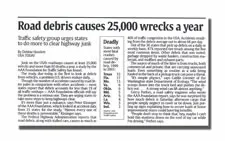
Use visual aids to help the customer see the need for and benefits of this product. Repair orders showing cost of factory alloy wheels, articles on road debris and paid tire & wheel road hazard claims all help the customer see the need for this product.
Gary Schnitzer, F&I director at Earnhardt Lincoln/Mercury in Tempe, Ariz., was skeptical about the value of wheel & tire — until he needed it. Now, in his office, he has the wheel from his vehicle that was ruined when he ran over something on the highway.
"Gary (Schnitzer) shares his own experience with customers and shows them the ruined wheel to help them see the need for this product," says Dave O’Brien, corporate F&I director for Earnhardt Management Group. "And it works!"
Customers are much more likely to buy products when they can see how it will benefit them specifically. When presenting tire & wheel road hazard protection, always focus on the customer’s needs and the exposure without this protection.
"Tires are something you take for granted every time you put your key in the ignition," says White of Saturn of Glen Burnie. "And almost everyone has had a flat tire. Tire & wheel road hazard protection is one of the most tangible products we offer."
Ron Reahard is president of Reahard & Associates Inc., an F&I training company providing in-dealership F&I training programs, consulting services and solutions. Ron is also an AFIP-certified course instructor. Contact him at (866) REAHARD or ron@go-reahard.com.
More F&I

AI: Facilitator, Not Fixer, in F&I
The dealerships that thrive in the years ahead will be those that embrace technology while continuing to invest in the people who make customer interactions count.
Read More →
Modern Technology Objection Handling
In this video, Trent White shares how to confidently handle technology-based objections by helping customers understand the value of protection, even with modern vehicle technology.
Read More →
Consistency at Scale: Driving F&I Performance
With 75 rooftops across the Sunshine State, Morgan Auto Group has proven to Floridians that it knows a thing or two about driving performance in a competitive market. But it didn’t start at the top.
Read More →
Gitty Up on GAP
The foundational finance-and-insurance product hasn’t kept up with the latest conditions for auto dealers. Is the time ripe?
Read More →
How AI-Powered Coaching Is Transforming F&I Performance
See how AI-powered coaching can turn F&I customer conversations into actionable insights that support compliance, performance and profitability
Read More →
Sell Value, Build Trust
In this video, Trent White explains why selling on value, not fear, builds lasting customer trust, reduces cancellations, and drives long-term success.
Read More →
F&I Sales Give Dealers First-Half Lift
Product business shored up total profits to avoid an overall revenue tanking as product penetrations held steady, StoneEagle reported.
Read More →
Targeted Training Drives Results
Today’s technology, instead of threatening F&I managers, can actually make them better, according to an industry veteran who’s watched market setbacks roil the unprepared.
Read More →
Double the Change, Double the Chance
When an F&I manager gets a customer refusal, it’s a wise move to tweak more than one thing in the product offering.
Read More →
Just Do It
F&I managers need training, but instead of resisting application or expecting perfection, they should improve by simply acting on what they learn.
Read More →