



Driving Profits in the Service Lane
What’s good for the showroom often is good for the service department. Fixed operations expert outlines a strategy to keep customers in the fold by showing them you care about the safety and reliability of their vehicles.

These days, a passionate pursuit of every repair order opportunity is required to retain our customers and properly service their needs. Are you closing on additional work requests, or are you just lying down when the customer voices any objection?
Your goal should be to work toward a close at every opportunity. That’s the only sure way to capitalize on every revenue stream and reinforce the client retention process. It’s easier said than done, of course, so let’s take a closer look at three obstacles you’re sure to encounter along the way.
What If They Just Say ‘No’?
There’s an old saying in sales: “Call them ’til they buy or die.” I wouldn’t suggest that service advisors adopt a similar attitude, but they should certainly never be discouraged by a “No” from the customer. After all, that first objection is really where the sale begins.
Identifying objections is the key to overcoming a “No”. Something as simple as one follow-up question can separate a good advisor from a great one. Be prepared to offer a counterproposal or prioritized services the technician has recommended. Any customer would agree that safety and reliability should be among their primary concerns. That’s where preventive maintenance comes in, and it’s a natural selling tool.
With proper training and repair order preparation, there is no reason service advisors can’t close an estimate to a sale with a second or even third request for consideration. The key is to be sure that each subsequent presentation includes an enhancement of the deal. Every time you let customers leave without a needed repair, you’re giving them an opportunity to visit one of your competitors. Remember, they will have the work done somewhere, so make it easy for them to do business with you!
One of the most important aspects of selling additional service is to create the perception of need in your customers’ minds. They should feel that it is worth their time and money to have the work performed. They have already chosen your dealership as a vendor; it’s up to you to retain them. However, you must also exercise caution. You can sink the whole deal if you barrage them with too many add-ons.
The best chance to communicate the need for service lies in the preparation. Ask your advisors the following questions:
■ Are we taking the opportunity to show them the problem if they are waiting?
■ Are we utilizing available and approved technology/tools to convey information visually and electronically to the customer, such as e-mailing a digital image to their office?
■ Are we anticipating logistical considerations such as a loaner vehicle?
■ Are we truly tuned in to the “buying premise” as articulated during the initial appointment booking/write-up or in the subsequent conversation?
[PAGEBREAK]
What If They Say It’s Too Expensive?
Preparation goes out the window when the cost is far greater than the customer anticipated. As with any other objection, successfully overcoming sticker shock is simply a matter of applying what you have already learned.
Our research indicates that the closing ratio for additional sales falls off a cliff when the number of items exceeds three. Prioritize your offerings and create a simple menu of items that can be addressed now and later, based on the client’s schedule and budget permits. When presenting the prioritized list, put the repairs first. Then ask the customer if they would like you to quote a price for reliability items or continue on to maintenance items.
If that doesn’t work, it’s time for management to get involved. Service advisors should feel free to seek permission from management to offer a discount. We polled more than 200 dealerships and found that a 15 percent discount was the tipping point. That’s a healthy amount, but it could mean the difference between keeping or losing a valuable customer. Remember, safety and reliability are important, so let customers know you are serious about not wanting to see them drive off the lot before necessary repairs can be made.
What If They Can’t Be Convinced?
Sometimes a new face can be helpful. Most salespeople have a defined process for passing resistant customers to a manager, and the same concept can be applied to the service department. You don’t want to remove your service advisors from the sales process and damage their credibility for future transactions, but an increase in horsepower may be appropriate. This is especially relevant when it involves a big-ticket item and the customer’s requests fall out of the service advisor’s realm of authority. Just remember, the actual oversight of the work and agreed-upon logistical/invoicing accommodations still should be handled by the service advisor.
As mentioned above, reinforcing client retention is paramount. Give your customers every opportunity to take advantage of your store’s expertise and repair knowledge throughout the ownership lifecycle of their vehicle. The process is simple: Include them in the discussion, show them the situation up close, and let them know they are a valued customer and that you are genuinely concerned about the condition of their vehicle. Sincerity and credibility are your two greatest strengths when working to retain your customer base.
In the end, by combining a sincere interest in meeting the client’s needs with a failsafe process, you will see immediate and measurable improvements in revenue and profitability — likely within the first day of implementation.
There is no guarantee, mind you, but you can expect your fixed-ops absorption to increase if you can increase the close rate on client complaints and issues mentioned on the initial repair order by consistently employing the simple procedures discussed. With that comes the ability to continue doing business in a cycle of more and more service business based on higher and higher customer satisfaction experiences. It is a new way to generate business few of your competitors are doing consistently.
[PAGEBREAK]
Why Do a Walk-Around Write-Up?
By Bob Kellerman
Building relationships with our customers is important, but time is always of the essence.
Clients are not there to be told what else is wrong with the vehicle. They are there to address an immediate concern and get on with their day. Our job is to create a bond of trust based on credibility, which is the result of productive customer interaction.
The value of the walk-around write-up lies in its ability to uncover issues and share them simply and quickly. This is a critical moment of truth, and service advisers need to do everything they can to engage the client. Remember, retention equals profitability.
The walk-around write-up drives the process of establishing relationships with customers during service visits. It shows we care about them and the condition of their vehicle. We must show the importance of mechanical issues customers may take for granted, but could mean the difference between a collision and a near miss.
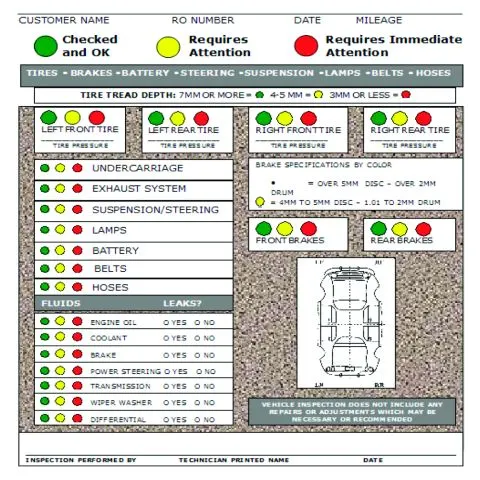
Pictured is a sample form you can use at your operation. It covers the main systems and components. When you use it, make sure to urge your customers to accompany you as you inspect their vehicles. If you see evidence of a deeper problem, be sure to ask permission for a more in-depth inspection. This minimizes misunderstandings and maximizes opportunities for finding safety-related and preventative maintenance issues, as well as the inevitable (and profitable) customer pay repair orders.
Once you have completed the write-up process, establish a time to follow up with customers and schedule any needed repairs. Don’t forget to thank customers for their time and consideration, and open the door for them whenever possible. More importantly, do the follow-up you’ve scheduled!
Once a connection is accomplished by this simple, easy-to-implement level of service, retention becomes a natural part of the relationship lifecycle.
Eric Wilson and Bob Kellerman are fixed operations experts and consultants with Applied Transportation Concepts Inc. E-mail them at eric.wilson@bobit.com and bob.kellerman@bobit.com.
More F&I

AI: Facilitator, Not Fixer, in F&I
The dealerships that thrive in the years ahead will be those that embrace technology while continuing to invest in the people who make customer interactions count.
Read More →
Modern Technology Objection Handling
In this video, Trent White shares how to confidently handle technology-based objections by helping customers understand the value of protection, even with modern vehicle technology.
Read More →
Consistency at Scale: Driving F&I Performance
With 75 rooftops across the Sunshine State, Morgan Auto Group has proven to Floridians that it knows a thing or two about driving performance in a competitive market. But it didn’t start at the top.
Read More →
Gitty Up on GAP
The foundational finance-and-insurance product hasn’t kept up with the latest conditions for auto dealers. Is the time ripe?
Read More →
How AI-Powered Coaching Is Transforming F&I Performance
See how AI-powered coaching can turn F&I customer conversations into actionable insights that support compliance, performance and profitability
Read More →
Sell Value, Build Trust
In this video, Trent White explains why selling on value, not fear, builds lasting customer trust, reduces cancellations, and drives long-term success.
Read More →
F&I Sales Give Dealers First-Half Lift
Product business shored up total profits to avoid an overall revenue tanking as product penetrations held steady, StoneEagle reported.
Read More →
Targeted Training Drives Results
Today’s technology, instead of threatening F&I managers, can actually make them better, according to an industry veteran who’s watched market setbacks roil the unprepared.
Read More →
Double the Change, Double the Chance
When an F&I manager gets a customer refusal, it’s a wise move to tweak more than one thing in the product offering.
Read More →
Just Do It
F&I managers need training, but instead of resisting application or expecting perfection, they should improve by simply acting on what they learn.
Read More →