



NADA Seeks Clarity Through Upheaval
NADA Chairman Wes Lutz laid out the association's priorities and touched on a number of pressing topics at the American Financial Services Association (AFSA)’s 2018 Vehicle Finance Conference.
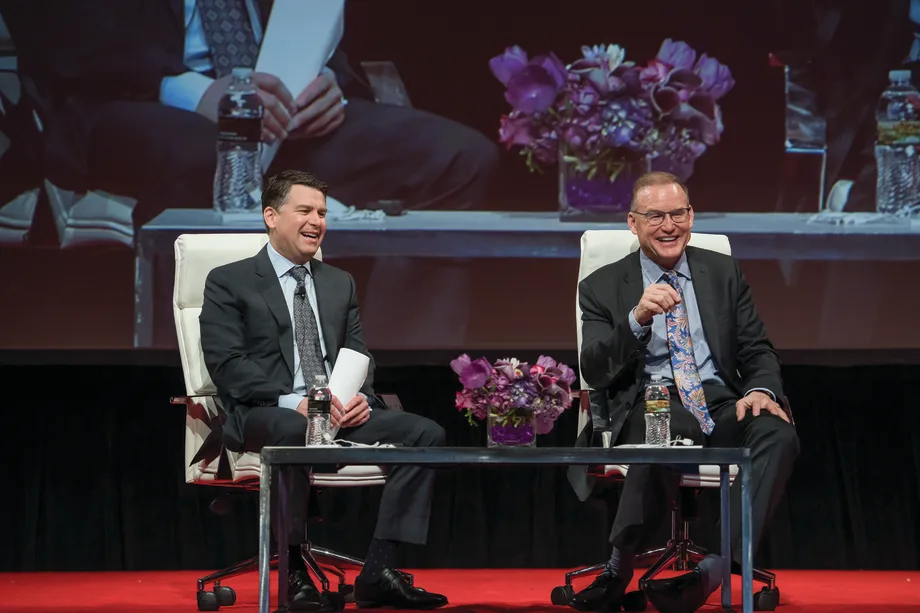
Vince Rice, COO of Hyundai Capital and 2018 chairman of the AFSA’s Vehicle Finance Division, interviews Wes Lutz, 2018 NADA chairman and president of Extreme Chrysler Dodge Jeep Ram Inc. in Jackson, Mich. (Photo courtesy of AFSA)
Three days before he officially assumed his role as the National Automobile Dealers Association (NADA)’s 2018 chairman, Wes Lutz took the stage at the 2018 Vehicle Finance Conference & Expo in Las Vegas to defend personal vehicle ownership and criticize vehicle OEMs for getting too far ahead of consumer demand for autonomous vehicles.
“I think the curve is going to be much slower than the experts expect,” Lutz said at the National American Financial Services Association’s annual event, which directly precedes the NADA’s annual convention. “People voting with their dollars seem to be contrary to what industry experts are telling us right now.”
Lutz is president of Extreme Chrysler Dodge Jeep Ram in Jackson, Mich. A Chrysler dealer since 1976, he said dealers are in the best position to know what consumers want, and his customers don’t want to give up driving their own cars. Meanwhile, the OEMs have committed billions of dollars to electrification, ridesharing, and autonomous driving.
“We talk to customers every day,” Lutz said. “I always talk to them, and something I say is, ‘Do you think this is the last car you’ll ever buy?’ They always look at me like I’m crazy, and I say, ‘Well, you’re not going to be driving a car in five years,’ and the people are just dumbfounded.”
Whatever They Want
Lutz said dealers would be OK with selling whatever customers want, including battery-powered electric cars or self-driving cars, if that’s what customers really wanted. However, he denied what he called “press reports” that say dealers are digging in their heels against electric cars. The theory is that dealers don’t like electric cars because they likely won’t generate as much service business as vehicles with internal-combustion engines.
“We have been told we don’t want to sell electric cars,” Lutz said. “But they still need struts, windshields, and tires … There are 260 million cars and trucks on the road today. If you’re telling me I’ve got a shot to replace 260 million vehicles, I’m in. Just ban combustion vehicles right now and we’ll replace ’em all. We’re OK with that!”
Interpreting the Rules
On a topic of more immediate interest to an audience of auto finance execs, Lutz said it’s a priority for the NADA this year, working with other trade groups like the AFSA, to get the Department of Defense (DOD) to withdraw its December 2017 interpretive rule under the Military Lending Act.
The net effect of the DOD’s rule is that many lenders and dealers have quit offering GAP coverage to military members and their families. That’s because including GAP and credit insurance on the same retail installment sales contract as the vehicle could make the entire deal subject to restrictions in the Military Lending Act.
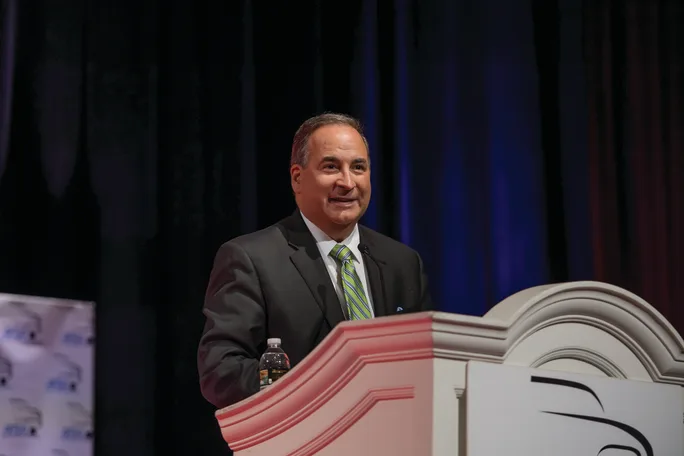
Bill Himpler, executive vice president of the American Financial Services Association, provides an update on federal regulatory and legislative issues impacting the auto finance industry. (Photo courtesy of AFSA)
“MLA was so immediate, and it had such an impact,” Lutz said. “And [GAP] is a product that’s really good for the market and good for the consumer that’s using it.” He said a fast lobbying effort against the DOD’s interpretive rule by the NADA and the AFSA was “a great example of collaboration on the part of both organizations.”
For vehicles that are stolen or totaled in an accident, GAP covers all or a portion of the shortfall if the actual value of the vehicle at the time of the loss is less than what the customer owes on the financing. Without GAP, the shortfall can be considerable for customers who are upside-down on their loans, Lutz added, and negative equity is building as finance terms stretch.
“There’s not a month that goes by where we don’t get a GAP claim, and you hate to generalize, but it’s often young people who tend to have more accidents,” he said. “And they’re always upside-down.”
In a separate presentation, AFSA Executive Vice President Bill Himpler said the association is hoping for a favorable outcome on the Military Lending Act’s interpretive rule, possibly by May.
The Survivors
Lutz said dealers have proved their adaptability every time an aftermarket F&I product falls in and out of favor of state and federal regulators. “I think we’re adaptive enough,” Lutz said, but added he would prefer to let the market decide, not regulators.
“We used to undercoat almost every vehicle — I live in Michigan — but we don’t sell that product anymore,” he said. “If a product’s not of value to the consumer, it’s going to fall by the wayside. Some were strong on undercoating 20-plus years ago. Today, you don’t see rusting on cars.”
In the area of compliance, lack of clear direction is frustrating dealers today, Lutz said. He criticized the Consumer Financial Protection Bureau (CFPB) in that regard, but he didn’t let the Trump administration completely off the hook, either.
The NADA and the AFSA have both criticized the CFPB for issuing consent decrees instead of clear-cut rule changes. The consent decrees are reached behind closed doors and tailored for individual lenders, but other finance sources and retailers then have to interpret them as precedents.
Lack of Clarity
Consent decrees are particularly puzzling for retailers, since franchised dealers were specifically exempted from the CFPB’s jurisdiction when the bureau was created in 2010. In effect, under the Obama administration, the bureau sought to regulate dealers indirectly by regulating their banks and finance companies.
Instead, the industry would prefer a well-defined set of rules, which would also include input from the industry in the rulemaking process. “What do you want us to do?” Lutz said he asked the CFPB. “And they couldn’t give me an answer.”
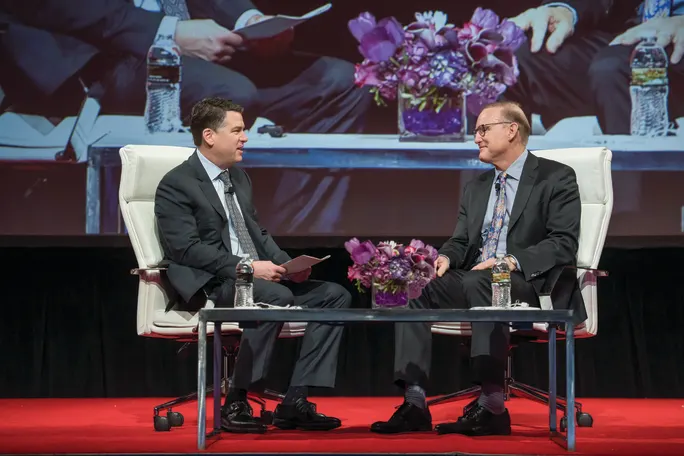
(Photo Courtesy of AFSA)
Under the Trump administration, the CFPB has gotten out of the business of “pushing the envelope,” according to Acting Director Mick Mulvaney. Nevertheless, Lutz said regulations still lack clarity.
“You just have to know the rules,” Lutz said. “And that’s a problem with this administration, too. You don’t know if you go by the official release or the tweet afterward.”
Lutz said he’s confident dealers would land on their feet. “I remember ‘the demise of the franchise system,’ because of the internet in the ’90s. Today, every dealer sells cars online,” he said. “Every business is a service business. It’s a relationship business. I just don’t see that changing.”
Jim Henry is a freelance writer based in the greater New York City area. Contact him at jim.henry@bobit.com.
More Auto Finance

Interest Rates Further Squeeze Auto Consumers
Last month’s hike and a potential second increase this month add to a growing list of inflation woes that could continue to dent overall car sales.
Read More →
Mind Your Process
Consistent steps taken in various aspects of the F&I office can make valuable differences over time, similar to an outline for a best-selling book.
Read More →
Top Five Credit Application Fraud Flags
Compliance audits regularly reveal bad habits that can lead to fraud charges and should have been stamped out decades ago.
Read More →
More Auto Loans for the Taking in August
Riskier categories were on the uptick for the month as lenders loosened access in several areas while balancing out the exposure in another, Cox Automotive reported.
Read More →
July Was Hot for Auto Borrowers
Credit proved readily available for many, but most loans left buyers in negative territory, Cox Automotive said.
Read More →
Dealer Lender Preferences Revealed
When lenders provide consistent, fast service, their overall satisfaction scores with dealers greatly improve, according to JD Power research.
Read More →
Auto Refi Savings Surge
Consumers with 84-month auto loan terms who refinanced saved the most on monthly payments, according to a new report by auto refinancing provider Caribou.
Read More →
Subaru Enters Lending Business
The automaker follows other brands in adding captive financing in the U.S., and says the move will strengthen its position here.
Read More →
Positive Equity Reaches Record High
Mainstream vehicle owners who bought a car seven years ago are likely to have positive equity when trading in for a new vehicle, according to second-quarter Edmunds data.
Read More →
Dealerships Are Paying the Price for Extended Car Loans
Growing negative-equity scenarios mean such lengthy terms should be addressed in a forward-looking way to make them work for the dealer and the consumer down the road.
Read More →