



Product Placement
Should the base payment be displayed on the menu? Officials with IAS offer their take on that hot-button question and more.

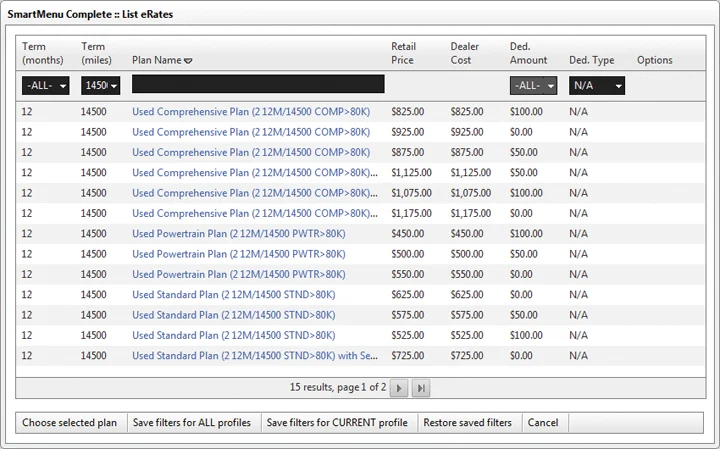
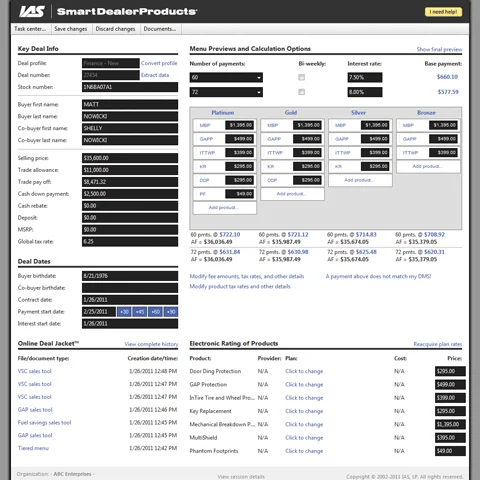
IAS offers its software free of charge to dealers who sell its products. Here's a look at SmartMenu Complete's e-rating (top) and deal entry screens (bottom).
Meet the two guys leading the charge for Innovative Aftermarket Systems (IAS)’s software and F&I product units: Bob Corbin, president, and Matt Nowicki, director of information technology. We caught up with the execs to talk about software integration, using the menu as a compliance tool, and the new No. 3 F&I product.
F&I: How has IAS faired in the e-contracting, e-rating and e-remittance arms race?
Nowicki: It’s really ramped up over the last six to eight months. Not only are we connecting to more providers, but the way in which we’re doing it is also changing.
F&I: Being that you’re also an F&I product provider, how do you work both sides?
Corbin: As you know, we provide our software free of charge to dealers who sell our products. Now, if one of our customers chooses to use a non-IAS menu and that menu offers e-rating and e-contracting capabilities, then we want to make sure our products are accessible through that menu.
F&I: Has the industry considered a standardized link between product providers and menu makers?
Corbin: For a standard to be realized, dealers need to embrace e-rating and e-contracting a lot more than they do today. If 50 percent of the dealers were e-contracting today, then we’d already have a standardized hub.
F&I: I would think not having a binder full of ratings would be reason enough.
Corbin: That’s how I see it. The reality is, most F&I managers don’t need to pull out the binder for every customer because they sell a service contract above dealer cost, which means they’ve already built in enough margin. So, it’s about building interest in the tools, not the tools themselves. That’s really the battle.
F&I: How has your view of the menu changed?
Corbin: Originally, it represented a way to print something out that had color and life to it, and that was specific to that consumer’s deal. We also spent a lot of time doing tax calculations and a lot of credit life, accident and health calculations. Today, it’s about integration. Currently, we’re certified with the top three providers of dealership management systems — Reynolds, ADP and DealerTrack.
F&I: Integration is a big investment. Have you realized the benefits?
Corbin: Definitely. Most of all, we have the ability to use them as advertising partners, which is a strong marketing tool. But I’ll tell you, the No. 1 reason for me is I never want to be one of those companies that gets a call from the dealer saying, “I’ve got deals to deliver right now and your software isn’t working.”
[PAGEBREAK]
F&I: When did the menu become a compliance tool?
Corbin: First of all, today’s menus offer OFAC and identity verifications, so that’s one aspect of compliance. I also think the menu legitimizes the sale of F&I products in the minds of consumers. So, from the get-go, the menu promised to make the operation more compliant because it brought consistency to the process. As it has evolved, whether it was displaying base payment or requiring initials or signatures next to the base payment, the idea that the menu was a compliance tool began to grow.
F&I: Should the menu display the base payment?
Nowicki: By default, our menu does. We used to lock that feature so dealers were kind of forced to show the base payment. That’s not the case anymore. We do suggest that they show it, but we also suggest that they talk to their legal counsel. And as far as I know, there are no rules that spell out anything that have to do with the menu.
F&I: You offer a video recording feature. Isn’t there a danger that those recordings can be used against the dealer?
Corbin: If you’re doing F&I the right way, the benefits outweigh the disadvantages. I would even say that our SmartEye feature has actually supported, rather than indicted, the dealer. It eliminates those “he-said, she-said” situations. Now, I’ve only heard of five instances in nine years where the video was used in a lawsuit against a dealer. Every single time the video actually supported the dealer’s position.
F&I: What disclosure rules does a dealer need to consider before employing a recording system?
Nowicki: It varies by state. What we recommend our customers do is check www.rcfp.org/taping/states.html. You can see what the rule is for all 50 states and the District of Columbia. The vast majority are “one-party” states, which means that as long as one party realizes they’re being recorded, that’s all you need.
F&I: Do you see other product categories growing in popularity?
Corbin: Obviously, it’s about controlling the financing, then selling the service contract No. 1, then GAP No. 2. I would say that tire-and-wheel protection is No. 3. It has really become a staple product in F&I. After that, it really comes down to what the dealer wants to push. Is it windshield protection or dent-and-ding?
Combo packages have really become big for us. We offer what we call Multi-Shield protection, which offers tire-and-wheel, windshield and dent-and-ding protection. It also offers 24/7 emergency roadside assistance. Another emerging product is key replacement.
[PAGEBREAK]
F&I: Considering how expensive keys are these days, I can see why.
Corbin: We have seen dealers offer the product as a one-year complimentary offering, then try to upsell it to a three- or five-year term in F&I.
F&I: So, has the industry found its stride?
Corbin: I think we have. Our company has put together an aggressive projection budget for 2011. We think it’s going to be a 11.5 or 11.7 million-unit sales year, maybe even 12 million. Last year was a good comeback year for us, so we expect that momentum to continue.
More F&I

AI: Facilitator, Not Fixer, in F&I
The dealerships that thrive in the years ahead will be those that embrace technology while continuing to invest in the people who make customer interactions count.
Read More →
Modern Technology Objection Handling
In this video, Trent White shares how to confidently handle technology-based objections by helping customers understand the value of protection, even with modern vehicle technology.
Read More →
Consistency at Scale: Driving F&I Performance
With 75 rooftops across the Sunshine State, Morgan Auto Group has proven to Floridians that it knows a thing or two about driving performance in a competitive market. But it didn’t start at the top.
Read More →
Gitty Up on GAP
The foundational finance-and-insurance product hasn’t kept up with the latest conditions for auto dealers. Is the time ripe?
Read More →
How AI-Powered Coaching Is Transforming F&I Performance
See how AI-powered coaching can turn F&I customer conversations into actionable insights that support compliance, performance and profitability
Read More →
Sell Value, Build Trust
In this video, Trent White explains why selling on value, not fear, builds lasting customer trust, reduces cancellations, and drives long-term success.
Read More →
F&I Sales Give Dealers First-Half Lift
Product business shored up total profits to avoid an overall revenue tanking as product penetrations held steady, StoneEagle reported.
Read More →
Targeted Training Drives Results
Today’s technology, instead of threatening F&I managers, can actually make them better, according to an industry veteran who’s watched market setbacks roil the unprepared.
Read More →
Double the Change, Double the Chance
When an F&I manager gets a customer refusal, it’s a wise move to tweak more than one thing in the product offering.
Read More →
Just Do It
F&I managers need training, but instead of resisting application or expecting perfection, they should improve by simply acting on what they learn.
Read More →