



Tapping into the Automotive Accessory Market
While dealers continue to seek out new profit streams, one area of potential new business remains relatively untapped — the automotive accessory market.
It has a growth rate of eight to 10 percent, the $38 billion automotive accessory business would seem like the perfect way to pick up profits. Yet only 10 to 15 percent of the $38 billion accessory market is sold through automotive dealerships. The bulk of the business is sold through retailers and jobbers. As an F&I professional, you can play a key role in helping your dealership level the playing field.
Although financing reserves have shrunk with the credit crunch, a dealership’s ability to add an accessory sale to a customer’s vehicle financing provides a significant advantage over accessory retailers and jobbers. Instead of a lump sum, your customers see a manageable monthly payment — a big selling point in today’s tight economy.
In this credit market, the challenge is figuring out how to make accessory financing happen. In an environment where many of your customers may not be able to get financing at all, it may seem impossible to include accessories into a vehicle’s financing. However, with the right strategy and situation, this is a sale you can still pull off. And when you can’t, there are other approaches to consider, including alternative financing options.
Sell Accessories Before F&I
The optimal sales process is to introduce accessories after a customer has committed to a vehicle, and before he or she visits the F&I department. Presenting accessories before the customer goes into F&I can lend greater continuity to the overall sales process, as it increases customer engagement and satisfaction.
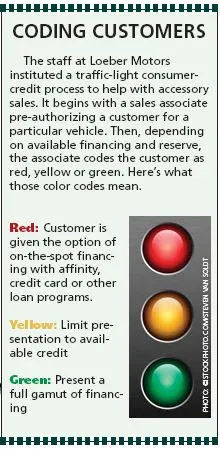
Using a “traffic-light” customer-credit process can limit the risks of this approach. For example, Loeber Motors in Lincolnwood, Ill., begins the process with a sales associate preauthorizing the customer’s credit for a particular vehicle. Then, depending on the available financing and reserve, the associate codes the customer as red, yellow or green.
[PAGEBREAK]
The customer then visits with the accessory sales manager, who, depending on the customer’s color code, tailors the presentation to meet available credit limits. While the goal is to roll the cost of accessories into the financing, a “red” customer is given the option of on-the-spot financing with affinity, credit card or other loan programs.
While some dealerships prefer to let the sales team handle accessories, others invest in an accessory expert who handles the presentation, sale and coordination of accessories.
“Instituting an accessories sales system and process has been very beneficial for our dealership,” said Jim Marquardt, parts manager at Loeber Motors. “Our sales have increased drastically. We’re meeting the needs of our customers, and our whole dealership has benefited.”
For an F&I department that is still wary of accessory sales cannibalizing F&I profits, Marquardt points to the fact that increased accessory sales have not resulted in lower F&I profits or the dealership.
Loeber Motors uses DealerTrack’s Accessories Solution to drive the dealership’s accessories program. “The solution has become a highly valued asset at our dealership,” Marquardt added.
Know What to Pitch to Each Customer
Generally speaking, your best bet may be to pitch lower cost accessories, such as floor mats, to a customer with less-than-stellar credit. The reserve probably won’t allow the financing of more expensive accessories, such as step bars and high-end electronics. Moreover, if it turns out the customer won’t be able to finance the accessories, he or she is more likely to use cash, a credit card or another program offered by your dealership.
For that rare customer with superb credit, you may still have the ability to finance more expensive accessories, depending on your lender relationships and additional financing programs. This is the situation where you may want to pitch more expensive options such as an in-car entertainment package. If financing is not possible in this situation, this type of customer may have the financial resources to purchase the accessories outright.
Amit Maheshwari is a director and general manager at DealerTrack. He can be reached at amit.maheshwari@bobit.com.
More F&I

AI: Facilitator, Not Fixer, in F&I
The dealerships that thrive in the years ahead will be those that embrace technology while continuing to invest in the people who make customer interactions count.
Read More →
Modern Technology Objection Handling
In this video, Trent White shares how to confidently handle technology-based objections by helping customers understand the value of protection, even with modern vehicle technology.
Read More →
Consistency at Scale: Driving F&I Performance
With 75 rooftops across the Sunshine State, Morgan Auto Group has proven to Floridians that it knows a thing or two about driving performance in a competitive market. But it didn’t start at the top.
Read More →
Gitty Up on GAP
The foundational finance-and-insurance product hasn’t kept up with the latest conditions for auto dealers. Is the time ripe?
Read More →
How AI-Powered Coaching Is Transforming F&I Performance
See how AI-powered coaching can turn F&I customer conversations into actionable insights that support compliance, performance and profitability
Read More →
Sell Value, Build Trust
In this video, Trent White explains why selling on value, not fear, builds lasting customer trust, reduces cancellations, and drives long-term success.
Read More →
F&I Sales Give Dealers First-Half Lift
Product business shored up total profits to avoid an overall revenue tanking as product penetrations held steady, StoneEagle reported.
Read More →
Targeted Training Drives Results
Today’s technology, instead of threatening F&I managers, can actually make them better, according to an industry veteran who’s watched market setbacks roil the unprepared.
Read More →
Double the Change, Double the Chance
When an F&I manager gets a customer refusal, it’s a wise move to tweak more than one thing in the product offering.
Read More →
Just Do It
F&I managers need training, but instead of resisting application or expecting perfection, they should improve by simply acting on what they learn.
Read More →