



Vehicle Dependability Declines
In the same month Consumer Reports advised consumers to skip vehicle service contracts, J.D. Power reported that vehicle dependability declined for the first time in 15 years.

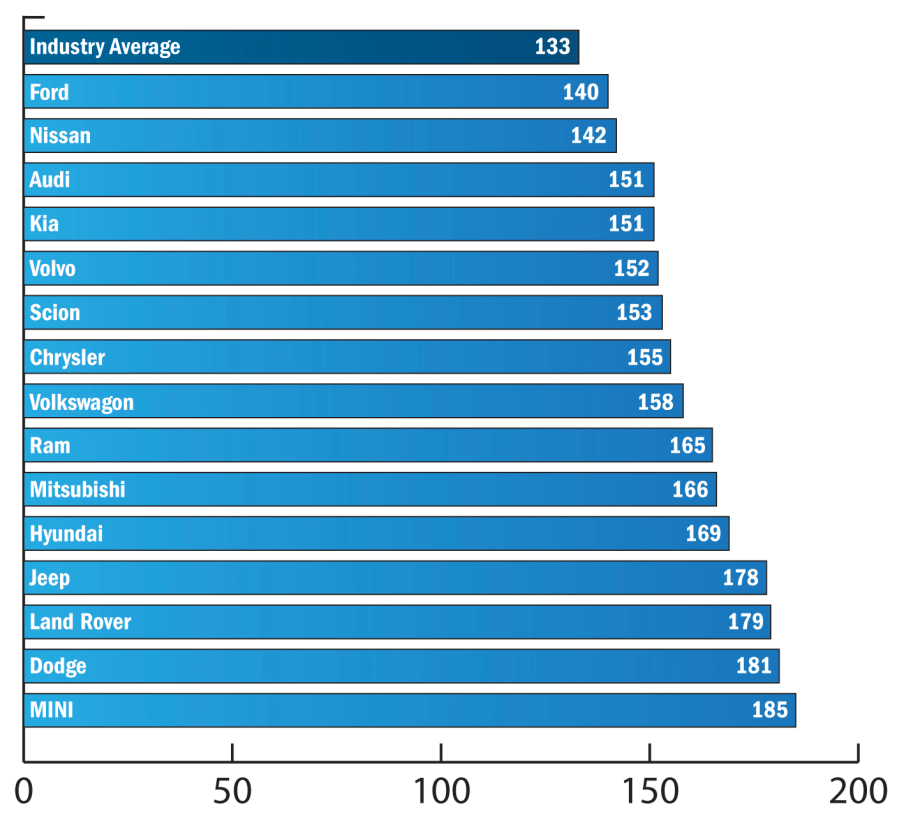
Top 10 nameplates with most problems per 100 vehicles
For the first time in 15 years, owners of three-year old vehicles reported more problems than did owners of three-year-old vehicles in the previous year. This unexpected drop in dependability was largely attributed to an increase in engine and transmission problems, findings that could make vehicle service contracts a critical consideration for car buyers.
The 2014 U.S. Vehicle Dependability Study, which J.D. Power and Associates has conducted annually for the past 25 years, examined problems experienced by more than 41,000 original owners of 2011 model-year vehicles. The study was fielded between October and December 2013.
“Until this year, we have seen a continual improvement in vehicle dependability,” said David Sargent, vice president of global automotive at J.D. Power. “However, some of the changes that automakers implemented for the 2011 model year have led to a noticeable increase in problems reported.”
The report was issued the same month Consumer Reports published a piece urging car buyers to skip service contracts, finding that 55% of owners who purchased the coverage hadn’t used it. Those who had, it reported, spent hundreds more for the coverage than they saved in repair costs. The survey, however, covered vehicles built during model years 2006 to 2010.
According to J.D. Power, automakers have been largely focusing on improving fuel economy to keep up with today’s budget-conscious car shopper. But the struggle to provide economical options for consumers might be having an unexpected negative impact on vehicle dependability, Sargent suggested.
“… while striving to reduce fuel consumption, automakers must be careful not to compromise quality,” he said. “Increases in such problems as engine hesitation, rough transmission shifts and lack of power indicate that this is a continuing challenge.”
Overall dependability in the study was determined by the number of problems experienced per 100 vehicles (PP100), with a lower score reflecting higher quality. Compared to last year, owners of three-year-old cars experienced a 6% increase in problems — from 126 PP100 to 133 PP100.
Engine and transmission problems increased by nearly 6 PP100 year over year, accounting for the majority of the overall 7 PP100 increase in reported problems. The decline was particularly prevalent in vehicles with four-cylinder engines, where problem levels increased by nearly 10 PP100. Owners of vehicles with five- and six-cylinder engines, on the other hand, reported fewer problems, on average.
J.D. Power also found that car buyers who experienced fewer problems were more brand loyal. By combining data from last year’s dependability study with trade-in data, the firm determined that 56% of owners who reported no problems stayed with the same brand when they purchased their next new vehicle. For those who reported three or more problems, brand loyalty dropped to 42%.
“By combining our customer research with trade-in data, we see a very strong correlation between dependability and real-world brand loyalty,” Sargent noted. “Also, we see that brands with lower dependability are likely to be shut out of a significant piece of the market, as many consumers will not even consider purchasing one of their vehicles because of concerns about its likely reliability.”
More F&I

AI: Facilitator, Not Fixer, in F&I
The dealerships that thrive in the years ahead will be those that embrace technology while continuing to invest in the people who make customer interactions count.
Read More →
Modern Technology Objection Handling
In this video, Trent White shares how to confidently handle technology-based objections by helping customers understand the value of protection, even with modern vehicle technology.
Read More →
Consistency at Scale: Driving F&I Performance
With 75 rooftops across the Sunshine State, Morgan Auto Group has proven to Floridians that it knows a thing or two about driving performance in a competitive market. But it didn’t start at the top.
Read More →
Gitty Up on GAP
The foundational finance-and-insurance product hasn’t kept up with the latest conditions for auto dealers. Is the time ripe?
Read More →
How AI-Powered Coaching Is Transforming F&I Performance
See how AI-powered coaching can turn F&I customer conversations into actionable insights that support compliance, performance and profitability
Read More →
Sell Value, Build Trust
In this video, Trent White explains why selling on value, not fear, builds lasting customer trust, reduces cancellations, and drives long-term success.
Read More →
F&I Sales Give Dealers First-Half Lift
Product business shored up total profits to avoid an overall revenue tanking as product penetrations held steady, StoneEagle reported.
Read More →
Targeted Training Drives Results
Today’s technology, instead of threatening F&I managers, can actually make them better, according to an industry veteran who’s watched market setbacks roil the unprepared.
Read More →
Double the Change, Double the Chance
When an F&I manager gets a customer refusal, it’s a wise move to tweak more than one thing in the product offering.
Read More →
Just Do It
F&I managers need training, but instead of resisting application or expecting perfection, they should improve by simply acting on what they learn.
Read More →