



ADAS Analysis from LexisNexis Risk Solutions Sets Record Straight on U.S. Auto Claims Severity
Advanced Driver Assistance Systems equate to loss cost reductions, underscoring the need for VIN-level feature information to improve policy rating.

Advanced Driver Assistance Systems equate to loss cost reductions, underscoring the need for VIN-level feature information to improve policy rating.
ATLANTA – LexisNexis® Risk Solutions announced a new analysis of the relationship between Advanced Driver Assistance Systems (ADAS) features and U.S. auto insurance claims, which counters common insurance industry sentiment that ADAS repair costs offset ADAS loss cost benefits. The results are featured in the new white paper, "True Impact of ADAS Features on Insurance Claim Severity Revealed," which examines the effect of ADAS on claim severity in a multivariate setting. The findings represent the second half of a two-part study that also examined the relationship between ADAS and claims frequency. The combined findings show that the change in claim severity in vehicles with ADAS were minimal; however, the decrease in claim frequency was significant. The LexisNexis Risk Solutions study shows an overall reduction in loss cost by coverage, which can warrant ADAS feature-based policy discounts and benefits for both drivers and insurers.
"Insurance companies can use this new ADAS data as part of their rating segmentation to better meet the expectations of insurers' customers, who often purchase vehicles with advanced safety features with the expectation that it will help lower their insurance rates,1" said John Kanet, director, auto insurance, LexisNexis Risk Solutions. "U.S. insurers have been trying to get ADAS feature information at a VIN level for years, but many believe technology has advanced too quickly and the expense of repairing these features neutralizes the loss cost impact of ADAS. LexisNexis Risk Solutions has good news for insurers – this ADAS data helps show there is a distinct loss cost benefit, and VIN-level feature information is now available through LexisNexis® Vehicle Build. Insurers focused on total risk analysis can begin to understand the safety features on the vehicle in combination with the risk factors associated with the driver."
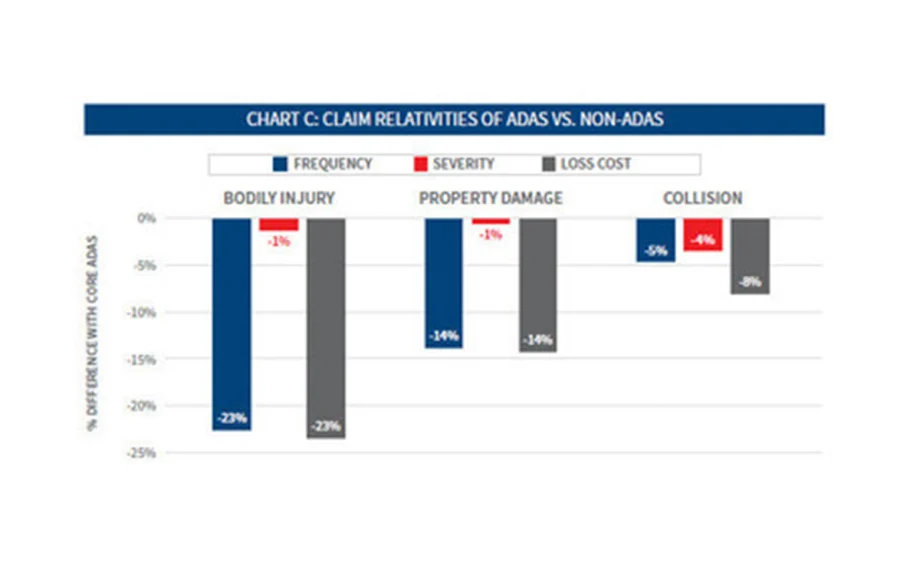
Results from the LexisNexis Risk Solutions multivariate analysis reveal that by having at least one core ADAS feature, there was a reduction in loss cost. Loss cost will vary – more or less – depending on the combination of core ADAS features and how each specific combination of features performs. According to the white paper, having ADAS feature information can result in the following:
23% reduction in Bodily Injury loss cost;
14% reduction in Property Damage loss cost; and
8% reduction in Collision claim loss cost in ADAS-equipped vehicles compared to non-ADAS vehicles
"We find it interesting from an actuarial perspective that all coverages resulted in a decrease in severity in ADAS-equipped vehicles," said Gabe Hinton, senior data scientist, insurance, LexisNexis Risk Solutions. "An educated guess is that the decrease in severity for liability coverages can be justified by the idea that vehicles with ADAS may collide with less force, resulting in less damage to another vehicle (Property Damage claim) or injury to a third party (Bodily Injury claim). A decrease in Collision severity, however, deserved a deeper look. By controlling for common rating variables, we were able to isolate the impact of ADAS. With collision, within a given cluster of values of control factors, there tends to be proportionally lower percentages of high severity claims with ADAS, resulting in an overall lower severity."
The level of warranted discount varies based on which ADAS features are present. Understanding which vehicles have which ADAS features, combined with loss cost performance, equips insurance carriers to apply appropriate discounts to the individual and the vehicle, delivering on consumer expectations along the way. In developing LexisNexis® Vehicle Build, LexisNexis Risk Solutions identified core ADAS features that were shown to have the highest impact on claim frequency.
More Auto Finance

Interest Rates Further Squeeze Auto Consumers
Last month’s hike and a potential second increase this month add to a growing list of inflation woes that could continue to dent overall car sales.
Read More →
Mind Your Process
Consistent steps taken in various aspects of the F&I office can make valuable differences over time, similar to an outline for a best-selling book.
Read More →
Top Five Credit Application Fraud Flags
Compliance audits regularly reveal bad habits that can lead to fraud charges and should have been stamped out decades ago.
Read More →
More Auto Loans for the Taking in August
Riskier categories were on the uptick for the month as lenders loosened access in several areas while balancing out the exposure in another, Cox Automotive reported.
Read More →
July Was Hot for Auto Borrowers
Credit proved readily available for many, but most loans left buyers in negative territory, Cox Automotive said.
Read More →
Dealer Lender Preferences Revealed
When lenders provide consistent, fast service, their overall satisfaction scores with dealers greatly improve, according to JD Power research.
Read More →
Auto Refi Savings Surge
Consumers with 84-month auto loan terms who refinanced saved the most on monthly payments, according to a new report by auto refinancing provider Caribou.
Read More →
Subaru Enters Lending Business
The automaker follows other brands in adding captive financing in the U.S., and says the move will strengthen its position here.
Read More →
Positive Equity Reaches Record High
Mainstream vehicle owners who bought a car seven years ago are likely to have positive equity when trading in for a new vehicle, according to second-quarter Edmunds data.
Read More →
Dealerships Are Paying the Price for Extended Car Loans
Growing negative-equity scenarios mean such lengthy terms should be addressed in a forward-looking way to make them work for the dealer and the consumer down the road.
Read More →