



Black Book Used Vehicle Retention Index Jumps 3.4 Points
Index reverses a 3-month slide and increases to 188.8 points in May 2022 as tight new inventory and record low incentives push used wholesale prices up across most segments.

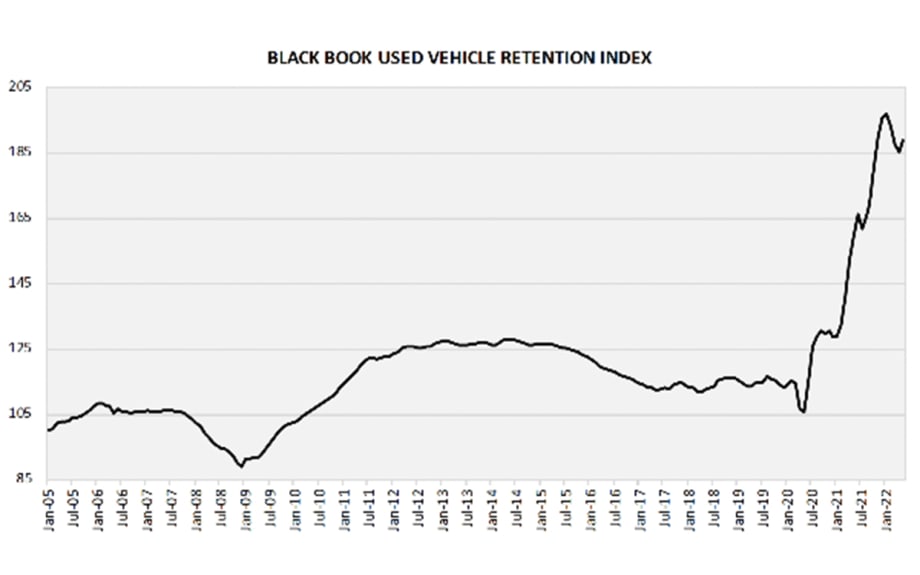
Index reverses a 3-month slide and increases to 188.8 points in May 2022 as tight new inventory and record low incentives push used wholesale prices up across most segments.
IMAGE: Black Book
LAWRENCEVILLE, Georgia – Black Book, a division of Hearst that provides industry-leading used vehicle valuations and residual value forecast solutions, released its Used Vehicle Retention Index for May 2022. The Index increased to 188.8, a 3.4-points (or 1.8%) gain. The Index currently stands 18% above where it was at the same time in 2021 and 65% above March 2020, pre-pandemic.
“In May, we saw a change in the trend of wholesale prices of 2-8-year-old vehicle segments that comprise of Black Book’s Retention Index” said Alex Yurchenko, Chief Data Science Officer at Black Book. “Even with softening of demand, wholesale prices rose across almost all segments (with the exception of some sporty and luxury segments continuing to decline).
“New vehicle inventories are stable but low, with no relief in sight. Retail incentives continued to decline and dropped to about 2.8% of the typically equipped MSRP (as tracked by Black Book). With this pressure from the new vehicle’s market, used wholesale prices rose, even with the softening of retail demand due to low consumer confidence and record high gas prices.”
The Black Book Used Vehicle Retention Index is calculated using Black Book’s published Wholesale Average value on two- to six-year-old used vehicles, as percent of original typically equipped MSRP. It is weighted based on registration volume and adjusted for seasonality, vehicle age, mileage, and condition. The Index offers an accurate, representative, and unbiased view of the strength of today’s used vehicle market values.
To obtain a copy of the latest Black Book Wholesale Value Index, please click here.
Originally posted on Auto Dealer Today
More Auto Finance

July Was Hot for Auto Borrowers
Credit proved readily available for many, but most loans left buyers in negative territory, Cox Automotive said.
Read More →
Dealer Lender Preferences Revealed
When lenders provide consistent, fast service, their overall satisfaction scores with dealers greatly improve, according to JD Power research.
Read More →
Auto Refi Savings Surge
Consumers with 84-month auto loan terms who refinanced saved the most on monthly payments, according to a new report by auto refinancing provider Caribou.
Read More →
Subaru Enters Lending Business
The automaker follows other brands in adding captive financing in the U.S., and says the move will strengthen its position here.
Read More →
Positive Equity Reaches Record High
Mainstream vehicle owners who bought a car seven years ago are likely to have positive equity when trading in for a new vehicle, according to second-quarter Edmunds data.
Read More →
Dealerships Are Paying the Price for Extended Car Loans
Growing negative-equity scenarios mean such lengthy terms should be addressed in a forward-looking way to make them work for the dealer and the consumer down the road.
Read More →
Trade-Ins in Negative Equity Reach New Heights
As such trade-ins rise in frequency, so do monthly loan payment amounts and interest rates, according to second-quarter data compiled by Edmunds.
Read More →
Auto Credit Plentiful
June numbers show lenders are readily granting access, including to risky borrowers, as consumers leverage themselves to take on high prices.
Read More →
Automotive Consumers Sink Further in Debt
Most financing metrics hit records in the second quarter as more buyers locked themselves into long terms and high monthly payments.
Read More →
Porsche Financial Services Shifts Structure
After 36 years with Porsche, the Financial Services Chief Financial Officer Konrad Riedl is retiring, and the department is realigning its management structure.
Read More →