



Cox Automotive: As More Americans Choose EVs, Price and Range Continue to Hold Back the Market
The 2021 Cox Automotive Path to EV Adoption Study provides a look at the major consumer barriers that continue to slow EV adoption.

The 2021 Cox Automotive Path to EV Adoption Study provides a look at the major consumer barriers that continue to slow EV adoption.
ATLANTA – Sales of battery-powered electric vehicles (EVs) in the United States are on track to set an all-time record in 2021, with sales up more than 88% through the end of September. With new players entering the field and consumer choice expanding rapidly, the EV market is on course to grow to 400,000 vehicles this year, and Cox Automotive is forecasting EV sales to double in the next 24 months.
Still, despite the rapid growth, EVs will account for only 3% of the new-vehicle market this year and, according to new research released by Cox Automotive today, many barriers to EV adoption remain. The 2021 Cox Automotive Path to EV Adoption Study provides a look at the major consumer barriers that continue to slow EV adoption. It also uncovers market perceptions and customer experiences with the EV shopping and buying process. The research was conducted in June and July of 2021 and included a survey of nearly 5,000 in-market consumers who owned, considered or rejected a pure battery-electric vehicle in that timeframe. Additional Cox Automotive studies were considered in the analysis.
The study had three objectives:
Understand the nuances of EV adoption and the key barriers to overcome
Explore how the shopping experience for EV and traditional gas-powered vehicles differ
Uncover market perceptions and consumer experiences with EVs
Overall, the 2021 Cox Automotive Path to EV Adoption Study illustrates that, while barriers remain, consumers in the U.S. – particularly younger Millennial and Gen Z buyers – are becoming more open to the idea of an electric vehicle future. Availability of charging stations, vehicle range, and battery concerns have become less of a barrier for potential buyers. Vehicle price, however, continues to be a major obstacle for many.
“This latest round of EV research opened our eyes to a number of shifts in the market,” said Vanessa Ton, senior industry intelligence manager, Cox Automotive. “As the traditional barriers come down, attributes like styling and affordability move to the front, much like traditional gas-powered vehicles. That’s an indication that consumers are looking at EVs more like automobiles, less like science projects.”
In the summer of 2021, during the research phase of the study, consumers had nearly 300 different models to choose from, but less than 20 pure electric models, with most being higher-end, luxury offerings. The average price paid for a new EV was close to $60,000, before rebates, and well above gasoline-equivalent vehicles. And while the number of EV models continues to grow, with new models being added every quarter, the Cox Automotive study shows the path to EV adoption remains difficult at best.
THE INDUSTRY MUST BUILD HIGHER CONSIDERATION AMONG SHOPPERS
Among consumers in-market for a new vehicle, general consideration for a pure electric model is relatively high, at 38% of all shoppers. New research from Cox Automotive, however, indicates that consideration drops off notably to 21% of in-market shoppers saying they are more than 50% confident their next vehicle will be an EV. Further still, only 3% of shoppers in the study indicate that their next will, for certain, be an EV.
Vehicle range and price remain the top barriers, according to this research. The study also shows that automakers and dealers would benefit from focusing on those issues as they market their new EVs.
RANGE ANXIETY SHOWS SIGNS OF WANING
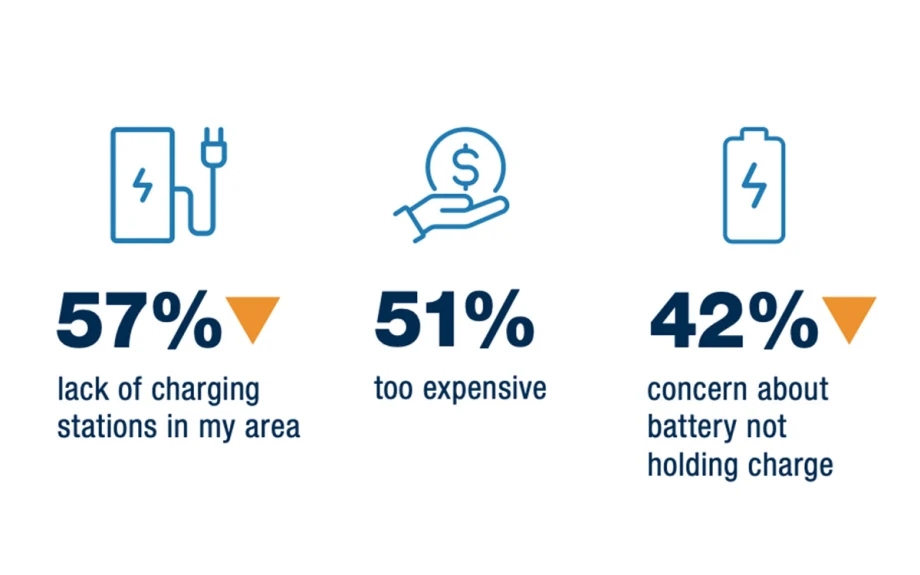
In good news for EV sellers, the study shows that some select barriers to EV adoption are shrinking. For example, two years ago, 47% of in-market consumers noted that low vehicle range was a concern. In 2021, that number dropped to 37%. Notably, younger shoppers – Gen Z and Millennials – are far less concerned about vehicle range, with only 20% and 29%, respectively, indicating that range was holding them back from buying an EV. Also noteworthy: In the most recent study, 57% of consumers point to a lack of charging stations in their area as a top barrier, but that percentage is down from 64% in 2019.
Range expectations among consumers considering EVs continue to increase, but vehicle performance is increasing rapidly as well, which is one reason range anxiety is slowly dissipating among in-market shoppers.
In 2019, the minimum expectation for range on a full charge was 184 miles, and, at the time, the average EV delivered 195 miles per charge, approximately 6% above the minimum acceptable level. In 2021, range expectations jumped to a minimum of 217 miles. Among EVs offered today, the average range is approximately 257 miles, 18% more than the minimal accepted range.
“As EV battery performance improves and the charging infrastructure is slowly built up, traditional EV concerns will fade,” notes Lea Malloy, head of electric-vehicle battery solutions at Cox Automotive Mobility. “Consumers are experiencing the typical learning curve with new technology. And we believe range will be even less of an issue as new generations of battery technology are launched. It is astounding how quickly improvements are being realized.”
REACHING PRICE PARITY WILL HELP CLEAR THE PATHWAY TO ADOPTION
While range and charging station availability is becoming less of a concern for EV considerers, price remains a significant issue with half of all EV intenders. The new study shows that 51% of shoppers noted EVs were too expensive to seriously consider, a similar number to the results in 2019.
EVs are in fact on average more expensive to purchase than their gasoline-powered counterparts. In October, when average transaction prices for a new vehicle topped $46,000, the average EV was above $56,000, a premium of more than 20%.
The research demonstrates that price parity would greatly improve serious EV consideration. Indeed, nearly 60% of vehicle intenders would consider an EV if there was no price premium, up from the 38% currently considering an EV. Further, that number jumps to 71% in a case where EVs are priced $5,000 below an equivalent gas vehicle.
DEALERS, AUTOMAKERS STRUGGLE TO EFFECTIVELY REACH CONSUMERS
Another key finding in the 2021 Path to EV Adoption Study suggests that auto dealers need more help to prepare for an EV future. The study shows that dealers play a crucial, influential role in the process, with nearly 80% of EV owners noting that the dealer influenced their purchase decision. At the same time, in a survey of dealers reviewed for the study, 71% indicated they were “only somewhat” or “not at all” prepared to sell more EVs in the future.
Many automakers continue to struggle with consumer awareness of their EV product offering, certainly a first step in consideration. While 83% of EV considerers are aware that Tesla sells electric vehicles, only 44% of EV considerers are aware that Ford has a competitive EV model, the all-new Mustang Mach-E, which was launched in the spring of 2021.
Worse still, even though Nissan has been selling the all-electric Leaf model in the U.S. for more than a decade, only 37% of respondents in the survey were aware of Nissan’s EV offering. Chevrolet has similar issues. The all-electric Bolt was launched in late 2016, and yet 69% of current EV shoppers are unsure if Chevrolet even makes an EV.
Click here to download the Study.
Originally posted on Auto Dealer Today
More Digital

AI: Facilitator, Not Fixer, in F&I
The dealerships that thrive in the years ahead will be those that embrace technology while continuing to invest in the people who make customer interactions count.
Read More →
Simple But Effective Hacking Surges
Data from the past year at U.S. auto dealerships finds that email and identity phishing are growing threat sources that can dispense with malware by exploiting trust.
Read More →
The Future of Car Dealerships
Artificial intelligence is reshaping the service-drive experience and will help retailers stay competitive.
Read More →
Structure Leads to Optimized Auto Listings
As the average car-buying journey has shifted to a blend of digital and retail, a dealership’s vehicle listings must be optimized to answer shoppers’ questions clearly and accurately.
Read More →
Real Intelligence
AI, though it presents many opportunities for productivity, efficiency and more, isn’t a one-for-one stand-in for people. It can augment human capital but not replace it altogether.
Read More →
Zurich Launches Advisor IQ for F&I Manager Coaching
The new platform uses real transaction data and artificial intelligence-driven insights to help car dealerships improve consistency and performance.
Read More →
F&I in the Digital Age
Digital retailing has not made the F&I manager obsolete. If anything, it has revealed how valuable the role can become when technology is used correctly.
Read More →
Need for Speed: EV Apps Lack Consistency
Fifty-five percent of surveyed EV owners said their mobile applications had a major or moderate impact on their purchasing decisions, but connectivity issues remain a problem.
Read More →
Four Keys to Your Digital Trail Defense
Federal regulators are cracking down on hidden fees. This protective measure could mean the difference between winning and losing a lawsuit or surviving a duel with the Dark Side.
Read More →
Hyundai Hosts Tech Talent Forum
Technology leaders from Hyundai Motor Group will have open discussions at the inaugural HMG Tech Talent Forum on topics ranging from autonomous driving to 'smart' manufacturing.
Read More →