



DMEautomotive: Service Retailers Missing Profit Opportunities
A new consumer survey from DMEautomotive reveals that service shops aren't cashing in on key service opportunities. It also shows that young, Internet-savvy shoppers are rewriting the purchase process.
DAYTONA BEACH, Fla. — A new study from DMEautomotive found that consumers are changing the way they purchase brakes, batteries and tires. It also revealed that service department will need to change the way they market and sell to today’s younger car owners.
Only 5 percent of the more than 2,000 consumers surveyed said the service outlet they worked with informed them that they needed tires. Only 9 percent who needed a battery said the service outlet they worked with recommended the batter be replaced, while 21 percent said the service department recommended that their brakes be serviced.
Vehicle owners under the age of 35 also research at a higher rate than other age groups, the study also found. Two in three vehicle owners in that demographic said they research core service work like brakes, batteries and tires. On average, only one in three vehicle owners over the age of 35 said they researched those services.
Thirty-eight percent of younger consumers are now buying batteries online, while 17 percent said the order tires online. That’s four and eight times, respectively, higher than customers over the age of 35.
With battery, brake and tire replacement services representing tens of billions in customer pay dollars annually, the findings serve as an industry wake-up call. On average, only one car owner in 12 first learned that they needed new brakes, tires or a battery from a dealer or mechanic, indicating that an overly passive sales approach is leading to lost revenue opportunities. And while the survey reveals that consumers, on average, do a large amount of research on these services, it's the under-35 crowd that's radically remaking the path-to-purchase.
"This new research helps all service businesses understand today's brakes/battery/tires purchasing funnel, so they can put in place the right, cross-channel strategies to grow market share," said Doug Van Sach, vice president of strategy and analytics at DMEautomotive. "And the new data suggests several basic, best practices that retailers really should embrace:
To combat widespread sales passivity, complimentary, comprehensive multipoint inspections need to happen with every service visit, the study recommends. Retailers also need to create a engaging online shopping platform for batteries and tires, with clear pricing, a range of price-points and detailed product features.
“The “holy grail” is to implement marketing programs that can anticipate when a customer is ready to make a brakes, battery, or tire purchase and deliver timely, relevant campaigns that interrupt their typical research windows – to put that store top of mind when it most matters," the study states.
While both the aftermarket and dealerships alike are missing out on crucial revenue opportunities, Van Sach noted that other, recent DMEautomotive research reveals that aftermarket players are winning the brakes-battery-tires war, with only 64 percent of dealer customers reporting they would consider using dealers for brake services — 46 percent for battery replacements and 36 percent for tires.
Additionally, only 44 percent are likely to choose dealerships for these services (in aggregate) within the first two years of in-warranty ownership. And as vehicles hit 3 to 6 years, dealers lose roughly half of this business. Furthermore, DMEa research shows that for dealers, cracking the under-35 shopper's service selection "code" is mission critical, as roughly half of aftermarket chain loyalists are now under-35, while half of dealer loyalists are an aging 50-plus.
More F&I

Modern Technology Objection Handling
In this video, Trent White shares how to confidently handle technology-based objections by helping customers understand the value of protection, even with modern vehicle technology.
Read More →
Consistency at Scale: Driving F&I Performance
With 75 rooftops across the Sunshine State, Morgan Auto Group has proven to Floridians that it knows a thing or two about driving performance in a competitive market. But it didn’t start at the top.
Read More →
Gitty Up on GAP
The foundational finance-and-insurance product hasn’t kept up with the latest conditions for auto dealers. Is the time ripe?
Read More →
How AI-Powered Coaching Is Transforming F&I Performance
See how AI-powered coaching can turn F&I customer conversations into actionable insights that support compliance, performance and profitability
Read More →
Sell Value, Build Trust
In this video, Trent White explains why selling on value, not fear, builds lasting customer trust, reduces cancellations, and drives long-term success.
Read More →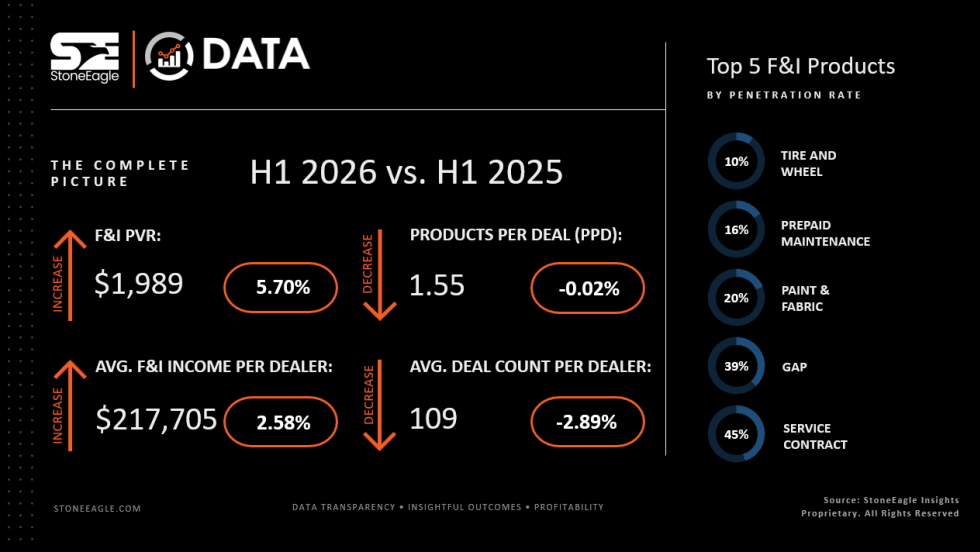
F&I Sales Give Dealers First-Half Lift
Product business shored up total profits to avoid an overall revenue tanking as product penetrations held steady, StoneEagle reported.
Read More →
Targeted Training Drives Results
Today’s technology, instead of threatening F&I managers, can actually make them better, according to an industry veteran who’s watched market setbacks roil the unprepared.
Read More →
Double the Change, Double the Chance
When an F&I manager gets a customer refusal, it’s a wise move to tweak more than one thing in the product offering.
Read More →
Just Do It
F&I managers need training, but instead of resisting application or expecting perfection, they should improve by simply acting on what they learn.
Read More →
Dealer Lender Preferences Revealed
When lenders provide consistent, fast service, their overall satisfaction scores with dealers greatly improve, according to JD Power research.
Read More →