



GM’s Viability Plan Ends Run for Pontiac
Although yesterday’s unveiling of General Motors’ updated viability plan signaled the end of an 83-year-old brand and the potential sale of three others, some viewed the moves as a necessary and positive step toward turning around the automaker.
Although yesterday’s unveiling of General Motors’ updated viability plan signaled the end of an 83-year-old brand and the potential sale of three others, some viewed the moves as a necessary and positive step toward turning around the automaker.
During a press conference held yesterday, Fritz Henderson, president and CEO of GM, unveiled a revised restructuring plan, one that called for phasing out of Pontiac by the end of 2010. Henderson also said the revised plan moves up the possible sale of Saab, Saturn, and Hummer to the end of 2009.
“Four weeks ago, President Obama announced that GM’s overall restructuring plan did not go far enough to warrant substantial new support from the U.S. government,” Henderson wrote in his GM Fastlane blog. “Today, we’re announcing a number of tough but necessary actions to ramp up our U.S. turnaround efforts in four focus areas.”
Henderson said the company will now focus on four core brands — Chevrolet, Cadillac, Buick and GMC. He added that the decision will allow GM to put forth a more competitive level of marketing support for each brand.
Henderson also said the company will accelerate restructuring efforts of its
U.S. dealer base, as the company plans to cut 42 percent of it dealers by the end of 2010. He also said the company will improve U.S. capacity utilization by reducing powertrain, stamping, and assembly plants by 28 percent by the end of 2010, and by 31 percent by 2010.
Additionally, GM will work at lowering structural costs, which the company projects will enable it to breakeven at a U.S. total industry volume of approximately 10 million vehicles. GM expects to cut hourly employment levels by 34 percent in 2010. Officials also said the company anticipates a further decline in salaried and executive employment.
“Our responsibility is clear – to secure GM’s future – and we intend to succeed,” said Henderson. “At the same time, we also understand the impact these actions will have on our employees, dealers, unions, suppliers, shareholders, bondholders, and communities, and we will do whatever we can to mitigate the effects on the extended GM team.”
Henderson also said the company is focused on strengthening its balance sheet. Yesterday, GM launched a bond exchange offer for approximately $27 billion of its unsecured debt. If successful, the bond exchange would result in the conversion of a large majority of this debt to equity.
The automaker is also in ongoing discussions with the United Auto Workers union to modify agreements, and with the U.S. Treasury regarding possible conversion of its debt to equity. If successful on all fronts, including the bond exchange, the company expects a debt reduction of $44 billion.
The company is currently operating on $15.4 billion in government aid, and said it expects to receive an additional $11.6 billion. Additionally, the company has until June 1 to demonstrate its viability. If its plan does not satisfy the government, bankruptcy could be the next step for GM.
Gary Allgeier, finance director at the Troy, Mich.-based Suburban Collection, a 43-rooftop dealer group that touts the No. 1 Saturn dealership in the world, said the news was positive from several angles.
“First, Hummer sales are down 90 percent, so a potential sale would be welcomed news as a new buyer would reinvest in this unique brand and drive sales forward,” said Allgeier, whose dealer group counts Hummer as one of its 38 brands. “While Pontiac’s dimly-lit flame as a possible niche brand was extinguished, it re-confirms that GM is serious about marshalling all their resources exclusively on their core brands.
“Lastly, Saturn remains an amazing brand with unparalleled customer following and today’s announcements have not changed that,” Allgeier added. “Any buyer of the Saturn brand will take over an incredible network of dealers and customers. And news that provides clarity is welcomed as each announcement, despite the painful implications, will ultimately serve to ease consumers’ fears of uncertainty and guide them back into the market.”
More F&I

AI: Facilitator, Not Fixer, in F&I
The dealerships that thrive in the years ahead will be those that embrace technology while continuing to invest in the people who make customer interactions count.
Read More →
Modern Technology Objection Handling
In this video, Trent White shares how to confidently handle technology-based objections by helping customers understand the value of protection, even with modern vehicle technology.
Read More →
Consistency at Scale: Driving F&I Performance
With 75 rooftops across the Sunshine State, Morgan Auto Group has proven to Floridians that it knows a thing or two about driving performance in a competitive market. But it didn’t start at the top.
Read More →
Gitty Up on GAP
The foundational finance-and-insurance product hasn’t kept up with the latest conditions for auto dealers. Is the time ripe?
Read More →
How AI-Powered Coaching Is Transforming F&I Performance
See how AI-powered coaching can turn F&I customer conversations into actionable insights that support compliance, performance and profitability
Read More →
Sell Value, Build Trust
In this video, Trent White explains why selling on value, not fear, builds lasting customer trust, reduces cancellations, and drives long-term success.
Read More →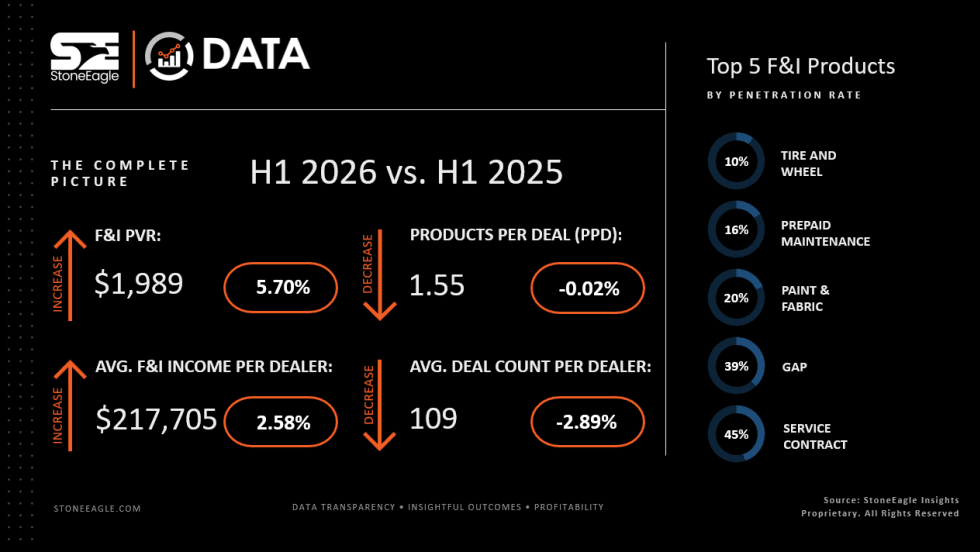
F&I Sales Give Dealers First-Half Lift
Product business shored up total profits to avoid an overall revenue tanking as product penetrations held steady, StoneEagle reported.
Read More →
Targeted Training Drives Results
Today’s technology, instead of threatening F&I managers, can actually make them better, according to an industry veteran who’s watched market setbacks roil the unprepared.
Read More →
Double the Change, Double the Chance
When an F&I manager gets a customer refusal, it’s a wise move to tweak more than one thing in the product offering.
Read More →
Just Do It
F&I managers need training, but instead of resisting application or expecting perfection, they should improve by simply acting on what they learn.
Read More →