


Manheim’s Webb Delivers ‘Upbeat’ Report
Tom Webb, Manheim's chief economist, announced gains in both new- and used-car sales in 2010 but noted that many of the key factors that drive the auto retail market and the economy in general, including employment rate and average household net worth, are not likely to approach pre-recession levels anytime soon.
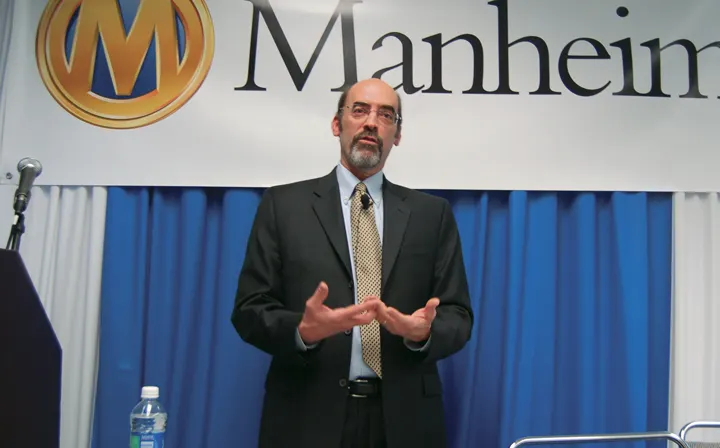
Tom Webb highlighted gains in new- and used-car sales, leasing and more, and praised dealers' increasing sophistication in inventory management in 2010.
SAN FRANCISCO — Manheim’s chief economist, Tom Webb, delivered the company’s annual Used Car Market Report at the 2011 National Automobile Dealers Association (NADA) Convention and Expo. Webb announced gains in both new- and used-car sales in 2010 but noted that many of the key factors that drive the auto retail market and the economy in general, including employment rate and average household net worth, are not likely to approach pre-recession levels anytime soon.
“It’s an upbeat forecast,” Webb said. “Some of our projections are actually above the consensus.”
One example is 2011 new-vehicle sales, which Webb believes may eclipse the much-discussed 13 million-unit mark forecast by most sources. He noted that much of the credit for the 2010 “rebound” of the new-vehicle market — 11.6 million units sold, an 11 percent increase from 2009 — should go to fleet sales, which increased by 22 percent.
However, Webb expects only “marginal” improvement in that category this year. “We need employment growth,” he said, alluding to the modest gains to the employment rate that have characterized the current period of economic recovery.
Leasing also saw gains in 2010 after dramatic losses in prior years. New-vehicle lease originations surged to 1.7 million in 2010 after falling to 1.19 million in 2009. Such gains are not likely, however, to offset an inevitable dearth of off-lease units in 2011 and 2012.
Webb applauded dealers for demonstrating an increasing sophistication in inventory management in 2010, despite a still-shrinking supply of wholesale units.
“New-vehicle sales will not be as competitive vs. used,” Webb said, predicting that “less supply, stable demand and strong pricing” will continue to drive that market.
More F&I

AI: Facilitator, Not Fixer, in F&I
The dealerships that thrive in the years ahead will be those that embrace technology while continuing to invest in the people who make customer interactions count.
Read More →
Modern Technology Objection Handling
In this video, Trent White shares how to confidently handle technology-based objections by helping customers understand the value of protection, even with modern vehicle technology.
Read More →
Consistency at Scale: Driving F&I Performance
With 75 rooftops across the Sunshine State, Morgan Auto Group has proven to Floridians that it knows a thing or two about driving performance in a competitive market. But it didn’t start at the top.
Read More →
Gitty Up on GAP
The foundational finance-and-insurance product hasn’t kept up with the latest conditions for auto dealers. Is the time ripe?
Read More →
How AI-Powered Coaching Is Transforming F&I Performance
See how AI-powered coaching can turn F&I customer conversations into actionable insights that support compliance, performance and profitability
Read More →
Sell Value, Build Trust
In this video, Trent White explains why selling on value, not fear, builds lasting customer trust, reduces cancellations, and drives long-term success.
Read More →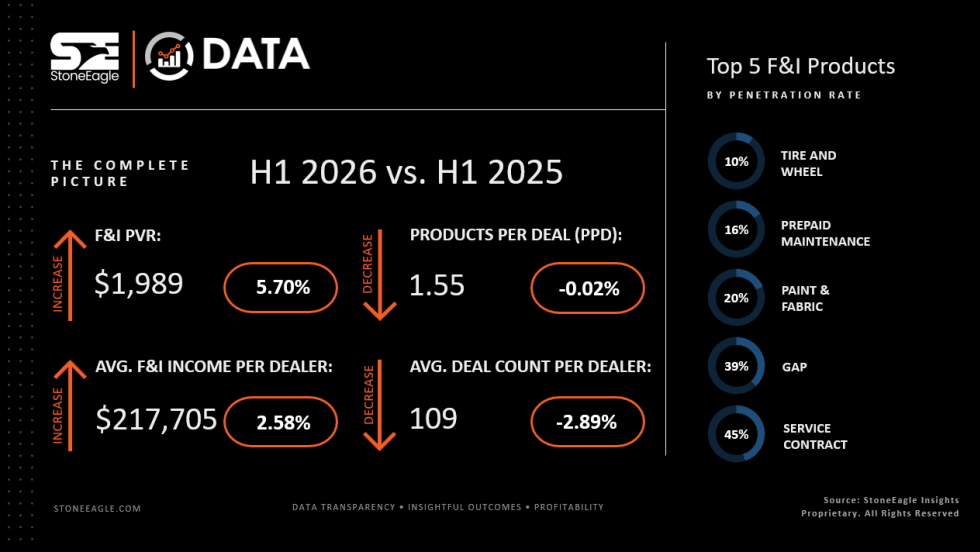
F&I Sales Give Dealers First-Half Lift
Product business shored up total profits to avoid an overall revenue tanking as product penetrations held steady, StoneEagle reported.
Read More →
Targeted Training Drives Results
Today’s technology, instead of threatening F&I managers, can actually make them better, according to an industry veteran who’s watched market setbacks roil the unprepared.
Read More →
Double the Change, Double the Chance
When an F&I manager gets a customer refusal, it’s a wise move to tweak more than one thing in the product offering.
Read More →
Just Do It
F&I managers need training, but instead of resisting application or expecting perfection, they should improve by simply acting on what they learn.
Read More →