



Market Insights from Black Book
Higher gas prices are affecting the demand for trucks and SUVs – almost all the non-luxury crossover / SUV and pickup segments of all ages are depreciating at an accelerating rate, while non-luxury car segments are appreciating.

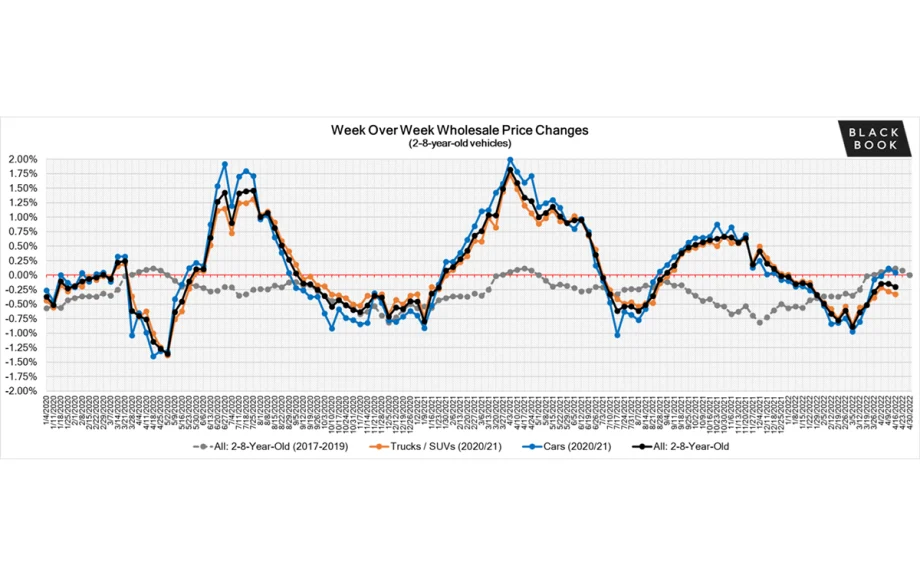
Higher gas prices are affecting the demand for trucks and SUVs – almost all the non-luxury crossover / SUV and pickup segments of all ages are depreciating at an accelerating rate, while non-luxury car segments are appreciating.
BLACK BOOK – Wholesale Prices, Week Ending April 16th
The overall market continues to decline. Older model years (8-to-16-year-olds) had another week of outperforming newer model years, but they started to decline again too. The spring / tax season market looks different and shorter this year: the “sweet spot” for the buyers shifted toward older than normal vehicles. Higher gas prices are affecting the demand for trucks and SUVs – almost all the non-luxury crossover / SUV and pickup segments of all ages are depreciating at an accelerating rate, while non-luxury car segments are appreciating.
This Week Last Week 2017-2019 Average (Same Week)
Car segments +0.05% +0.12% +0.23%
Truck & SUV segments -0.33% -0.28% +0.04%
Market -0.20% -0.15% +0.12%
Car Segments
On a volume-weighted basis, the overall Car segment increased +0.05%. For reference, the previous week, cars increased by +0.12%.
Five of the nine Car segments increased last week.
Compact (+0.45%) and Sub-Compact (+0.25%) Cars reported the largest increases last week. Compact Cars marked the fourth consecutive week of increases, with the segment reporting an average weekly increase of +0.38%.
The Luxury segments were the only Car segments to have declines last week, with Near Luxury Car moving down -0.34%, followed by Prestige Luxury Car at -0.30%, then Luxury Car (-0.20%) and Premium Sporty Car (-0.12%).
Truck / SUV Segments
The volume-weighted, overall Truck segment decreased -0.33%, compared to the prior week’s decrease of -0.28%.
Four out of the thirteen Truck segments reported increases.
Compact Crossovers increased for a third consecutive week, up +0.28% after the prior week’s increase of +0.24%.
The Full-Size Crossover/SUV (-2.14%) segment reported the largest decline last week, after the previous week’s already large decline of -1.70%.
Despite high fuel costs, Sub-Compact Crossovers continued to decline (-0.01%) last week, which marks seventeen consecutive weeks so far.
Weekly Wholesale Index
Calendar year 2020 and 2021 ended with used wholesale prices at elevated levels. With economic patterns (including the automotive market) driven by the pandemic, normal seasonal patterns (e.g., 2019 calendar year) in the wholesale market were not observed for most of the last 2 years. We saw a similar picture in 2009, at the end of the Great Recession. Calendar year 2021 did not have typical seasonality patterns as the market had rapid increases in wholesale values for the majority of the year. The Wholesale Weekly Price Index reached the highest point of the year at the end of December, reporting over 1.51 points. Now, in calendar year 2022, the index has been reverted back to the 1.00 mark and overall wholesale prices remained relatively stable after February declines.
The graph below looks at trends in wholesale prices of 2-6-year-old vehicles, indexed to the first week of the year. The index is computed keeping the average age of the mix constant to identify market movements.
Retail (Used and New) Insights
Honda Motor Co. is dropping the Insight gasoline-electric hybrid in the U.S. to focus on hybrid versions of the CR-V, Accord, and Civic.
Toyota Motor Corp. plans to launch a SUV version of the Crown sedan, which will come in hybrid, plug-in hybrid, and full-electric models.
Lucid added a Performance version of the Air Grand Touring; prices start at $179,000 and deliveries are expected to begin in June.
Production of the Chevrolet Bolt EV and EUV restarted this month in Michigan, after being recalled last year for defects in the battery packs.
Jeep debuted the 2023 Wagoneer L and Grand Wagoneer L at the New York Auto Show; each model measures 12 inches longer than the standard-wheelbase models and will go on sale in the second half of the year.
The Hyundai Ioniq 5 was named World Car of the Year at the New York International Auto Show; the other top vote-getters were Ford’s Mustang Mach-E and the Kia EV6.
Ram plans to unveil a concept of its electric 1500 pickup this year, with a live concept ahead of the truck’s slated 2024 release.
Used Retail Prices
Used Retail Prices are more accessible than in years past, due to the proliferation of ‘no-haggle pricing’ for used-vehicle retailing. Transparent pricing upfront makes the car buying process more enjoyable for customers and allows Black Book to accurately measure retail market trends.
At the on-set of the pandemic, in CY2020, used retail prices increased slightly, following typical seasonal patterns, and then began dropping in April, finally hitting a low point in the late spring months. By late summer of CY2020, Used Retail Prices increased as supply of new vehicle inventory started to become scarce, but retail demand slowed down at the end of CY2020, resulting in declining retail asking prices for the last several weeks of the year. When CY2021 kicked off, demand rebounded while retail prices lagged slightly behind wholesale prices; March of 2021 started the dramatic increases in Used Retail Prices, fueled by stimulus payments, tax season, and shortages of new inventory. During the third quarter, retail prices continued to rise at a slower rate but soon picked up the pace once again to start the fourth quarter. In Q4, prices on retail listings steadily increased week after week. As CY2021 came to an end, the retail listing price index closed 36% above where the year began.
So far in 2022, the Retail Listings Price Index has remained relatively unchanged (green curve on the graph below), The Index sits around 0.99, indicating a very slight decrease in retail pricing. Typically, there is a lag between changes in wholesale prices and retail prices.
This analysis is based on approximately two million vehicles listed for sale on U.S. dealer lots. The graph below looks at 2-6-year-old vehicles. The Index is computed keeping the average age of the mix constant to identify market movements.
Inventory
Used Retail
Used Retail Listing Volume dropped this week, and now sits just above 0.95.
The Used Retail Days-to-Turn Estimate has continued to drop over the last few weeks, and now sits below 36 days. This is very similar to the trend seen in CY21 at this time of year. While consumer sentiment may be down, this Used Retail Days-to-Turn Estimate indicates that vehicles are not only selling but selling quickly.
Wholesale
With supply chain issues as a result of the COVID-19 Pandemic and the war in Ukraine continuing to plague the automotive industry, model year 2022 vehicles continue to be scarce in the wholesale market. All indicators point to the fact that we are well underway into the spring / tax-season market, although it is slightly different this year when compared to prior years. Dealerships across the board have adapted to the rising vehicle values by purchasing older models for their spring market customers, which has led to some interesting trends in the 8-to-16-year-old vehicles. Franchise dealers have been fairly active in lane, indicating that although new inventory has been coming in from manufacturers, it is not enough to meet customer demand, at least for some brands. Large independent dealers have been active, but not as active as we have come to expect, so they may be finding luck sourcing inventory from upstream platforms or direct from consumer. Rental companies continue to be extremely competitive in lane since they are unable to source inventory directly from the manufacturers. With COVID restrictions rolling back and boarders opening, Americans are traveling easier for spring break with the trend expecting to continue for summer travel, so rental companies will most likely stay active through the fall months to keep up with demand.
The Estimated Average Weekly Sales Rate remained consistent last week at 67%, with sellers continuing to hold firm to floor pricing.
More Auto Finance

Interest Rates Further Squeeze Auto Consumers
Last month’s hike and a potential second increase this month add to a growing list of inflation woes that could continue to dent overall car sales.
Read More →
Mind Your Process
Consistent steps taken in various aspects of the F&I office can make valuable differences over time, similar to an outline for a best-selling book.
Read More →
Top Five Credit Application Fraud Flags
Compliance audits regularly reveal bad habits that can lead to fraud charges and should have been stamped out decades ago.
Read More →
More Auto Loans for the Taking in August
Riskier categories were on the uptick for the month as lenders loosened access in several areas while balancing out the exposure in another, Cox Automotive reported.
Read More →
July Was Hot for Auto Borrowers
Credit proved readily available for many, but most loans left buyers in negative territory, Cox Automotive said.
Read More →
Dealer Lender Preferences Revealed
When lenders provide consistent, fast service, their overall satisfaction scores with dealers greatly improve, according to JD Power research.
Read More →
Auto Refi Savings Surge
Consumers with 84-month auto loan terms who refinanced saved the most on monthly payments, according to a new report by auto refinancing provider Caribou.
Read More →
Subaru Enters Lending Business
The automaker follows other brands in adding captive financing in the U.S., and says the move will strengthen its position here.
Read More →
Positive Equity Reaches Record High
Mainstream vehicle owners who bought a car seven years ago are likely to have positive equity when trading in for a new vehicle, according to second-quarter Edmunds data.
Read More →
Dealerships Are Paying the Price for Extended Car Loans
Growing negative-equity scenarios mean such lengthy terms should be addressed in a forward-looking way to make them work for the dealer and the consumer down the road.
Read More →