



Pace of Dealership Acquisitions Slows in Q2
Kerrigan Advisors’ latest Blue Sky buy/sell report counts 49 transactions in the second quarter, a slight decline from Q1 but enough to maintain a 200-plus-transaction pace for 2019.


Experts say auto dealers’ ability to shift resources to higher-margin departments when new-vehicle sales slow contributes to a resilient business model.
Photo by Korhan Erdol via Pexels
IRVINE, Calif. — The 2019 auto dealership buy/sell market stayed “steady and on course” for yet another 200-plus-transaction year in 2019, with 103 completed transactions year-to-date, according to the Second Quarter 2019 Blue Sky Report by Kerrigan Advisors.
The 49 transactions recorded in Q2 represent a 9.3% decline from the prior quarter.
Read: Kerrigan: Dealership Buy/Sell Activity Up 38% in Q1
“The buy/sell market moved at a slower pace during the second quarter,” said Erin Kerrigan, the firm’s founder and managing director. “Yet even with the second quarter’s decline, 2019 is tracking to be another 200-plus transaction year — the sixth consecutive year at this elevated level. Kerrigan Advisors expects transaction activity to remain at today’s elevated pace through the remainder of 2019 and into 2020.”
Kerrigan noted that since 2014, an estimated 1,000 dealers have sold their businesses, representing 12% of the total dealer network. Sellers continue to come to market at a high rate, while the buyer pool grows with new capital seeking investment in auto retail thanks to a diversified and high-margin business model that hedges against an uncertain economy.
“The global trade war has clearly caused uncertainty in the investment community, leading to a flight to higher-quality, less risky assets.”
Despite recession fears, Kerrigan expects dealership buy/sell activity to remain strong for the remainder of 2019.
“The global trade war has clearly caused uncertainty in the investment community, leading to a flight to higher-quality, less risky assets,” said Kerrigan. “Auto retail is emerging as one of those asset classes. High net worth individuals, family offices and Wall Street investors recognize the counter cyclical measures dealers can take to sustain profitability, even when new-car sales turn south. Auto retail’s nimble model makes the industry a highly attractive investment in a time of greater economic uncertainty.”
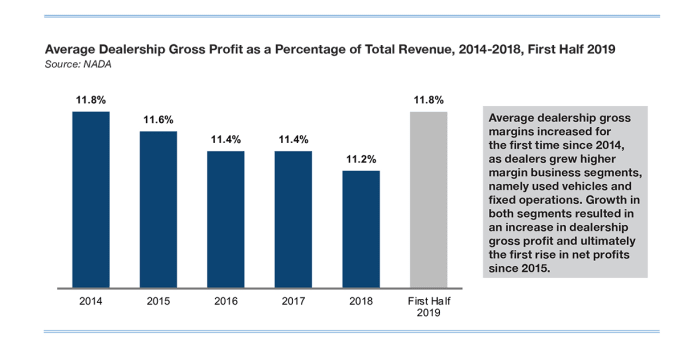
Analysts found a decline in new vehicle sales spurred dealers to turn to their higher-margin business segments, including used-vehicle sales, F&I, and fixed ops. The result was a marked increase in gross profit and earnings.
Notably, the number of multidealership transactions declined in the first half. Kerrigan analysts said the rise in single-store transactions may reflect “franchise pruning” that many organizations are currently undertaking.
“Both the public groups and large private dealership groups are capitalizing on their ability to jettison underperforming dealerships and redeploy their capital into higher-ROI investments in today’s active buy/sell market,” said Managing Director Ryan Kerrigan. “Among the franchises being acquired, domestics continue to grow their market share, because buyers are attracted to their lower blue-sky multiples and higher expected ROI.”
Originally posted on Auto Dealer Today
More F&I

AI: Facilitator, Not Fixer, in F&I
The dealerships that thrive in the years ahead will be those that embrace technology while continuing to invest in the people who make customer interactions count.
Read More →
Modern Technology Objection Handling
In this video, Trent White shares how to confidently handle technology-based objections by helping customers understand the value of protection, even with modern vehicle technology.
Read More →
Consistency at Scale: Driving F&I Performance
With 75 rooftops across the Sunshine State, Morgan Auto Group has proven to Floridians that it knows a thing or two about driving performance in a competitive market. But it didn’t start at the top.
Read More →
Gitty Up on GAP
The foundational finance-and-insurance product hasn’t kept up with the latest conditions for auto dealers. Is the time ripe?
Read More →
How AI-Powered Coaching Is Transforming F&I Performance
See how AI-powered coaching can turn F&I customer conversations into actionable insights that support compliance, performance and profitability
Read More →
Sell Value, Build Trust
In this video, Trent White explains why selling on value, not fear, builds lasting customer trust, reduces cancellations, and drives long-term success.
Read More →
F&I Sales Give Dealers First-Half Lift
Product business shored up total profits to avoid an overall revenue tanking as product penetrations held steady, StoneEagle reported.
Read More →
Targeted Training Drives Results
Today’s technology, instead of threatening F&I managers, can actually make them better, according to an industry veteran who’s watched market setbacks roil the unprepared.
Read More →
Double the Change, Double the Chance
When an F&I manager gets a customer refusal, it’s a wise move to tweak more than one thing in the product offering.
Read More →
Just Do It
F&I managers need training, but instead of resisting application or expecting perfection, they should improve by simply acting on what they learn.
Read More →