



Q3 Auto Originiations Up at Wells Fargo, Chase Auto Finance
Wells Fargo and Chase Auto Finance grew third-quarter auto originations by 10% and 19%, respectively, with a Wells Fargo official noting that new auto sales were at their highest levels in a decade.
SAN FRANCISCO and NEW YORK — Wells Fargo reported last week a 10% increase in third-quarter auto originations from a year ago, while Chase Auto Finance realized a 19% increase in originations from the year-ago period.
Wells Fargo’s third quarter auto originations, which were up 2% from the prior quarter, totaled $8.3 billion, with bank officials noting that new auto sales were at their highest levels in a decade.
“Auto loans were up $39 billion, or 7%, from last year,” said John Shrewsberry, Wells Fargo’s CFO. “We had record new originations in the third quarter … reflecting the strong auto market while we have remained disciplined in our approach.”
Wells Fargo’s net charge-off rate was 31 basis points of average loans, up slightly from the prior quarter due primarily to seasonally higher auto losses.
Auto originations for Chase Auto Finance grew to $8.1 billion in the third quarter, with officials noting that loans skewed toward the prime space.
Net income for Chase’s card, commerce solutions and auto finance divisions totaled $1.1 billion, a 6% decrease from a year ago, according to the company. Combined net revenue totaled $4.8 billion, a 2% increase. Additionally, noninterest expense for card, commerce solutions and auto rose 8% to $2.2 billion, driven by higher auto lease depreciation and higher marketing expense.
Chase stated that third-quarter results reflected a continued steady growth in new-vehicle sales and stable used-car values.
“We saw average loan and lease balances up 9% and the pipeline is good,” said Marianne Lake, JP Morgan Chase CFO. “Finally, on credit, the net charge-off rate for the quarter was 241 basis points, and we expect net charge-offs of around 250 basis points over the medium term.”
Overall, JP Morgan Chase reported net income of $6.8 billion, or $1.68 per share for the third quarter 2015 — an increase of22% from a year ago. Net revenue fell 6% to $23.5 billion.
Wells Fargo reported net income of $5.8 billion, or $1.05 per diluted common share — up 1% from a year ago. Revenue was up 3% at $21.9 billion.
More F&I

Managing Expectations
Learn how proactive communication, setting clear expectations, and providing solutions when plans change can strengthen customer trust and improve the overall service experience.

The F&I Manager's Report Card
The best managers take the time and attention to measure the behaviors behind the numbers.

AI: Facilitator, Not Fixer, in F&I
The dealerships that thrive in the years ahead will be those that embrace technology while continuing to invest in the people who make customer interactions count.

Modern Technology Objection Handling
In this video, Trent White shares how to confidently handle technology-based objections by helping customers understand the value of protection, even with modern vehicle technology.

Consistency at Scale: Driving F&I Performance
With 75 rooftops across the Sunshine State, Morgan Auto Group has proven to Floridians that it knows a thing or two about driving performance in a competitive market. But it didn’t start at the top.

Gitty Up on GAP
The foundational finance-and-insurance product hasn’t kept up with the latest conditions for auto dealers. Is the time ripe?

How AI-Powered Coaching Is Transforming F&I Performance
See how AI-powered coaching can turn F&I customer conversations into actionable insights that support compliance, performance and profitability

Sell Value, Build Trust
In this video, Trent White explains why selling on value, not fear, builds lasting customer trust, reduces cancellations, and drives long-term success.
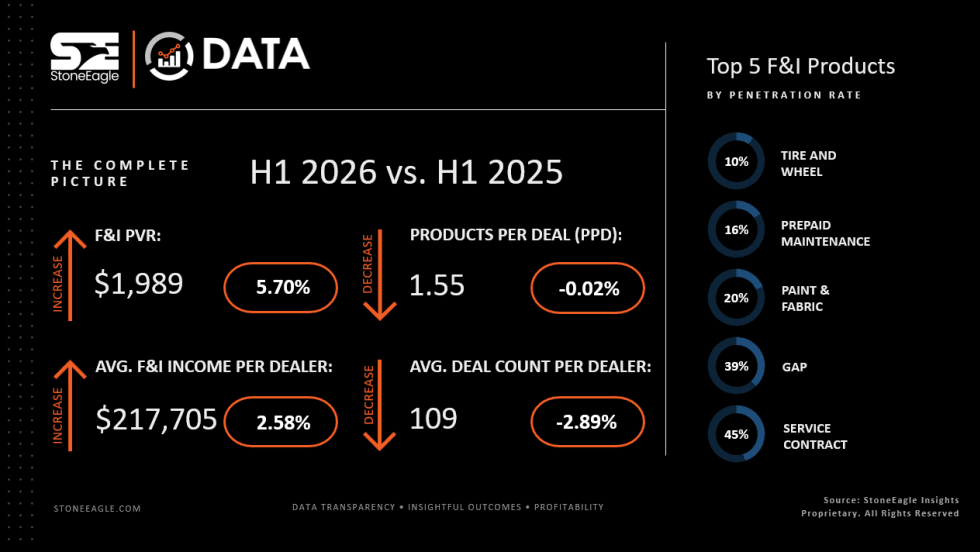
F&I Sales Give Dealers First-Half Lift
Product business shored up total profits to avoid an overall revenue tanking as product penetrations held steady, StoneEagle reported.

Targeted Training Drives Results
Today’s technology, instead of threatening F&I managers, can actually make them better, according to an industry veteran who’s watched market setbacks roil the unprepared.