



Report: GPS Tracking Reduces Impound Costs
In the year since impound fees cost the used car industry $1.1 billion, new data released by Spireon shows maturing technology has made a positive impact.


New data shows promising trends for dealers concerned about impound fees.
Photo by Tony Webster via Wikimedia Commons
IRVINE, Calif. — Vehicle intelligence provider Spireon has reported that in 2019, significantly more used vehicles have been recovered expeditiously from impound lots than in 2018. Analysts say faster recovery time has resulted in an estimated average savings of $107 per vehicle impounded.
Spireon data indicates that in 2019, 27.8% more vehicles were recovered from impound lots in less than a day. Meanwhile, vehicles accruing mounting fees in excess of one week to more than a month has improved by 27% since its 2018 findings.
Read: Used-Vehicle Prices Up 2% From 2018
“Last year’s data was pulled during a period when impound lot recovery technology powered by GPS was still in its early stages and did not yet have a strong foothold among dealers,” said Director of Product Management Brian Deeley Sr. “However, since then, through gradual adoption and education, we are seeing the fruits of our labor pay off in the form of significant savings for both independent and BHPH dealers.”
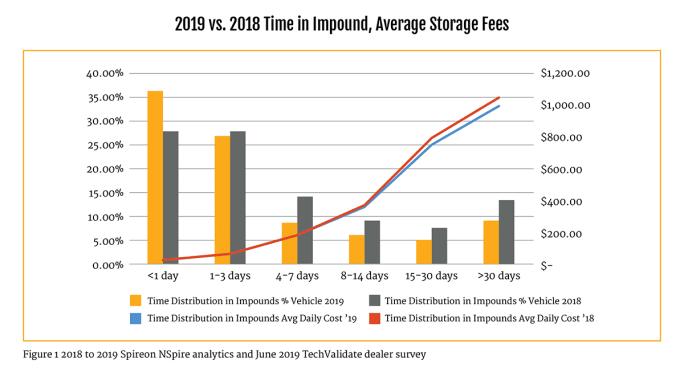
Spireon’s latest findings, recently published in the latest annual NIADA Used Car Industry Report, are the second iteration of data analysis gathered from dealer surveys and Spireon’s NSpire IoT platform data tracked from nearly 4 million GPS-equipped vehicles.
In its inaugural 2018 report, the company identified the critical need for impounded vehicles to be recovered as early as possible before fees rise to disproportionate levels. In 2018, there were an estimated 76,000 impounds per day nationwide, nearly half of which stayed on an impound lot for four days or more — 22% at 15 days or more. In all, dealers, lenders, and consumers were left responsible for an astonishing $3.04 million in impound fees each day, or $1.1 billion per year.
To download the full report, click here.
More Digital
Fixed-Ops Automation Can Help Dealerships Stand Out
Technology turns everyday service repairs into lasting customer loyalty and dealer profitability.

AI and the Auto Dealer
These are risks you can’t ignore as the technology becomes more and more of a presence in the auto retail environment.

Data Drives Success
Dealerships that make decisions based on data rather than gut instinct or experience have a leg up on their competitors, according to a recent survey.

AI: Facilitator, Not Fixer, in F&I
The dealerships that thrive in the years ahead will be those that embrace technology while continuing to invest in the people who make customer interactions count.

Simple But Effective Hacking Surges
Data from the past year at U.S. auto dealerships finds that email and identity phishing are growing threat sources that can dispense with malware by exploiting trust.

The Future of Car Dealerships
Artificial intelligence is reshaping the service-drive experience and will help retailers stay competitive.

Structure Leads to Optimized Auto Listings
As the average car-buying journey has shifted to a blend of digital and retail, a dealership’s vehicle listings must be optimized to answer shoppers’ questions clearly and accurately.

Real Intelligence
AI, though it presents many opportunities for productivity, efficiency and more, isn’t a one-for-one stand-in for people. It can augment human capital but not replace it altogether.

Zurich Launches Advisor IQ for F&I Manager Coaching
The new platform uses real transaction data and artificial intelligence-driven insights to help car dealerships improve consistency and performance.

F&I in the Digital Age
Digital retailing has not made the F&I manager obsolete. If anything, it has revealed how valuable the role can become when technology is used correctly.