



Social Networking Sales Could Top 2 Million in 2010, Says CNW
Recent data collected by CNW Research points to social networking sites like Facebook and Twitter becoming forces to be reckoned with as used-car selling channels.
Recent data collected by CNW Research points to social networking sites like Facebook and Twitter becoming forces to be reckoned with as used-car selling channels.
Based on a two-and-a-half year study of popular social networking sites, the Bandon, Ore.-based market research firm found that a growing percentage of private-party used-car offers and sales are being made via these sites.
In calendar year 2008, about 1.3 million private-party offers on social networking sites resulted in 785,000 sales. The number of offers made in 2009 increased to 1.9 million, resulting in 1.3 million sales.
In the first half of this year (through June 15), the rate of social networking offers that resulted in a sale inched up to 70 percent. Projecting the full year, that means social networking sales will top 2 million units on 2.96 million offers.
“While this is a short version of the complete data, it provides a taste of what may be in the future for paid used-car advertising in the private-party marketplace,” wrote Spinella in his June report. “In the study we found that there were almost as many ‘Do you know anyone …” used-car requests as there were “I have a … for sale.”
CNW also looked at the impact social networking is having on other promotion channels, such as classified ads. In 2008, for instance, about 55 percent of those who sold a vehicle via a social networking site also offered the vehicle in a paid classified ad. That percentage dropped to 49 percent in 2009 and plummeted to barely 39 percent during the first half of this year.
Spinella believes the data points to about one million units no longer marketed through the classified advertising environment.
The one downside to social networking sales is the time from offer/search to sale/purchase. Social networking sites take an average of 6.2 weeks from offer to purchase, while mass-market commercial marketers, such as AutoTrader and Cars.com, turn vehicles in less than 5 weeks.
“For those commercial enterprises that rely on classifieds for their livelihood, it means finding a new value-added message that justifies spending hard-earned cash to sell a vehicle,” wrote Spinella. “The social networking component may also be the reason Internet sales have shown a dramatic increase on a month-to-month basis and the sales rate of Internet offerings has steadily increased over the last year.”
More F&I

AI: Facilitator, Not Fixer, in F&I
The dealerships that thrive in the years ahead will be those that embrace technology while continuing to invest in the people who make customer interactions count.
Read More →
Modern Technology Objection Handling
In this video, Trent White shares how to confidently handle technology-based objections by helping customers understand the value of protection, even with modern vehicle technology.
Read More →
Consistency at Scale: Driving F&I Performance
With 75 rooftops across the Sunshine State, Morgan Auto Group has proven to Floridians that it knows a thing or two about driving performance in a competitive market. But it didn’t start at the top.
Read More →
Gitty Up on GAP
The foundational finance-and-insurance product hasn’t kept up with the latest conditions for auto dealers. Is the time ripe?
Read More →
How AI-Powered Coaching Is Transforming F&I Performance
See how AI-powered coaching can turn F&I customer conversations into actionable insights that support compliance, performance and profitability
Read More →
Sell Value, Build Trust
In this video, Trent White explains why selling on value, not fear, builds lasting customer trust, reduces cancellations, and drives long-term success.
Read More →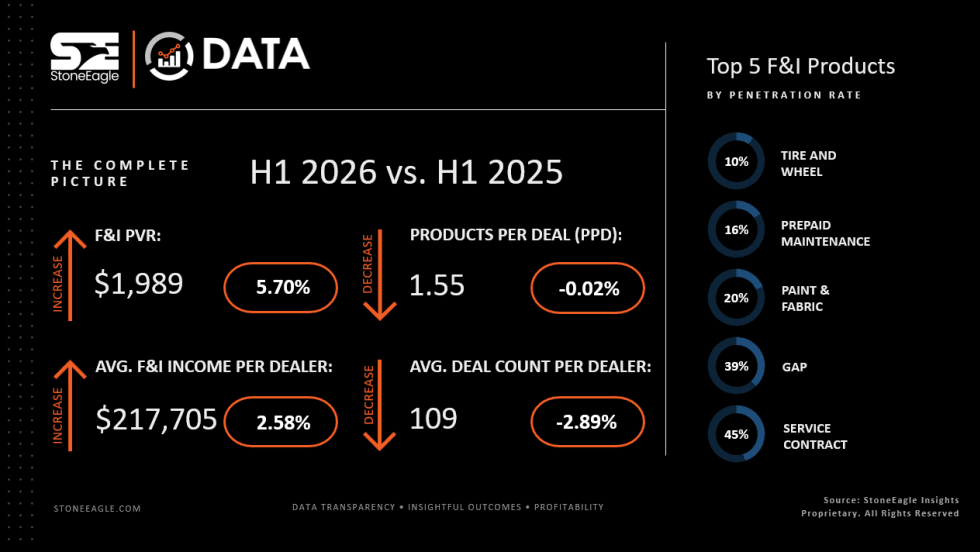
F&I Sales Give Dealers First-Half Lift
Product business shored up total profits to avoid an overall revenue tanking as product penetrations held steady, StoneEagle reported.
Read More →
Targeted Training Drives Results
Today’s technology, instead of threatening F&I managers, can actually make them better, according to an industry veteran who’s watched market setbacks roil the unprepared.
Read More →
Double the Change, Double the Chance
When an F&I manager gets a customer refusal, it’s a wise move to tweak more than one thing in the product offering.
Read More →
Just Do It
F&I managers need training, but instead of resisting application or expecting perfection, they should improve by simply acting on what they learn.
Read More →