



S&P/Experian: Auto Default Rate Registers Largest Increase Since December 2011
Despite the nine-basis-point increase, the auto loan default rate remains near levels recorded one year ago. However, declining auto sales and the normal end-of-year push to make room for newer models may encourage easier credit conditions and raise concerns about future defaults.
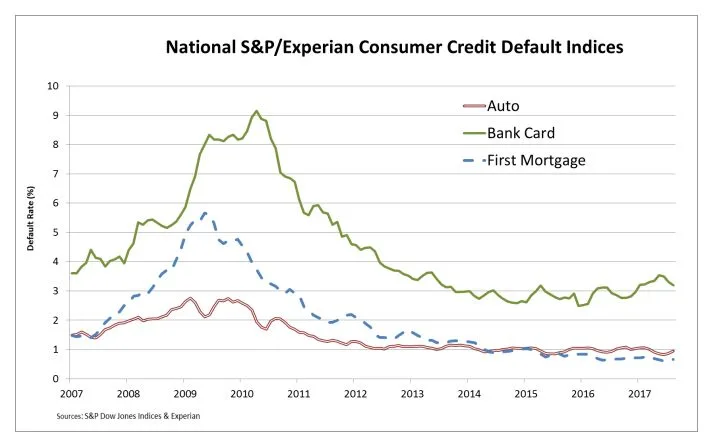
NEW YORK — Auto loan defaults in increased nine basis points from July to August, the largest month-over-month increase since December 2011, according to the S&P/Experian Consumer Credit Default Indices.
Despite the drop, the auto loan default rate remains low relative to historical levels. In fact, the rate is closer to levels recorded one year ago. The same is true for the composite rate for overall consumer defaults and first mortgage defaults, both of which increased three basis points from July.
“Overall, consumer credit defaults show no reason for alarm,” said David M. Blitzer, managing director and chairman of the Index Committee at S&P Dow Jones Indices. “Defaults on first mortgages are flat to down while defaults on auto loans have risen slightly in recent months. Consumer credit defaults on bank cards continue their upward creep since the end of 2015 despite a recent drop. The combination of an improving labor market, low inflation, and low interest rates are the principal factors behind currently favorable consumer credit conditions.”
The bank card default rate fell 12 basis points from July to 3.19% — the lowest level since December 2016. Bank cards were the only loan type to register a decrease in August.
Out of the five major cities analyzed by S&P/Experian, three registered increases in their default rates in August. New York recorded the largest increase, up 13 basis points from July to 0.95%. Los Angeles reported a rate of 0.66% for August, up three basis points from the previous month. Chicago came in at 0.94%, up four basis points from July.
Dallas reported a decrease of three basis points from the previous month to 0.74%, while Miami’s rate fell 10 basis points from July to 1.13%.
“Some future developments could affect consumer credit defaults: Auto sales have fallen since December 2016 and are down 11%. Declining auto sales and the normal end-of-model year push to make room for new cars may encourage easier credit conditions and raise concerns about future defaults,” Blitzer noted. “Hurricane damage in Houston and across Florida is creating substantial financial stress. The impact on mortgages on damaged or destroyed homes is not yet clear. Job losses and rising spending needs could lead to increased consumer credit defaults in coming months.”
More F&I

AI: Facilitator, Not Fixer, in F&I
The dealerships that thrive in the years ahead will be those that embrace technology while continuing to invest in the people who make customer interactions count.
Read More →
Modern Technology Objection Handling
In this video, Trent White shares how to confidently handle technology-based objections by helping customers understand the value of protection, even with modern vehicle technology.
Read More →
Consistency at Scale: Driving F&I Performance
With 75 rooftops across the Sunshine State, Morgan Auto Group has proven to Floridians that it knows a thing or two about driving performance in a competitive market. But it didn’t start at the top.
Read More →
Gitty Up on GAP
The foundational finance-and-insurance product hasn’t kept up with the latest conditions for auto dealers. Is the time ripe?
Read More →
How AI-Powered Coaching Is Transforming F&I Performance
See how AI-powered coaching can turn F&I customer conversations into actionable insights that support compliance, performance and profitability
Read More →
Sell Value, Build Trust
In this video, Trent White explains why selling on value, not fear, builds lasting customer trust, reduces cancellations, and drives long-term success.
Read More →
F&I Sales Give Dealers First-Half Lift
Product business shored up total profits to avoid an overall revenue tanking as product penetrations held steady, StoneEagle reported.
Read More →
Targeted Training Drives Results
Today’s technology, instead of threatening F&I managers, can actually make them better, according to an industry veteran who’s watched market setbacks roil the unprepared.
Read More →
Double the Change, Double the Chance
When an F&I manager gets a customer refusal, it’s a wise move to tweak more than one thing in the product offering.
Read More →
Just Do It
F&I managers need training, but instead of resisting application or expecting perfection, they should improve by simply acting on what they learn.
Read More →