



Survey Reveals Top Technologies for Meeting CAFE Requirements
Survey reveals technologies automakers will likely tap to get into compliance with proposed CAFE requirements.
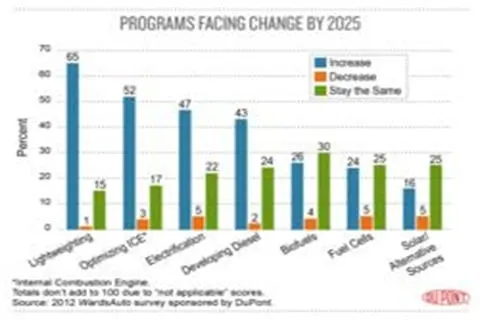
TRAVERSE CITY, Mich. — Automakers are increasing efforts to reduce vehicle weight, optimize internal combustion engines and electrify vehicles to meet proposed Corporate Average Fuel Economy Standards (CAFE), according to results of the 2012 WardsAuto survey sponsored by DuPont. Results were released during the Center for Automotive Research’s management briefing seminar this week.
Nearly 700 subscribers to WardsAuto responded to the survey designed to track the impact of 2025 CAFE changes. If adopted, the new regulations establish milestones on the way to doubling fuel economy and cutting emissions in half, compared to 2010 model year vehicles.
“These aggressive goals require urgent development and adoption of higher efficiency technologies,” said Chris Murphy, DuPont global automotive industry director. “We’re on a steep trajectory to reduce dependence on fossil fuels and reduce CO2 emissions. Getting there requires strong collaboration throughout the globe and across the value chain.”
For its part, DuPont developed a global collaboration network to link industry need to more than 9,500 DuPont scientists and engineers located in more than 150 technical centers around the world. Further, DuPont organized its automotive materials science and global development teams to focus on lightweighting, engine efficiency, bio-based solutions, electrification and alternative drive systems to help the industry develop low-emission, fuel-efficient vehicles without compromising performance, safety, comfort or cost.
“These are not discrete but interconnected solutions,” said DuPont Global Automotive Technology Director David Glasscock, drawing an example from hybrid and electric vehicle traction motors. “Lightweighting, for example, is more than replacing metal components with plastic components. For example, using DuPont Nomex papers and electrical insulation systems enables greater output from smaller traction motors, which require smaller support brackets to fit into a smaller system and deliver weight savings throughout the vehicle. That secondary gain is why today ‘every gram counts.’”
Nearly 30 percent of the respondents said that a breakthrough in combustion engine technology would have the greatest impact on reducing emissions and improving fuel economy. “There is a tremendous effort under way on an array technologies, including turbo systems, direct injection, Homogeneous Charge Compression Ignition (HCCI) systems and valve timing and lift programs to better control air flow,” said DuPont Global Powertrain Segment Director Mike Day. “Many of the technological answers are understood. Uncovering new ways to manufacture efficiently, reduce weight, integrate parts and functions and reduce friction loss in moving parts in these new technologies is best achieved when the value chain comes together at the onset of component and system design.”
Respondents were asked if there is a disconnect between what is driving vehicle development —regulations, cost, consumer preference, affordable technology or fuel prices — and what should be driving development. “This year we saw a dramatic change in alignment,” said Murphy, referring to 2011 results where nearly half the respondents said the government is driving development when it should be the consumer who is driving new-vehicle development. This year’s gap is narrow (see chart).
“High sales of fuel-efficient vehicles help validate that consumers do want greater efficiency and in some cases they are willing to pay more,” said Murphy. “This greater alignment – though not perfect – helps us focus on what matters most – development of affordable vehicles that rely less on fossil fuels that people want to buy.”
More F&I

Modern Technology Objection Handling
In this video, Trent White shares how to confidently handle technology-based objections by helping customers understand the value of protection, even with modern vehicle technology.
Read More →
Consistency at Scale: Driving F&I Performance
With 75 rooftops across the Sunshine State, Morgan Auto Group has proven to Floridians that it knows a thing or two about driving performance in a competitive market. But it didn’t start at the top.
Read More →
Gitty Up on GAP
The foundational finance-and-insurance product hasn’t kept up with the latest conditions for auto dealers. Is the time ripe?
Read More →
How AI-Powered Coaching Is Transforming F&I Performance
See how AI-powered coaching can turn F&I customer conversations into actionable insights that support compliance, performance and profitability
Read More →
Sell Value, Build Trust
In this video, Trent White explains why selling on value, not fear, builds lasting customer trust, reduces cancellations, and drives long-term success.
Read More →
F&I Sales Give Dealers First-Half Lift
Product business shored up total profits to avoid an overall revenue tanking as product penetrations held steady, StoneEagle reported.
Read More →
Targeted Training Drives Results
Today’s technology, instead of threatening F&I managers, can actually make them better, according to an industry veteran who’s watched market setbacks roil the unprepared.
Read More →
Double the Change, Double the Chance
When an F&I manager gets a customer refusal, it’s a wise move to tweak more than one thing in the product offering.
Read More →
Just Do It
F&I managers need training, but instead of resisting application or expecting perfection, they should improve by simply acting on what they learn.
Read More →
Dealer Lender Preferences Revealed
When lenders provide consistent, fast service, their overall satisfaction scores with dealers greatly improve, according to JD Power research.
Read More →