


Toyota, Lexus Continue to Rebound in Perceived Quality
ALG’s Spring 2011 Perceived Quality Study (PQS) showed Toyota’s Perceived Quality Score rose 4 percent over the last six months and Lexus again captured the luxury category’s highest Perceived Quality rating during the reporting period.
SANTA BARBARA, Calif. – ALG’s Spring 2011 Perceived Quality Study (PQS) showed Toyota’s Perceived Quality Score rose 4 percent over the last six months and Lexus again captured the luxury category’s highest Perceived Quality rating during the reporting period. The study also showed that Land Rover, up 2.5 percent, and Kia, up 5.6 percent, experienced the biggest gains in perception among luxury and mainstream brands respectively.
“The continued rebound of Toyota is a testament to the brand’s solid reputation for quality and ownership loyalty. Toyota isn’t out of the woods yet, however, as the company faces the repercussions of another large recall earlier this year,” said Eric Lyman, director for Residual Value Solutions for ALG. “We also see the success of Land Rover being fueled by the growing popularity of its driver-oriented Range Rover Sport and the Evoque, helping the brand slowly notch perception improvements. For Kia, the consumer quality recognition is the payoff for a recent revolution in product quality and design supported by aggressive marketing campaigns.”
ALG surveys approximately 3,000 to 4,000 U.S. consumers twice a year for its PQS to gauge perceptions of a number of luxury and mainstream automotive brands.
Additional highlights from the survey include: in the luxury category, Lexus topped the charts with an overall PQS of 83 (out of 100), followed by Mercedes (82.7 and -1.4 percent compared to the Fall 2010 Study), BMW (80.2; +1.7 percent), Porsche (79.7; - 0.6 percent) and Acura (78.1; +0.9 percent). Honda (81.2; -0.2 percent) once again led the mainstream brands and Toyota (73.5; +4.0 percent) rebounded to finish the year strong. Ford Trucks (71.2; +1.9 percent), Subaru (70.6; +2.5 percent) and Nissan (69.8; +1.2 percent) finished third, fourth and fifth, respectively, in the mainstream category.
The complete list with scores and details is available on ALG’s website.
More F&I

AI: Facilitator, Not Fixer, in F&I
The dealerships that thrive in the years ahead will be those that embrace technology while continuing to invest in the people who make customer interactions count.
Read More →
Modern Technology Objection Handling
In this video, Trent White shares how to confidently handle technology-based objections by helping customers understand the value of protection, even with modern vehicle technology.
Read More →
Consistency at Scale: Driving F&I Performance
With 75 rooftops across the Sunshine State, Morgan Auto Group has proven to Floridians that it knows a thing or two about driving performance in a competitive market. But it didn’t start at the top.
Read More →
Gitty Up on GAP
The foundational finance-and-insurance product hasn’t kept up with the latest conditions for auto dealers. Is the time ripe?
Read More →
How AI-Powered Coaching Is Transforming F&I Performance
See how AI-powered coaching can turn F&I customer conversations into actionable insights that support compliance, performance and profitability
Read More →
Sell Value, Build Trust
In this video, Trent White explains why selling on value, not fear, builds lasting customer trust, reduces cancellations, and drives long-term success.
Read More →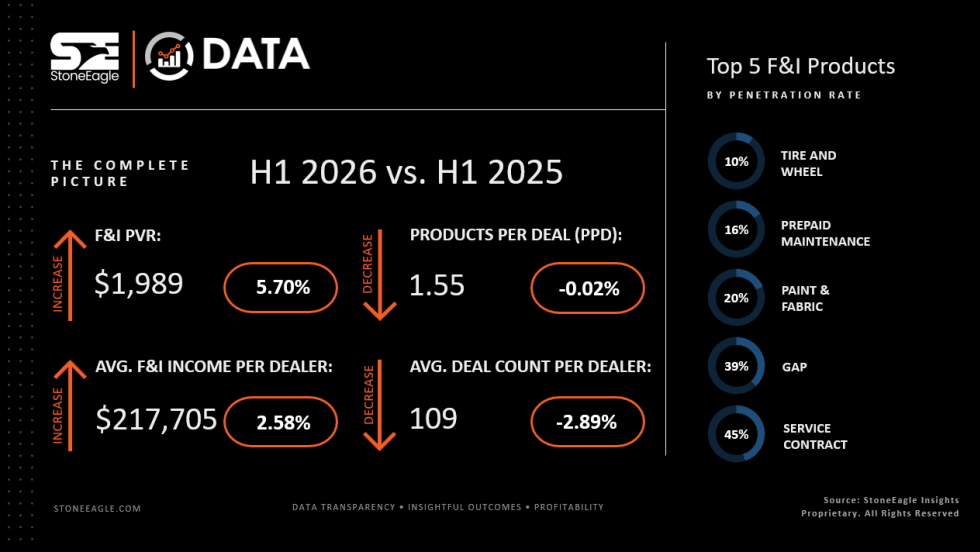
F&I Sales Give Dealers First-Half Lift
Product business shored up total profits to avoid an overall revenue tanking as product penetrations held steady, StoneEagle reported.
Read More →
Targeted Training Drives Results
Today’s technology, instead of threatening F&I managers, can actually make them better, according to an industry veteran who’s watched market setbacks roil the unprepared.
Read More →
Double the Change, Double the Chance
When an F&I manager gets a customer refusal, it’s a wise move to tweak more than one thing in the product offering.
Read More →
Just Do It
F&I managers need training, but instead of resisting application or expecting perfection, they should improve by simply acting on what they learn.
Read More →