



U.S. Auto Manufacturers Increase Incentive Spending in July
Edmunds.com, the online resource for automotive information, estimated that the average automotive manufacturer incentive in the U.S. was $2,611 per vehicle sold in July 2008, up $166 or 6.8 percent, from June 2008, and up $90 or 3.6 percent, from July 2007.
SANTA MONICA, Calif. — Edmunds.com, the online resource for automotive information, estimated that the average automotive manufacturer incentive in the U.S. was $2,611 per vehicle sold in July 2008, up $166, or 6.8 percent, from June 2008, and up $90, or 3.6 percent, from July 2007.
"This month we had the highest level of averaged combined incentives in 2008 for both domestic and Japanese automakers," stated Jesse Toprak, executive director of industry analysis for Edmunds.com. "As domestic automakers start to restrict leasing, we will start to see a decrease in their incentive spending."
According to Edmunds.com, combined incentives spending for domestic manufacturers averaged $3,741 per vehicle sold in July 2008, up from $3,382 in June 2008. From June 2008 to July 2008, European automakers increased incentives spending by $474 to $3,335 per vehicle sold; Japanese automakers increased incentives spending by $5 to $1,394 per vehicle sold; and Korean automakers increased incentives spending by $106 to $2,064 per vehicle sold.
In July 2008, the industry's aggregate incentive spending is estimated to have totaled approximately $3.29 billion, up 6.2 percent from June 2008. Chrysler, Ford and General Motors spent an aggregate of $2.1 billion, or 62.4 percent of the total; Japanese manufacturers spent $734 million, or 22.3 percent; European manufacturers spent $337 million, or 10.2 percent; and Korean manufacturers spent $167 million, or 5.1 percent.
"Beginning this month, we'll see an increase in domestic manufacturers offering zero percent interest incentives." commented Edmunds' AutoObserver.com senior editor Michelle Krebs. "Finance incentives are less expensive for manufacturers and as their financial institutions are getting out of leasing or adjusting their criteria for leasing, automakers will try to lure former lease customers into buying."
Among vehicle segments, large SUVs had the highest average incentives, $6,199 per vehicle sold, followed by large trucks at $5,424. Compact cars had the lowest average incentives per vehicle sold, $1,001, followed by compact SUVs at $1,473. Analysis of incentives expenditures as a percentage of average sticker price for each segment shows large trucks averaged the highest, 16.7 percent, followed by large SUVs at 16.0 percent of sticker price. Sport cars averaged the lowest, 5.5 percent, followed by compact cars at 5.6 percent of sticker price.
Comparing all brands, in July smart spent virtually nothing followed by MINI at $24 per vehicle sold. At the other end of the spectrum, Saab spent the most, $8,326, followed by Cadillac at $7,933 per vehicle sold. Relative to their vehicle prices, Saab and HUMMER spent the most, 23.4 percent and 20.1 percent of sticker price, respectively; while smart spent near zero percent and MINI spent just 0.1 percent.
Edmunds.com's monthly True Cost of Incentives report takes into account all automakers' various U.S. incentives programs, including subvented interest rates and lease programs, as well as cash rebates to consumers and dealers. To ensure the greatest possible accuracy, Edmunds.com bases its calculations on sales volume, including the mix of vehicle makes and models for each month, as well as on the proportion of vehicles for which each type of incentive was used.
More F&I
Plug Your Profit Leaks
By building in clear processes, your dealership can realize more profits in plugged leaks to maximize sales opportunities.
Managing Expectations
Learn how proactive communication, setting clear expectations, and providing solutions when plans change can strengthen customer trust and improve the overall service experience.
The F&I Manager's Report Card
The best managers take the time and attention to measure the behaviors behind the numbers.

AI: Facilitator, Not Fixer, in F&I
The dealerships that thrive in the years ahead will be those that embrace technology while continuing to invest in the people who make customer interactions count.
Modern Technology Objection Handling
In this video, Trent White shares how to confidently handle technology-based objections by helping customers understand the value of protection, even with modern vehicle technology.

Consistency at Scale: Driving F&I Performance
With 75 rooftops across the Sunshine State, Morgan Auto Group has proven to Floridians that it knows a thing or two about driving performance in a competitive market. But it didn’t start at the top.
Gitty Up on GAP
The foundational finance-and-insurance product hasn’t kept up with the latest conditions for auto dealers. Is the time ripe?

How AI-Powered Coaching Is Transforming F&I Performance
See how AI-powered coaching can turn F&I customer conversations into actionable insights that support compliance, performance and profitability

Sell Value, Build Trust
In this video, Trent White explains why selling on value, not fear, builds lasting customer trust, reduces cancellations, and drives long-term success.
F&I Sales Give Dealers First-Half Lift
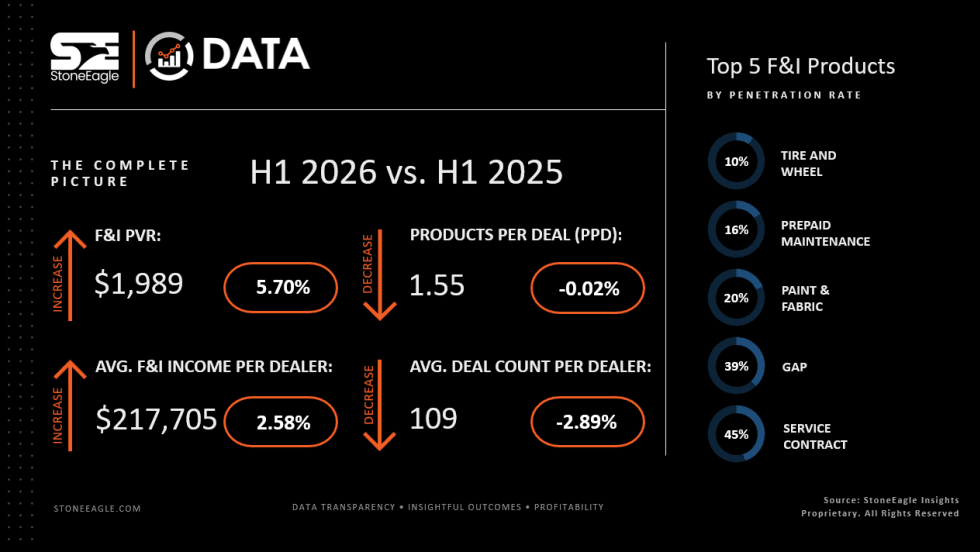
Product business shored up total profits to avoid an overall revenue tanking as product penetrations held steady, StoneEagle reported.