



Values of Late-Model Luxury Vehicles Drop as 2010 Models Enter Auction Lanes
The arrival of 2010 model-year vehicles at auction has put downward pressure on late-model luxury vehicles, according to this month’s Blue Book Market Report from Kelley Blue Book.
IRVINE, Calif. — The arrival of 2010 model-year vehicles at auction has put downward pressure on late-model luxury vehicles, according to this month’s Blue Book Market Report from Kelley Blue Book.
The used-car market was relatively flat for July 2010 with a 0.2 percent overall increase in values. Among depreciating segments, luxury cars and crossovers dropped more aggressively than their non-luxury counterparts, each depreciating 1.5 percent on average. As 2010 model-year luxury vehicles have started to arrive at auction, the value of 2009 and 2008 model-year vehicles have dropped to accommodate the arrival of these newer vehicles in the marketplace.
With continued weakness in the economy, car shoppers are trending toward vehicles that offer great fuel economy at an affordable price. According to Kelley Blue Book Market Intelligence, luxury owners who are not reconsidering their vehicle’s brand are looking toward their car’s non-luxury counterpart. The manufacturers with the highest percentage of owners defecting to their non-luxury parent brand are Acura to Honda and Lincoln to Ford at 23 percent each, as seen on kbb.com. Cadillac owners follow with 19 percent of owners interested in Chevrolet, while 16 percent of Lexus in-market owners are moving toward Toyota.
“While this is common in most segments, this phenomenon is more pronounced this year in the luxury segment due to the luxury buyer’s preference for the latest and greatest model,” said Juan Flores, director of vehicle valuations for Kelley Blue Book. “With fresh luxury vehicles appearing at auctions, demand is skirting away from two- and three-year-old vehicles, putting significant downward pressure on their values.”
Leading the luxury segment’s depreciation in values are the BMW 7 Series (-3 percent), and the Mercedes-Benz CLS-Class (-3 percent), ML-Class (-4.1 percent), R-Class (-3 percent) and GL-Class (-3 percent).
Mercedes Benz depreciation (1.8 percent for the month) has resulted from the aforementioned trend; arrival of 2010s at auction and increased volumes of two- and three-year-old vehicles returning from lease. This has contributed to an increasing supply of vehicles, ultimately lowering transaction prices for Mercedes-Benz products.
It should be noted that although Mercedes-Benz is down significantly for the month, they remain up 3.5 percent year-over-year.
More F&I

AI: Facilitator, Not Fixer, in F&I
The dealerships that thrive in the years ahead will be those that embrace technology while continuing to invest in the people who make customer interactions count.
Read More →
Modern Technology Objection Handling
In this video, Trent White shares how to confidently handle technology-based objections by helping customers understand the value of protection, even with modern vehicle technology.
Read More →
Consistency at Scale: Driving F&I Performance
With 75 rooftops across the Sunshine State, Morgan Auto Group has proven to Floridians that it knows a thing or two about driving performance in a competitive market. But it didn’t start at the top.
Read More →
Gitty Up on GAP
The foundational finance-and-insurance product hasn’t kept up with the latest conditions for auto dealers. Is the time ripe?
Read More →
How AI-Powered Coaching Is Transforming F&I Performance
See how AI-powered coaching can turn F&I customer conversations into actionable insights that support compliance, performance and profitability
Read More →
Sell Value, Build Trust
In this video, Trent White explains why selling on value, not fear, builds lasting customer trust, reduces cancellations, and drives long-term success.
Read More →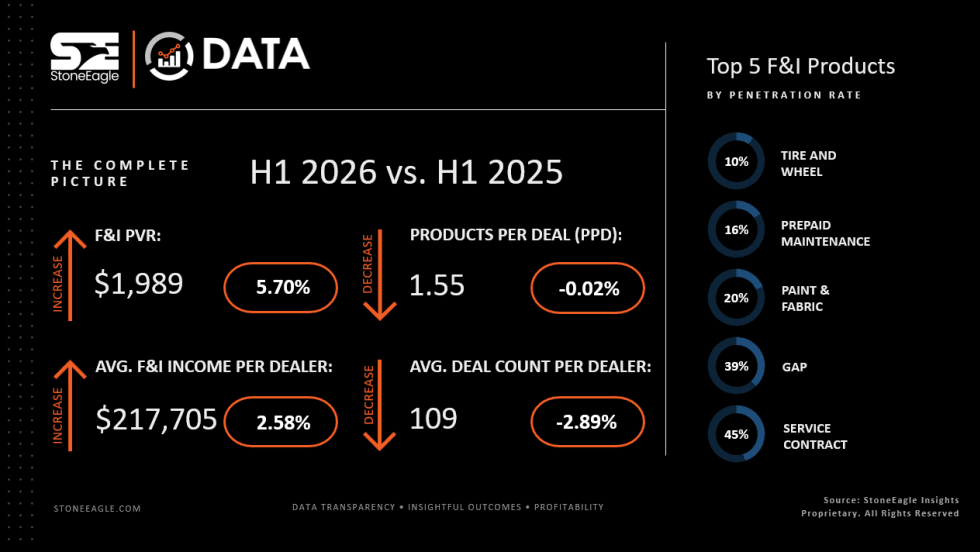
F&I Sales Give Dealers First-Half Lift
Product business shored up total profits to avoid an overall revenue tanking as product penetrations held steady, StoneEagle reported.
Read More →
Targeted Training Drives Results
Today’s technology, instead of threatening F&I managers, can actually make them better, according to an industry veteran who’s watched market setbacks roil the unprepared.
Read More →
Double the Change, Double the Chance
When an F&I manager gets a customer refusal, it’s a wise move to tweak more than one thing in the product offering.
Read More →
Just Do It
F&I managers need training, but instead of resisting application or expecting perfection, they should improve by simply acting on what they learn.
Read More →