



Black Book, Fitch Predict Vehicle Depreciation Will Reach 15% in 2016
In a joint report issued this week, the two firms said increased supply and incentives will drive higher depreciation in 2016. Auto ABS performance will face pressure, but no material concerns, the firms say.
LAWRENCEVILLE, Ga. — Overall vehicle depreciation for two- to six-year-old vehicle should reach 15% this year from last year’s 13.2% level, according to a joint report from Black Book and Fitch Ratings.
The firms’ projection would also mark the first time in the previous five years that annual depreciation crests above 14%. Despite this rate still remaining below average pre-recession levels, Fitch and Black Book believe this increase will be driven by several factors.
Black Book forecasts new-car sales to grow slightly to 17.6 million units in 2016. This level of sales activity, which brings a high volume of trade activity, coupled with a large amount of lease returns, will contribute to the continued increase in depreciation rates.
Fitch expects U.S. prime and subprime auto loan and lease ABS performance to be stable and within historical loss levels, although annualized net losses (ANL) will creep up in conjunction with marginally higher vehicle depreciation in 2016, as predicted by Black Book.
“The strength in last year’s performance was largely driven by truck segments,” the firms noted. “The truck segments as a whole experienced half the depreciation rate of the car segments, with annual depreciation of trucks at 9.2% and cars at 18.2%.”
The variability in depreciation across the segments increased during 2015. Among the trucks, the depreciation ranged from 2% to 23% across the segments, while depreciation rates for the car segments ranged from 14% to 22%.
“Given the spread and volatility across various segments, it becomes important for a lender to have a diversified portfolio,” the firm noted. “Portfolios concentrated in smaller segments experienced the steepest decline in equity. With longer terms and softening used-vehicle values, portfolio equity will experience higher risk as it would take longer for a loan to enter into a positive equity position.”
Pressure on residual performance will trend higher in 2016, according to the firms, due to expectations of elevated new-vehicle sales, and higher fleet and rental volumes entering the secondary market during the year. Despite this, Fitch said it believes auto loan and lease ABS ratings performance will not be impacted by the negative asset performance trends in 2016.
The agency has a positive rating outlook for loan ABS in 2016, with the pace of upgrades expected to continue and be consistent with 2015, albeit at a slightly slower pace. The outlook for auto lease ABS asset performance is stable in 2016 given pressure on residual values, but no impacted is expected on ratings which also have a stable outlook.
“The focus in 2016 will be in the depreciation disparity between car and truck segments, which showed a widening spread toward the end of last year,” said Anil Goyal, senior vice president of automotive valuation and analytics for Black Book. “We expect this spread to remain, however there is growing belief that cars are nearing their floor in terms of depreciation changes.”
Hylton Heard, senior director of Fitch Ratings, added: “All eyes will remain on the health of the economy and state of the wholesale vehicle market this year. Additionally, rising off-lease returns will result in overall higher used vehicle volumes hitting the market and will pressure auto lease residual performance in 2016.”
To download the Black Book-Fitch Vehicle Depreciation Report, click here.
More F&I

Why Your F&I PVR Is Misleading You
Here’s a handy checklist of the numbers to track in 2026 instead.
Read More →
Auto Consumer Anxiety Presents Opportunity
A survey of U.S. drivers found the majority are concerned about finances and the economy, but those fears make many ready to buy vehicle-protection products.
Read More →
Humble and Hungry: 12 Rules for an F&I Life
Dustin Gingerich, with a decade in the F&I business under his belt, shares his thoughts on leadership, building trust with customers, and the importance of learning and innovation.
Read More →
Focus on the Opening
F&I managers must learn as much as possible about their customers, starting before they walk into their offices. The bulk of today’s consumers expect that, and good results will follow.
Read More →
F&I Reaches for the Sky
The increasingly important profit center continued making gains in the first quarter, according to StoneEagle data, ancillary products proving more popular as consumers hold onto their buys longer.
Read More →
Timing the Market Can Hurt Long-Term Program Performance
For dealer-owned reinsurance entities, avoiding volatility entirely can mean falling behind inflation and missing market rebounds that drive long term surplus growth. Missing just a handful of strong market days can materially impact cumulative returns—an important reminder for long horizon trust and investment strategies.
Read More →
The 90/10 Rule
In this video, Ryan Ruff explains the rule that elite sales professionals use to turn ordinary conversations into unforgettable customer experiences.
Read More →
Your Office Is Talking
What’s the atmosphere saying about you to your customers? You can make minor adjustments and additions that transform your space into one that creates trust with the people on the other side of the desk.
Read More →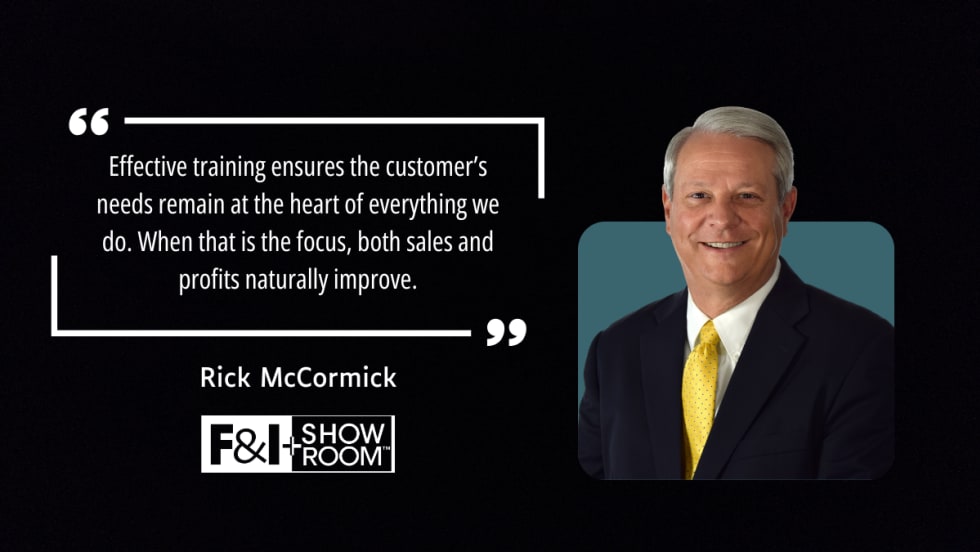
F&I Training Fundamentals
How can auto dealerships help F&I managers fulfill their vital role in the most effective ways? Industry expert Rick McCormick shares his insights on the best ways to train these professionals and help them maintain good habits.
Read More →
Not Just Any Tire Will Do
More consumers and businesses are opting for all-season options for various reasons as safety, sustainability and convenience push practical change.
Read More →