



CFPB Issues Proposal to End Forced Arbitration
At its May 5 field hearing in Albuquerque, N.M., the CFPB issued its proposal to ban mandatory arbitration clauses in finance contracts. Financial services providers will still be able to include arbitration clauses in finance contracts; they just can’t use the agreements to stop consumers from being part of a class action in court.


ALBUQUERQUE, N.M. — As expected, the Consumer Financial Protection Bureau used its 34th field hearing to issue its proposed rule prohibiting mandatory arbitration clauses in finance contracts. Companies will still be able to include such clauses in their contracts under the bureau’s proposal; they just won’t be able to use such agreements to stop consumers from being part of a class action in court.
Issued on May 5, the proposal comes more than a year after the bureau issued its 728-page report on the use of pre-dispute arbitration clauses in consumer finance markets. The study, which reviewed more than 1,800 consumer finance arbitration disputes filed over a three-year period beginning in 2010 and more than 3,400 individual federal lawsuits, found that consumers were awarded less than $175,000 in damages and less than $190,000 in debt forbearance in arbitration suits vs. just less than $1 million in federal lawsuits.
“Today, we are proposing a new regulation for public comment and further consideration. If finalized in its current form, the proposal would ban consumer financial companies from using mandatory pre-dispute arbitration clauses to deny their consumers the right to band together to seek justice and meaningful relief from wrongdoing,” said CFPB Director Richard Cordray at the hearing, held at the Albuquerque Convention Center. “This practice has evolved to the point where it effectively functions as a kind of legal lockout. Companies simply insert these clauses into their contracts for consumer financial products or services and literally, with the stroke of a pen, are able to block any group of consumer from filing joint lawsuits known as class actions.”
Through the Dodd-Frank Wall Street Reform and Consumer Protection Act, Congress asked the CFPB to study the use of mandatory arbitration clauses in consumer financial markets. Congress also gave the bureau the power to issue regulations that are “in the public interest, for the protection of consumers, and consistent with the study.”
Released in March 2015, the CFPB’s study concluded that very few consumers bring individual actions against their financial service provider, either in court or in arbitration. It also showed that at least 160 million class members were eligible for relief over the five-year period studied. Those settlements totaled $2.7 billion in cash, in-kind relief, and attorney’s fees and expenses. In its press release announcing the proposed rule, the bureau said the study’s findings do not account for the “the potential value to consumers of class action settlements requiring companies to change their behavior.”
But not all findings in the study supported the elimination of mandatory arbitration clauses. For instance, the study showed that in many class action cases where the principal purpose of seeking class relief was to pressure a settlement, members of the class action got nothing or next to nothing. It also found that class action cases almost never make it to trial, while a significant percentage of arbitration proceedings actually resolve the disputes. The study also showed that arbitration is both faster and more economical than litigation.
“Late last year, the CFPB released a study on arbitration, which the bureau says shows that consumers are harmed by arbitration agreements as opposed to class action lawsuits. However, a careful review of the CFPB’s study demonstrates that the opposite is true …,” the American Financial Services Association wrote in a news brief issued last Thursday. “In 60% of class actions studied by the CFPB, consumers received no remuneration at all.
“In the 15% of cases where consumers received monetary compensation in class actions, they received an average of just $32.25, after waiting an average of 23 months,” the associated added. “In contrast, consumers who prevailed in arbitration agreements, on average, received $5,389. The real winners in class action lawsuits are plaintiff’s attorneys, who divided approximately $424 million in fees.”
The CFPB said its proposal, which will be open for public comment for the next three months, would open up the legal system to consumers so they can file or join a class action someone else files. And while companies will still be able to include arbitration clauses in their contracts under the proposal, the clauses would have to say explicitly that they cannot be used to stop consumers from being part of a class action in court. The proposal would also provide the specific language companies must use.
Additionally, the bureau’s proposal would require companies with arbitration clauses to submit to the CFPB claims, awards, and certain related materials that are filed in arbitration cases. This would allow the bureau to monitor consumer finance arbitrations to ensure that the arbitration process is fair for consumers. The bureau is also considering publishing information it would collect in some form so the public can monitor the arbitration process as well.
“If arbitration truly offers the benefits that its proponents claim, such as providing a less costly and more efficient means of dispute resolution, then it stands to reason that companies will continue to make it available,” Cordray said at the bureau’s hearing. “So the essence of the proposal issued today is that it would prevent mandatory arbitration clauses from imposing legal lockouts to deny groups of consumers the right to pursue justice and secure meaningful relief from wrongdoing.”
That’s not how the AFSA views the bureau’s proposal. “Despite a wealth of evidence suggesting that the bureau’s interpretation of its own study is flawed, today’s rule, in its present form, would have a negative impact on customers by taking away a valuable tool to resolve disputes,” the associated stated. “AFSA will comment on the proposed rule and will continuing its ongoing dialogue with the CFPB.”
More F&I

Why Your F&I PVR Is Misleading You
Here’s a handy checklist of the numbers to track in 2026 instead.
Read More →
Auto Consumer Anxiety Presents Opportunity
A survey of U.S. drivers found the majority are concerned about finances and the economy, but those fears make many ready to buy vehicle-protection products.
Read More →
Humble and Hungry: 12 Rules for an F&I Life
Dustin Gingerich, with a decade in the F&I business under his belt, shares his thoughts on leadership, building trust with customers, and the importance of learning and innovation.
Read More →
Focus on the Opening
F&I managers must learn as much as possible about their customers, starting before they walk into their offices. The bulk of today’s consumers expect that, and good results will follow.
Read More →
F&I Reaches for the Sky
The increasingly important profit center continued making gains in the first quarter, according to StoneEagle data, ancillary products proving more popular as consumers hold onto their buys longer.
Read More →
Timing the Market Can Hurt Long-Term Program Performance
For dealer-owned reinsurance entities, avoiding volatility entirely can mean falling behind inflation and missing market rebounds that drive long term surplus growth. Missing just a handful of strong market days can materially impact cumulative returns—an important reminder for long horizon trust and investment strategies.
Read More →
The 90/10 Rule
In this video, Ryan Ruff explains the rule that elite sales professionals use to turn ordinary conversations into unforgettable customer experiences.
Read More →
Your Office Is Talking
What’s the atmosphere saying about you to your customers? You can make minor adjustments and additions that transform your space into one that creates trust with the people on the other side of the desk.
Read More →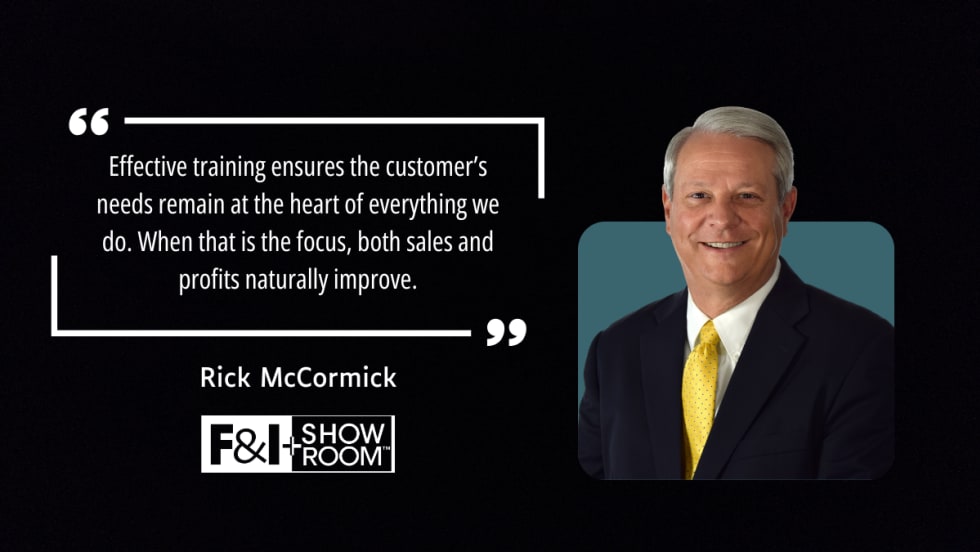
F&I Training Fundamentals
How can auto dealerships help F&I managers fulfill their vital role in the most effective ways? Industry expert Rick McCormick shares his insights on the best ways to train these professionals and help them maintain good habits.
Read More →
Not Just Any Tire Will Do
More consumers and businesses are opting for all-season options for various reasons as safety, sustainability and convenience push practical change.
Read More →