



AFSA Panel Bursts Subprime Bubble
Representatives from the three major credit bureaus opened the 21st annual Vehicle Finance Conference and Exposition by confirming that there is no forming subprime bubble. They explained why and how millennials are contributing to a healthy auto finance market.

NEW ORLEANS — A panel of experts representing the three major credit bureaus and an auto finance company convened today for “Fiction vs. Reality: Examining the Subprime Auto Market,” a discussion that set off the American Financial Services Associations (AFSA)’s 21st annual Vehicle Finance Conference and Exposition.
Held this year at the Sheraton New Orleans, the AFSA event is an annual precursor to the National Automobile Dealers Association (NADA)’s conference, which kicks off this Thursday, Jan. 26, at the nearby Ernest N. Morial Convention Center.
Moderator Danielle Fagre Arlowe, AFSA’s senior vice president, was joined by Denise Brown, chief risk officer for Veritas Auto Finance and chair of AFSA’s Vehicle Credit Risk Committee; Amy Crews Cutts, senior vice president and chief economist at Equifax Automotive Services; Jason Laky, senior vice president and auto business lead for TransUnion; and Melissa Zabritski, senior director of Experian and an F&I and Showroom contributor.
Fagre Arlowe began the discussion by asking what the word “subprime” means to the panelists and whether a subprime auto finance bubble exists. The consensus answer was a credit score of about 600 or below, although Zabritski noted that the majority of delinquencies are found in the sub-500 group.
Responding to the question of whether a subprime bubble exists and, if so, whether it poses a threat to our nation’s economic health, the panelists answered firmly in the negative.
“I definitely do not believe there’s a bubble. There’s no asset-flipping,” Crews Cutts said, explaining that, unlike homes, there is little chance a customer is buying the car for anything but personal use.
Laky concurred, saying that, even if half of all auto loans defaulted, lenders would be able to recover most of that inventory. Zabritski blamed the appearance of a bubble on several factors, including the “massive trough” that appeared when the lending market dried up in 2009, when the Great Recession was in full swing. In fact, despite impressive year-over-year gains, Zabritski said, originations have yet to outpace 2008 levels.
Fagre Arlowe asked the group how lender policies and portfolios have changed over the past decade. Laky said lenders’ newfound ability to understand the “credit health” of consumers, thanks mostly to reams of new data, has led to more accurate behavior prediction models.
Brown agreed, pointing to the helpfulness of “alternate” data — information not found in credit reports — in making lending decisions. She cited examples such as the use of GPS monitors on deep-subprime deals, identity-verification products offered by the credit bureaus, and even Google Earth, which analysts can use to quickly verify an address is an actual home.
“When you can find the car and repossess it, that means lenders can open the doors a little wider,” Crews Cutts said.
Asked to identify behaviors common to every credit tier, Zabritski noted that demand for small cars has fallen behind crossover SUVs and pickup trucks, and there is more demand for leasing across the board. But prime credit customers have gravitated toward leasing in particularly high numbers, making the finance market appear “more subprime than it was.”
The conversation then turned to millennial buyers and their impact on the auto finance market. Zabritski said she has observed a generational shift away from high levels of credit-card debt, meaning that, for many younger consumers, their car loan is their first major outstanding balance.
“Millennials didn’t fall out of the sky,” Crews Cutts said, noting that the highest age in that bracket is 35, and observable behaviors between the high end of millennials and the low end of Generation X are negligible.
Laky agreed, saying, “Millennials are not that different in behavior, but we are seeing a delay in their behaviors.” That group may be more interested in car-sharing and ride-hailing services, he said, but only for as long as they live in a dense urban area. Once they have relocated to a suburban or rural area, “even if you use ride-share, you need a car or two in your garage.”
“One thing to not lose sight of is all the new-car sales those are spurring,” Zabritski said. “Quite a few of those folks are buying a car to become an Uber or Lyft driver.”
More F&I

Why Your F&I PVR Is Misleading You
Here’s a handy checklist of the numbers to track in 2026 instead.
Read More →
Auto Consumer Anxiety Presents Opportunity
A survey of U.S. drivers found the majority are concerned about finances and the economy, but those fears make many ready to buy vehicle-protection products.
Read More →
Humble and Hungry: 12 Rules for an F&I Life
Dustin Gingerich, with a decade in the F&I business under his belt, shares his thoughts on leadership, building trust with customers, and the importance of learning and innovation.
Read More →
Focus on the Opening
F&I managers must learn as much as possible about their customers, starting before they walk into their offices. The bulk of today’s consumers expect that, and good results will follow.
Read More →
F&I Reaches for the Sky
The increasingly important profit center continued making gains in the first quarter, according to StoneEagle data, ancillary products proving more popular as consumers hold onto their buys longer.
Read More →
Timing the Market Can Hurt Long-Term Program Performance
For dealer-owned reinsurance entities, avoiding volatility entirely can mean falling behind inflation and missing market rebounds that drive long term surplus growth. Missing just a handful of strong market days can materially impact cumulative returns—an important reminder for long horizon trust and investment strategies.
Read More →
The 90/10 Rule
In this video, Ryan Ruff explains the rule that elite sales professionals use to turn ordinary conversations into unforgettable customer experiences.
Read More →
Your Office Is Talking
What’s the atmosphere saying about you to your customers? You can make minor adjustments and additions that transform your space into one that creates trust with the people on the other side of the desk.
Read More →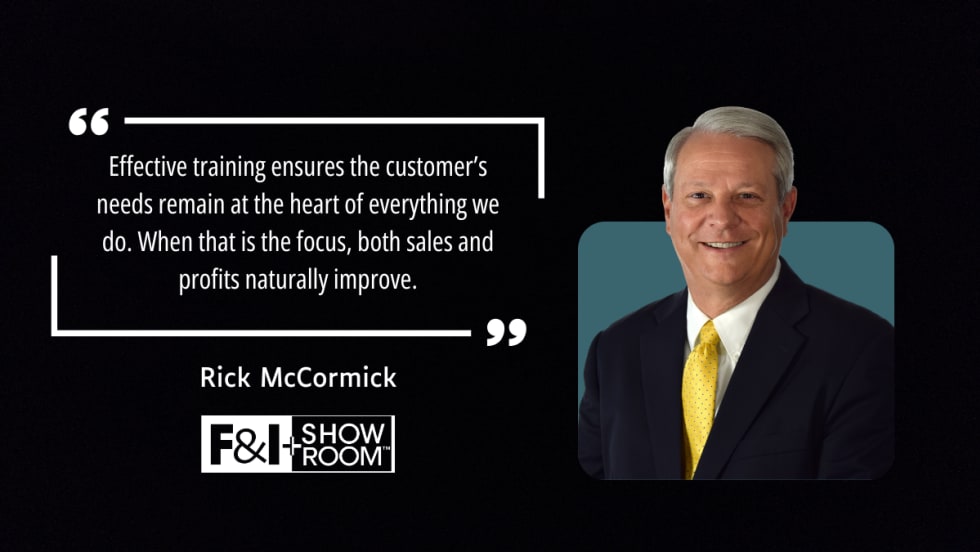
F&I Training Fundamentals
How can auto dealerships help F&I managers fulfill their vital role in the most effective ways? Industry expert Rick McCormick shares his insights on the best ways to train these professionals and help them maintain good habits.
Read More →
Not Just Any Tire Will Do
More consumers and businesses are opting for all-season options for various reasons as safety, sustainability and convenience push practical change.
Read More →