



Edmunds: Stage Set for Market Contraction
June’s annual percentage rate of 5.82% marked a 17% increase since January 2018. Add rising rates to a virtually saturated U.S. market, record-high vehicle prices, and historically high numbers of people who owe more than their cars are worth, and the stage is set for a market contraction, the firm said.

SANTA MONICA, Calif. — A week after saying a strong economy is likely masking market factors bubbling just below the service that could start to slow down sales, Edmunds reported on Tuesday that auto loan interest rates in June likely reached their highest level since 2009.
The annual percentage rate on new financed vehicle averaged 5.82% in June, up from 4.96% in June 2017 and 4.10 in June 2013. The firm’s analysts point to the most recent rate hike by the Federal Reserve as a contributing factor, noting that June marks a 17% total increase since January 2018, when APRs averaged just below 5%.
“Auto loan interest rates have been steadily on the rise this year and we don't see them going down anytime soon, which could mean trouble for automaker sales through the end of the year,” said Jeremy Acevedo, Edmunds' manager of industry analysis. "While some shoppers may take this as a cue to purchase new vehicles now while rates are still somewhat favorable, we're getting dangerously close to a tipping point. Shoppers with average or subprime credit may end up putting off purchases as financing vehicles get increasingly more expensive."
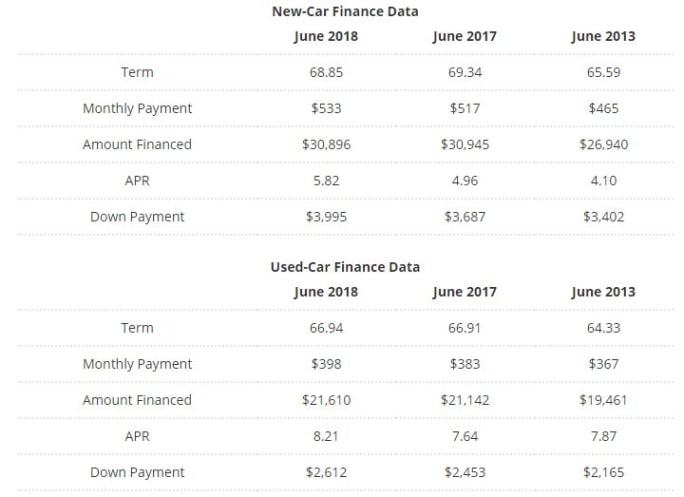
The firm noted that zero percent interest loans reached their lowest level in nine years in June, accounting for just 5.6% of total finance deals, compared to 9.47% in June 2017 and 10.55% in June 2013.
Edmunds revealed another problem in its midyear automotive trend report, which was released last week. It noted that the number of buyers who owe more than their vehicle is worth remains high, with 14.1% of buyers owing more than their car was worth. That’s down from 14.2% in 2017 and 14.6% in 2015 — the latter being a 14-year high.
"June typically boasts a substantial amount of zero percent financing offers, so this is a big red flag," added Acevedo. "This might be a sign that access to cheap and easy credit — a post-recession hallmark that we've all grown so accustomed to — could be officially over. But there's hope yet — the true indicator will be whether zero percent deals materialize through the rest of the summer selling season, which automakers typically rely on to clear outgoing model-year inventory."
Edmunds put June sales at 1.52 million new cars and trucks and the month’s seasonally adjusted annual rate at 17.1 million, reflecting a 4.1% decline in sales from May but a 3.4% increase from June 2017. Through May, 2018 sales were up 1.1% compared to the same period in 2017. However, the firm noted that the month-to-month fluctuations are enough to give the industry pause.
As for retail sales, Edmunds put June’s retail SAAR at 13.9 million units, with fleet transactions accounting for 18.4% of total sales. Additionally, 3.2 million used vehicles were expected to be sold in June, for a SAAR of 39.2 million. That down from 3.3 million used sales in May, which had a SAAR of 39.3 million.
The firm also noted that millennial new-vehicle purchases hit a record high through May, with 21% of millennial car purchase being new.
"The strength of the economy is creating a very thick force field for automakers now, but once that starts to weaken, there are a lot of market factors bubbling just below the surface that could really start to slow down sales," said Jeremy Acevedo, manager of industry analysis at Edmunds. "Even though millennials are finally starting to buy new vehicles, the U.S. market is virtually saturated. Add to that record-high vehicle prices, rising interest rates and historically high numbers of people who owe more than their cars are worth, and the stage is set for a market contraction."
More F&I

Why Your F&I PVR Is Misleading You
Here’s a handy checklist of the numbers to track in 2026 instead.
Read More →
Auto Consumer Anxiety Presents Opportunity
A survey of U.S. drivers found the majority are concerned about finances and the economy, but those fears make many ready to buy vehicle-protection products.
Read More →
Humble and Hungry: 12 Rules for an F&I Life
Dustin Gingerich, with a decade in the F&I business under his belt, shares his thoughts on leadership, building trust with customers, and the importance of learning and innovation.
Read More →
Focus on the Opening
F&I managers must learn as much as possible about their customers, starting before they walk into their offices. The bulk of today’s consumers expect that, and good results will follow.
Read More →
F&I Reaches for the Sky
The increasingly important profit center continued making gains in the first quarter, according to StoneEagle data, ancillary products proving more popular as consumers hold onto their buys longer.
Read More →
Timing the Market Can Hurt Long-Term Program Performance
For dealer-owned reinsurance entities, avoiding volatility entirely can mean falling behind inflation and missing market rebounds that drive long term surplus growth. Missing just a handful of strong market days can materially impact cumulative returns—an important reminder for long horizon trust and investment strategies.
Read More →
The 90/10 Rule
In this video, Ryan Ruff explains the rule that elite sales professionals use to turn ordinary conversations into unforgettable customer experiences.
Read More →
Your Office Is Talking
What’s the atmosphere saying about you to your customers? You can make minor adjustments and additions that transform your space into one that creates trust with the people on the other side of the desk.
Read More →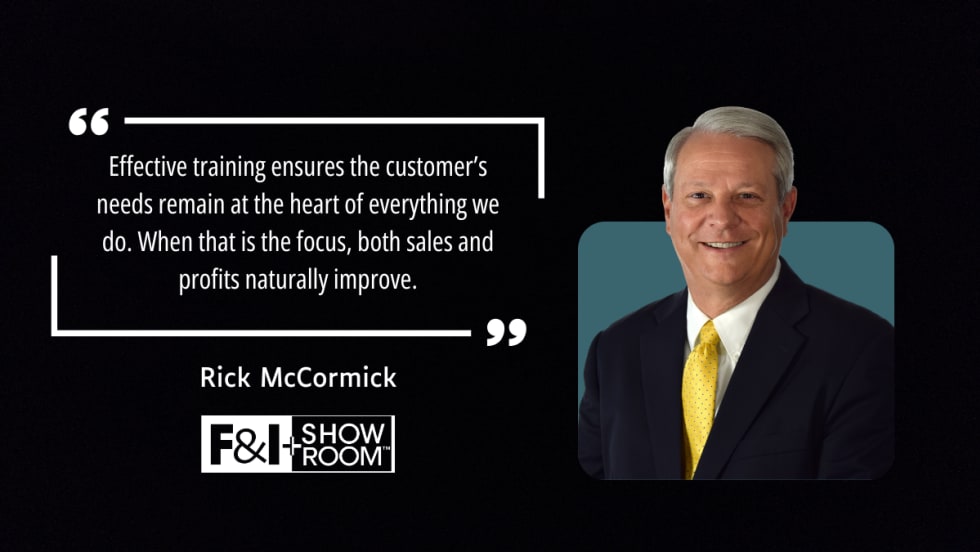
F&I Training Fundamentals
How can auto dealerships help F&I managers fulfill their vital role in the most effective ways? Industry expert Rick McCormick shares his insights on the best ways to train these professionals and help them maintain good habits.
Read More →
Not Just Any Tire Will Do
More consumers and businesses are opting for all-season options for various reasons as safety, sustainability and convenience push practical change.
Read More →