



Experian: Finance Amounts, Monthly Payments Reach New Highs in Q2
Affordability remains a concern despite finance sources continuing to tighten underwriting standards, according to the firm. Consumers, however, seem unfazed, with outstanding balances climbing to a new record high.


SCHAUMBURG, Ill. — Tighter underwriting standards on the part of finance sources drove improvements in auto loan delinquency rates in the second quarter, but affordability remains a key concern, according to Experian Automotive.
According to the firm, 30-day delinquencies dropped to 2.11% of outstanding balances from 2.2% in the prior-year period, while the 60-day delinquency rate dropped to 0.64% of outstanding balances from 0.67% over the same time period. However, the industry saw average finance amounts and monthly payments reach new highs during the period.
“As we monitor the health of the automotive market, delinquencies are one of the most telling metrics. If this downward trend continues, it can be an encouraging sign,” said Melinda Zabritski, Experian’s senior director of automotive financial solutions. “Moving forward, lenders will want to keep a close eye on car buyers’ payment performance.”
Average finance amounts continued to rise across the spectrum during the second quarter, with the average new-vehicle finance amount jumping more than $700 from the prior-year period to $30,958. As for used, the average jumped $520 from the prior-year period to $19,708. At the same time, the average monthly payment for a new-vehicle purchase increased $20 over the same period to a record $525, while the average payment for used increased by $13 to a record $378.
Experian also noted that 72 months remains the most common loan term for both new and used financing,
Also growing was the gap between new and used financing amounts, which widened by $147 in the second quarter. “For some consumers, that gap can mean the difference between buying a new or used vehicle,” the firm noted in its report.
Still, with outstanding loan balances increasing from $1.027 trillion in the prior-year period to a record $1.149 trillion, consumers seemed somewhat unfazed by the rise in loan amounts and monthly payments. However, the average interest rate for new and used increased 56 and 38 basis points to 5.76% and 9.40%, respectively.
The report also shows that consumers are increasingly looking to credit unions to secure vehicle financing; the segment realizing double-digit growth in new-vehicle financing (12.9%) and strong growth overall (4.9%). Credit unions also closed the quarter with a 21.3% share of the market in the second quarter. The only other lender type to experience growth was the captive finance segment, which grew 1.2 percent during the same time period.
Market share for banks dropped to 31.6% from 32.3% in the second quarter of 2017.
Additionally, the high-risk tiers continued to feel the impact of tightening credit standards, with the percentage of both subprime and deep subprime falling below 19% of loan balances. On its own, deep subprime hit an all-time low of 3.54%, compared with 3.98% in the prior-year quarter. The pullback from the high-risk tiers caused average credit scores for new and used financing to rise from 714 and 652 in the year-ago period to 715 and 655, respectively.
“Having access to quality credit is something every consumer deserves, regardless of the type of financing used. As the cost of vehicles rises, lenders need to make sure they’re leveraging all available data so they can offer comprehensive financing options to all consumers,” Zabritski said. “Consumers can also take steps to make sure they’re financially ready when looking to buy a car. We’re seeing the positive trend of on-time payments, which is just one step toward improving credit scores.”
More F&I

Why Your F&I PVR Is Misleading You
Here’s a handy checklist of the numbers to track in 2026 instead.
Read More →
Auto Consumer Anxiety Presents Opportunity
A survey of U.S. drivers found the majority are concerned about finances and the economy, but those fears make many ready to buy vehicle-protection products.
Read More →
Humble and Hungry: 12 Rules for an F&I Life
Dustin Gingerich, with a decade in the F&I business under his belt, shares his thoughts on leadership, building trust with customers, and the importance of learning and innovation.
Read More →
Focus on the Opening
F&I managers must learn as much as possible about their customers, starting before they walk into their offices. The bulk of today’s consumers expect that, and good results will follow.
Read More →
F&I Reaches for the Sky
The increasingly important profit center continued making gains in the first quarter, according to StoneEagle data, ancillary products proving more popular as consumers hold onto their buys longer.
Read More →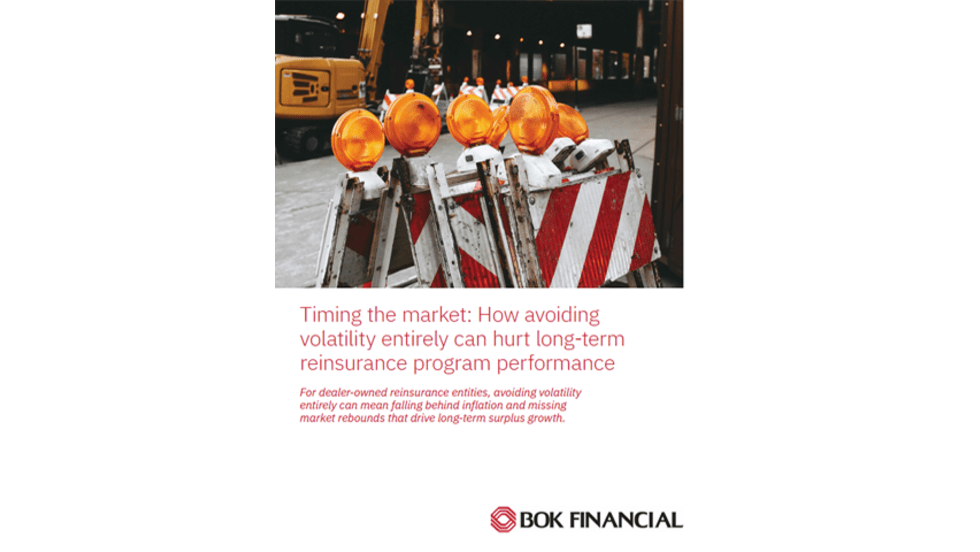
Timing the Market Can Hurt Long-Term Program Performance
For dealer-owned reinsurance entities, avoiding volatility entirely can mean falling behind inflation and missing market rebounds that drive long term surplus growth. Missing just a handful of strong market days can materially impact cumulative returns—an important reminder for long horizon trust and investment strategies.
Read More →
The 90/10 Rule
In this video, Ryan Ruff explains the rule that elite sales professionals use to turn ordinary conversations into unforgettable customer experiences.
Read More →
Your Office Is Talking
What’s the atmosphere saying about you to your customers? You can make minor adjustments and additions that transform your space into one that creates trust with the people on the other side of the desk.
Read More →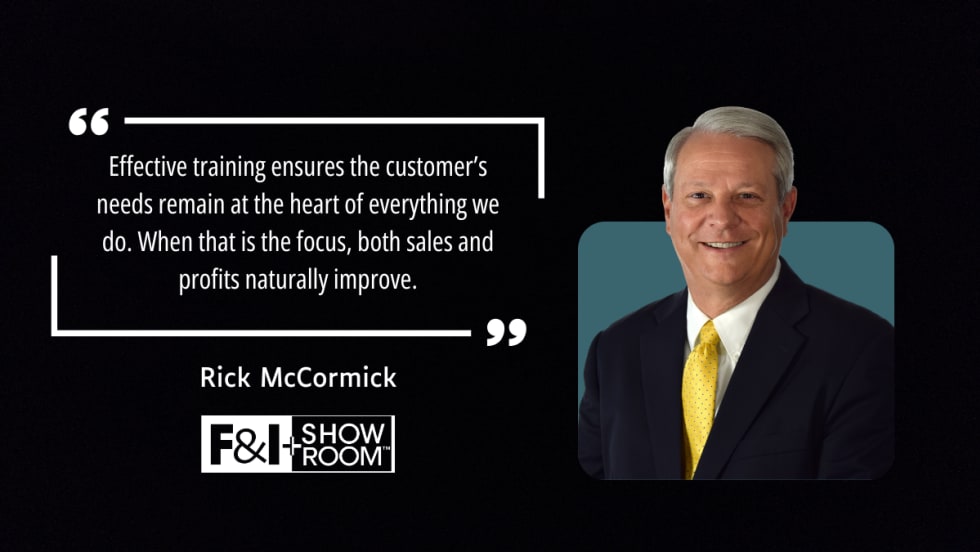
F&I Training Fundamentals
How can auto dealerships help F&I managers fulfill their vital role in the most effective ways? Industry expert Rick McCormick shares his insights on the best ways to train these professionals and help them maintain good habits.
Read More →
Not Just Any Tire Will Do
More consumers and businesses are opting for all-season options for various reasons as safety, sustainability and convenience push practical change.
Read More →