



Gilchrist: USMCA a Win for Dealers, Industry
NADA Chairman Charlie Gilchrist voiced his support for the United States-Mexico-Canada Agreement in remarks at a press event. The Texas dealer urged Congress not to ignore the ‘reality’ of an auto industry built on favorable relationships among the three nations.

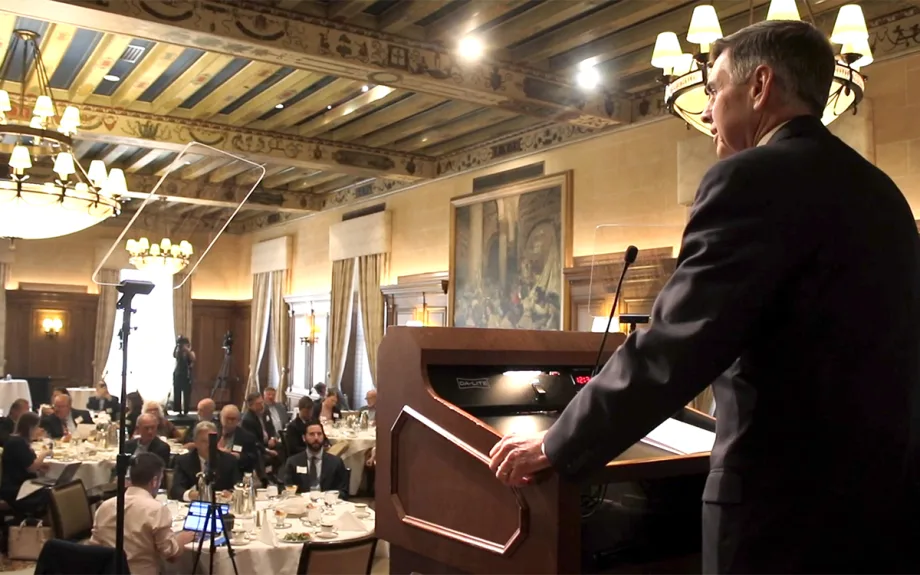
Texas dealer and NADA Chairman Charlie Gilchrist described the United States-Mexico-Canada trade agreement as a victory for manufacturers, retailers, and consumers.
DETROIT — National Automobile Dealers Association 2019 Chairman Charlie Gilchrist announced the organization’s support for the United States-Mexico-Canada Agreement at the Automotive Press Association luncheon in Detroit Tuesday.
“Congress should pass USMCA to preserve competition in the auto industry, and to enable dealers to continue providing affordable vehicles to millions of Americans without interruption — and they should do so expeditiously,” said Gilchrist, who represents new-car dealers in Northern Texas on NADA’s board.
Read: NADA Mounts Opposition to Enhanced Safeguards Rule
In urging passage of USMCA, Gilchrist underscored the global nature of auto manufacturing and the integrated supply chains that have arisen from favorable trading relationships between the U.S. and its partners in international trade.
“We cannot escape, nor should we try to undo, the reality that the U.S. auto industry is built on a favorable trading relationship with our two biggest trading partners.”
“NAFTA has greatly enhanced the global competitiveness of the U.S. auto industry, and this edge in competitiveness has allowed dealers to offer our customers more choices at better prices,” Gilchrist said. “We cannot escape, nor should we try to undo, the reality that the U.S. auto industry is built on a favorable trading relationship with our two biggest trading partners — Canada and Mexico.”
If the USMCA is implemented, he added, it will solidify a favorable trading relationship with Canada and Mexico and ensure the continuation of tariff-free exchanges of vehicles and auto parts across North America, the largest source of vehicles sold by U.S. dealers.
Gilchrist praised the Trump administration for the framework it has negotiated with Canada and Mexico.
“The U.S.-Mexico-Canada Agreement that the President has negotiated will maintain auto production and distribution in North America. It will preserve the global competitiveness of the U.S. automotive industry. And it will enable dealers to continue providing affordable vehicle options for American consumers,” Gilchrist said.
And he stressed that approval of USMCA will also reduce the threat of any future tariffs on vehicles and parts by exempting two of the largest sources of vehicle and parts sold by franchised dealers in the U.S.
“We need to take advantage of the USMCA agreement. The USMCA is [a] win for us. Let’s make it happen.”
Read: Technology, Tariffs, and Technicians: Charlie Gilchrist to Lead NADA Through New Challenges
Originally posted on Auto Dealer Today
More Auto Finance

Interest Rates Further Squeeze Auto Consumers
Last month’s hike and a potential second increase this month add to a growing list of inflation woes that could continue to dent overall car sales.
Read More →
Mind Your Process
Consistent steps taken in various aspects of the F&I office can make valuable differences over time, similar to an outline for a best-selling book.
Read More →
Top Five Credit Application Fraud Flags
Compliance audits regularly reveal bad habits that can lead to fraud charges and should have been stamped out decades ago.
Read More →
More Auto Loans for the Taking in August
Riskier categories were on the uptick for the month as lenders loosened access in several areas while balancing out the exposure in another, Cox Automotive reported.
Read More →
July Was Hot for Auto Borrowers
Credit proved readily available for many, but most loans left buyers in negative territory, Cox Automotive said.
Read More →
Dealer Lender Preferences Revealed
When lenders provide consistent, fast service, their overall satisfaction scores with dealers greatly improve, according to JD Power research.
Read More →
Auto Refi Savings Surge
Consumers with 84-month auto loan terms who refinanced saved the most on monthly payments, according to a new report by auto refinancing provider Caribou.
Read More →
Subaru Enters Lending Business
The automaker follows other brands in adding captive financing in the U.S., and says the move will strengthen its position here.
Read More →
Positive Equity Reaches Record High
Mainstream vehicle owners who bought a car seven years ago are likely to have positive equity when trading in for a new vehicle, according to second-quarter Edmunds data.
Read More →
Dealerships Are Paying the Price for Extended Car Loans
Growing negative-equity scenarios mean such lengthy terms should be addressed in a forward-looking way to make them work for the dealer and the consumer down the road.
Read More →