



Reinsurance Check Up: What Are You Really Paying For?
Dealers need to protect themselves by understanding their statements, what they are paying out, and the services they are receiving.

Dealers need to protect themselves by understanding their statements, what they are paying out, and the services they are receiving.
IMAGE: Getty Images
Reinsurance and wealth management are complicated subject matter. As a dealer, your concerns are focused on whether your F&I products are aligned and tailored to your reinsurance goals. All decisions you make on F&I products impact the health and vitality of your reinsurance program. It may seriously be time for you to do a reinsurance checkup to affirm whether you are maximizing your profits and building your wealth.
The benefits of reinsurance programs are clear, they are intended to drive wealth by allowing dealers to keep a greater share of the profits generated from the F&I products they sell. Reinsurance helps dealers increase profits, however, not all platforms are the same, and they are certainly not all created equally. The reinsurance industry has come a long way and is now well regulated.
Different Plans to Consider
Each dealer needs to find the right structure and needs to sell the right products for their customers, while also being profitable. Dealers’ financial partners need to understand the goals and objectives, and ensure that they are measuring up to existing reinsurance decisions. An essential component of wealth management is having good financial partners who understand the ins and outs, and can also guide the program to its highest returns, but it’s often what’s missing.
Retrocession (“retro”) is the reinsurance platform that transfers the risks it has reinsured to another reinsurer. There is profit participation, but there is no opportunity for investment income. With retro you don’t incur any losses, but you only benefit if losses are under 100%. You participate in what’s left over after claims are paid. The pros here are that you participate in the profits, and you don’t accrue any losses. A con is that as a dealer you have no decisions on the claims being paid, other than what the administrator states. For smaller dealerships that are not ideal for reinsurance, but do qualify for a retro program, it’s a good option for service contracts. However, if they don’t hit the minimum annual qualifier, they get nothing. Dealers tend to use retro programs if they are risk adverse.
Dealer Reinsurance (“reinsurance”) allows you to share in the underwriting profits on the F&I products that you sell. It is a specialized financial product that is your own business. Diligence is required with a reinsurance platform because administration fees vary per service contract, and you need to have an understanding of these. You also need to be aware of the level of service you are getting for the fees charged to be assured that they are equitable.
With OEM factory contracts, a dealer is likely comfortable using a factory branded product, but there is no service loyalty attached to it. This does nothing to drive customer retention, so you are not guaranteed to see this customer back. This essentially surrenders your customers over to the OEM and does nothing to further your reputation or create a customer for life.
Tips for Reinsurance Success
Some admins will tell you to put all your products in reinsurance, but with certain high lines, it just doesn’t make sense. Not everything belongs in reinsurance. Do direct deals instead of putting these make and models into reinsurance.
Fees that you should be prepared to understand are admin fees, seeding fees, premium tax paid to states, and repair order fees (claims fees). You may even find that some admins charge three separate fees, others charge two or one. Working with experienced F&I agents can reap you benefits including dealer support and admin fee discounts.
Regardless of the type of plan you have, be sure to review the ‘cession’ statements that come out quarterly. These explain the money that has been seeded that quarter, claims that were paid, will advise on the health of your reinsurance company. A good acceptable baseline is typically 60% profit and 40% loss.
Many dealers don’t look at what really transpires with their reinsurance plans due to being overloaded with other issues or unavailable. These statements can be enormous and highly time consuming to review. Therefore, they don’t have the full picture of what they are paying out. Some dealers can use their own brokers, others do not. Many dealers don’t understand that this is an option that is available to them.
Dealers need to protect themselves by understanding their statements, what they are paying out, and the services they are receiving. Brokers, accountants, CFOs, and agents should all be present and accountable for these quarterly reviews.
It’s Time for Your Reinsurance Check Up
Through consultancy, I have seen where admin fees were up to $457 per contract or $99 per vehicle service contract, ceding fees ranging from 0% to 7%, ones where there was a premium tax charged and there are no claim fees. These are all variables that need to be understood and accounted for as part of your reinsurance checkup, to truly understand what you are paying on your admin fees.
Frank Torchia is northeast division manager at Vanguard Dealer Services.
Originally posted on Auto Dealer Today
More F&I

Why Your F&I PVR Is Misleading You
Here’s a handy checklist of the numbers to track in 2026 instead.
Read More →
Auto Consumer Anxiety Presents Opportunity
A survey of U.S. drivers found the majority are concerned about finances and the economy, but those fears make many ready to buy vehicle-protection products.
Read More →
Humble and Hungry: 12 Rules for an F&I Life
Dustin Gingerich, with a decade in the F&I business under his belt, shares his thoughts on leadership, building trust with customers, and the importance of learning and innovation.
Read More →
Focus on the Opening
F&I managers must learn as much as possible about their customers, starting before they walk into their offices. The bulk of today’s consumers expect that, and good results will follow.
Read More →
F&I Reaches for the Sky
The increasingly important profit center continued making gains in the first quarter, according to StoneEagle data, ancillary products proving more popular as consumers hold onto their buys longer.
Read More →
Timing the Market Can Hurt Long-Term Program Performance
For dealer-owned reinsurance entities, avoiding volatility entirely can mean falling behind inflation and missing market rebounds that drive long term surplus growth. Missing just a handful of strong market days can materially impact cumulative returns—an important reminder for long horizon trust and investment strategies.
Read More →
The 90/10 Rule
In this video, Ryan Ruff explains the rule that elite sales professionals use to turn ordinary conversations into unforgettable customer experiences.
Read More →
Your Office Is Talking
What’s the atmosphere saying about you to your customers? You can make minor adjustments and additions that transform your space into one that creates trust with the people on the other side of the desk.
Read More →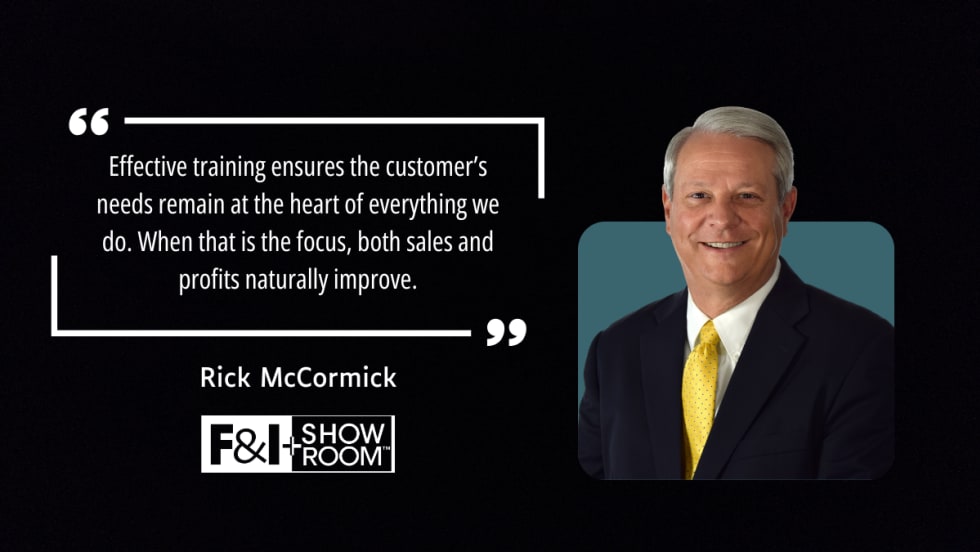
F&I Training Fundamentals
How can auto dealerships help F&I managers fulfill their vital role in the most effective ways? Industry expert Rick McCormick shares his insights on the best ways to train these professionals and help them maintain good habits.
Read More →
Not Just Any Tire Will Do
More consumers and businesses are opting for all-season options for various reasons as safety, sustainability and convenience push practical change.
Read More →