



Better Selling Through Disclosure
F&I expert has a method for turning one of the most awkward parts of the F&I process into a moneymaker.


Photo courtesy of iStock.
Those of you whom I have worked with, or who have attended our training, have heard me say over and over again that we use honesty and full disclosure as a sales strategy. And the more I work with the top performers, the more I realize that this approach is more than just a concept. In fact, it has turned out to be one of the most effective F&I techniques we have ever identified.
First, a little background: Back in the early 1990s, when we were developing the first F&I menus, one of the areas we spent a lot of time on was making sure the menus and processes we developed — and the training we provided for their use — stayed well within state and federal guidelines.
Since there seemed to be a lot of differing opinions from the “experts” on what those guidelines actually were, we went directly to those enforcement agencies for advice and clarification of the rules. We then applied their recommendations to the process we developed.
Because of that, we designed the process to work with a “bare” payment quote from the sales department. Then, to ensure there was no payment packing, we added an additional step: In the first 30 seconds with the customer, the F&I manager makes sure that the terms of the deal are fully disclosed and understood, then immediately verifies that the base payment was properly quoted using the exact “written disclosure” the sales department used to quote the payment.
As you can imagine, this approach was initially met with some resistance from F&I managers. Many of them had been trained in the old-school method of starting the customer with an inflated payment, allowing them to negotiate it down, getting an agreement based on payment and — because the payment was “loaded” — they negotiated away F&I products, not gross profit.
But once we began doing that full disclosure up front, measuring the results and using this approach in dealerships around the country, some very interesting and surprising things started to happen.
Isolating the F&I Function
First, we found that, as the sales process and the presentation of the F&I manager became more honest and upfront, the customers were choosing more products and the F&I departments were making more money. And the increase was significant. Today, we tell F&I professionals to not only begin the F&I process by disclosing the base payment and terms, but to put an emphasis on that disclosure as well.
You see, when a customer is buying a vehicle, they are understandably wary, skeptical and on the defensive. Why wouldn’t they be? What has every media source out there told them is going to happen to them in a car dealership?
Sales professionals have learned how to deal with this natural resistance by developing a rapport with the customer, using a feature-benefit presentation and justifying the price of the vehicle by showing value to the customer.
However, F&I is a completely different process than selling a car. If they stay in that frame of mind during the F&I process, the job is much tougher. What we have learned is that, to allow the F&I process to evoke the positive, security-driven motivators that drive people to buy F&I products, the process must be perceived by the customer as a separate, isolated function from the sale of the vehicle.
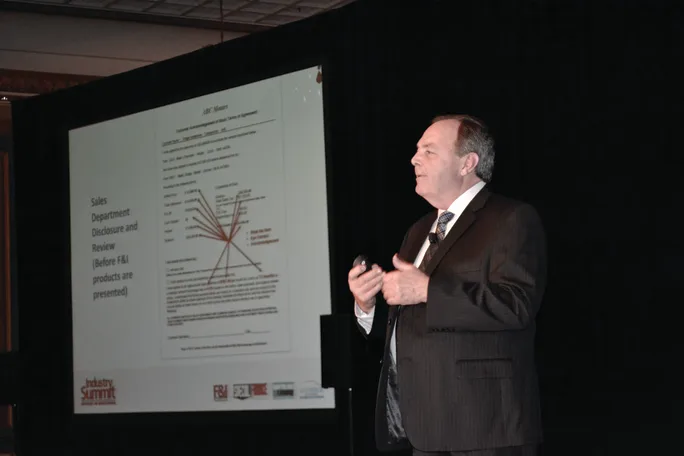
Honesty and full disclosure as a sales strategy was the subject of George Angus’ “Making Compliance Work for You” presentation last September at Industry Summit 2015 in Las Vegas.
Negotiation Mode vs. Receptive Mode
Our process accomplishes this perception through a systematic process and sequence of techniques, the first of which is the disclosure. You see, when the customer starts to view us as someone who is making sure they know what they are paying for the vehicle, are openly and transparently reviewing their options, and has their best interests in mind, they begin to shift from a resistant mindset toward a more receptive and less wary view of the F&I manager and the process.
The result is that the customer doesn’t feel threatened and will take a more open and receptive look at the options we present.
This also leads to a completely different view of the F&I process in the customer’s mind. One of the things dealers comment on when they start using our process is that customers actually compliment them on the F&I process rather than complain about it. And this is certainly reflected on their CSI questionnaires.
Using full disclosure from the get-go has become an integral part of our process because it makes the whole process easier for the F&I manager. It also produces, by far, more income and enhances the customer experience. As an added bonus, you never have to worry about someone saying you weren’t honest or that the proper disclosures weren’t being made. You’ve got it in writing in every deal jacket — not because you have to, but because it’s part of your strategy.
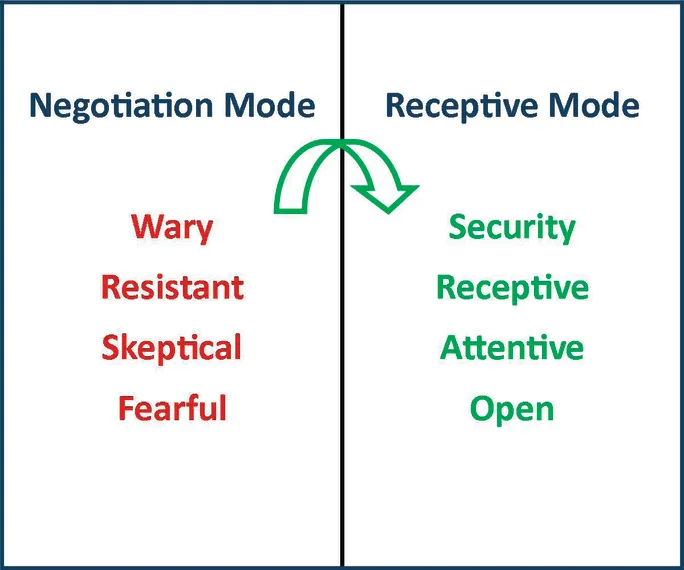
When customers view producers as someone who is making sure they know what they are paying for the vehicle, they become more receptive and less wary of the F&I manager and process.
Credibility Builder
How else can we develop credibility given those preconceived notions? Let’s start with eye contact. Why is this so important? Well, the connection between eye contact and credibility is well-established. Here’s what the authors of a University of Miami study that measured the impact of eye contact on credibility had to say:
“Eye contact enhanced both listener comprehension and speaker credibility. Posture had little effect on either credibility or comprehension, varied or limited vocal inflection had no significant effect and differences in vocal inflection did not affect listener comprehension. The only factor that showed to be significant in establishing credibility was eye contact.”
Obviously, this is an important technique that we want to remember. During your next initial disclosure, ask the customer, “Is that correct?” or “Is that what you agreed to?” While you wait for their answer, make eye contact. What’s important here is that you not only wait for their acknowledgement of each of the elements of the sale, but that you make eye contact with the customer (or each of them, if it’s a couple or a family) as every element is agreed to.
Now, you don’t want to give them some ogling stare that looks weird. Just establish normal eye contact. Practice your technique with a fellow F&I manager, your spouse or someone who is familiar with your natural way of speaking. If they tell you you’re creeping them out, keep practicing.
Incorporating these simple techniques into the first minute of the process produces an amazing difference in how the customers react to the rest of the presentation. Step out of your comfort zone and watch your production soar.
George Angus is the training director for Team One Research and Training, a company specializing in scientific, research-based program development and training. Email him at george.angus@bobit.com.
More F&I

AI: Facilitator, Not Fixer, in F&I
The dealerships that thrive in the years ahead will be those that embrace technology while continuing to invest in the people who make customer interactions count.
Read More →
Modern Technology Objection Handling
In this video, Trent White shares how to confidently handle technology-based objections by helping customers understand the value of protection, even with modern vehicle technology.
Read More →
Consistency at Scale: Driving F&I Performance
With 75 rooftops across the Sunshine State, Morgan Auto Group has proven to Floridians that it knows a thing or two about driving performance in a competitive market. But it didn’t start at the top.
Read More →
Gitty Up on GAP
The foundational finance-and-insurance product hasn’t kept up with the latest conditions for auto dealers. Is the time ripe?
Read More →
How AI-Powered Coaching Is Transforming F&I Performance
See how AI-powered coaching can turn F&I customer conversations into actionable insights that support compliance, performance and profitability
Read More →
Sell Value, Build Trust
In this video, Trent White explains why selling on value, not fear, builds lasting customer trust, reduces cancellations, and drives long-term success.
Read More →
F&I Sales Give Dealers First-Half Lift
Product business shored up total profits to avoid an overall revenue tanking as product penetrations held steady, StoneEagle reported.
Read More →
Targeted Training Drives Results
Today’s technology, instead of threatening F&I managers, can actually make them better, according to an industry veteran who’s watched market setbacks roil the unprepared.
Read More →
Double the Change, Double the Chance
When an F&I manager gets a customer refusal, it’s a wise move to tweak more than one thing in the product offering.
Read More →
Just Do It
F&I managers need training, but instead of resisting application or expecting perfection, they should improve by simply acting on what they learn.
Read More →