



By The Numbers
“Your future success is hidden in your daily activity” is a line widely quoted by pastors, business coaches and self-help gurus. The magazine’s resident F&I pro believes the saying especially applies to the men and women manning the F&I office.

Despite what you may believe, F&I isn’t all about the numbers. It’s about helping customers make great buying decisions. Our numbers merely serve as indicators of how well we are at doing that. However, to really gauge the health of your F&I department, you have to measure more than your department’s average profit per vehicle sold.
There are plenty of historic examples of how using multiple indicators can determine current success and drive future improvements. Take the story of anesthesiologist Virginia Apgar, who developed the first standardized method for evaluating a newborn’s transition to life outside the womb. See, in the 1950s, one in 30 newborn babies died at birth. What was happening was babies who were malformed, too small or just blue and not breathing well were listed a stillborn and left to die.
Appalled by what was happening, Apgar decided to devise a score that could turn an intangible and impressionistic clinic concept into numbers that people could collect and compare. And doctors, being both compassionate and competitive, wanted to make sure they had a good score. So they began giving babies oxygen or warming them up, switched from general anesthesia to spinals or epidurals, and started using prenatal ultrasounds and fetal heart monitors. Today, only one in every 500 babies dies at birth thanks to what is now known as the Apgar score.
Scoring F&I Pros
By using a consistent method for measuring results based on multiple factors, Apgar created positive peer pressure among medical professionals. And that’s what F&I needs. In fact, we can brand our scoring system with the doctor’s last name: the APGAR score. See, I have traveled coast to coast visiting dealerships and working with F&I departments. And in each one, there seem to be five areas that must be evaluated to achieve a customer-focused process that delivers consistent growth in skill levels and income. Let’s review.
“A” for Attitude: The biggest hurdle dealerships must overcome is the overall attitude of each individual employee and how each department views the other. That’s why a sales department and F&I team that work seamlessly together to deliver a better customer experience will have a positive effect on overall profits. Customers like to be around positive people, and they like to buy from individuals who have confidence in what they are selling and who strive to make the buying process as enjoyable as possible.
Bottom line, people don’t want to be sold, but they do love to buy. However, misery does love company, and individuals who have a negative attitude tend to spread their discontent to other team members. That’s why each team member should be required to operate with a positive attitude when working with both internal and external customers. Unless a positive attitude is expected and reinforced, it is almost impossible to see consistent and long-term growth in F&I profits and customer satisfaction levels.
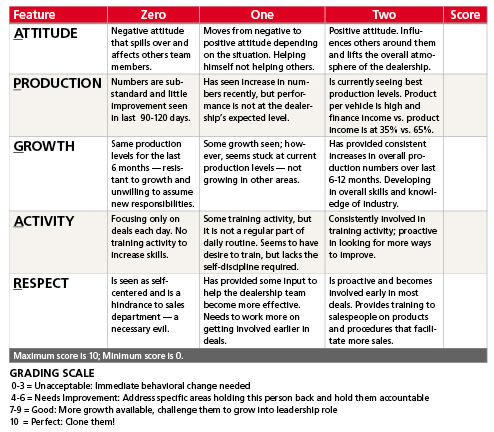
“P” for Production: As you’ll see, each of the five components listed here build on each other. In the case of “Production,” F&I managers with positive attitudes will focus on maximizing their opportunities instead of blaming their low production levels on a variety of factors. That’s why every F&I manager must be “married” to his or her numbers. And as we know, weddings are beautiful, divorces are ugly. That’s why a healthy F&I department will constantly evaluate the numbers, develop goals for improvement and have a plan for getting there.
But the focus needs to be on selling more products, not just increasing average profit per vehicle. That’s because everyone wins when products are sold. That means the key measurements for F&I should be products per vehicle sold, average profit per product and the ratio of product income to finance income.
“G” for Growth: Healthy things grow. So, to see consistent growth in production, F&I manager must be growing their skills and abilities to uncover customer needs. And to do that, they must operate under a process that involves the customer and makes the intangible products we offer come alive. That means we need up-to-date information and specific facts that demonstrate a need for our products.
That doesn’t mean telling a customer a vehicle has more high-tech components than the space shuttle. It does mean showing customers an article from J.D. Power and Associates that offers insights like this: “Since 2006, we have seen that problems in the in-vehicle technology category have risen by 45%, while problem incidence in other categories has improved by 24%, on average.” The most successful F&I managers are creative, and they are always looking for new and effective ways to present their products.
“A” for Activity: F&I managers touting healthy production levels set aside time each day to practice their skills and research their craft. If you want to grow as a professional, you have to change something you do every day. Committing yourself to daily training activities will provide you with fresh information and keep your skills sharp. That means reading articles to gain new perspectives on the F&I process, roleplaying your presentation, uncovering tangible proof of the current cost of frequent repairs, wheel and tire replacements and more. Bottom line, F&I managers who are growing their skills have intentional training activity on their daily calendar.
“R” for Respect: A top-producing F&I manager will have established himself or herself as the dealership expert on consumer credit, bank qualifications, customer behavior and the F&I products he sells. His (or her) knowledge in these areas will be called upon daily to help sell more vehicles, maximize profits and secure high levels of customer satisfaction.
That’s why getting involved in a deal early in the sales process is a key focus for top performers. They want to review the credit application and credit bureau report with the customer prior to submission to a lender. And by doing this, the producer shows salespeople his or her willingness to help move more metal. Customers also view the F&I department as their advocate in attaining financing — not a department bent on selling them products after the fact.
Grow to Go
The F&I office is the hub of dealership activity, and the knowledge required to be successful in that department can and should be shared with others to build a more productive and customer-focused process. And when the F&I producer gains the respect of the sales department, a process that drives up customer satisfaction levels and overall profitability can be achieved.
So what is your F&I APGAR score? More importantly, what is your goal to improve in the days ahead? Goal setting has become a burden to many, but true F&I leaders are always evaluating where they are, the areas they need to improve in, and are developing a plan to reach their goal. Growth never ends for these individuals. They operate with the mindset that their true potential can never be reached.
See, in the F&I office, how far you go is only limited by how much you grow. Conversely, lack of direction often leads to feelings of stress and anxiety, poor concentration levels, lack of confidence and being reactive rather than proactive in the F&I office. Simply put, individuals without goals often lack determination, patience and tenacity, all of which are key ingredients to F&I success. Top F&I managers know this and are always reviewing and adjusting their goals and F&I presentation. Maybe it’s time you did the same.
Rick is senior training consultant for Reahard & Associates Inc., a provider of customized, in-dealership F&I training for dealerships throughout the United States and Canada. Email him at rick.mccormick@bobit.com.
More F&I

How AI-Powered Coaching Is Transforming F&I Performance
See how AI-powered coaching can turn F&I customer conversations into actionable insights that support compliance, performance and profitability
Read More →
Sell Value, Build Trust
In this video, Trent White explains why selling on value, not fear, builds lasting customer trust, reduces cancellations, and drives long-term success.
Read More →
F&I Sales Give Dealers First-Half Lift
Product business shored up total profits to avoid an overall revenue tanking as product penetrations held steady, StoneEagle reported.
Read More →
Targeted Training Drives Results
Today’s technology, instead of threatening F&I managers, can actually make them better, according to an industry veteran who’s watched market setbacks roil the unprepared.
Read More →
Double the Change, Double the Chance
When an F&I manager gets a customer refusal, it’s a wise move to tweak more than one thing in the product offering.
Read More →
Just Do It
F&I managers need training, but instead of resisting application or expecting perfection, they should improve by simply acting on what they learn.
Read More →
Dealer Lender Preferences Revealed
When lenders provide consistent, fast service, their overall satisfaction scores with dealers greatly improve, according to JD Power research.
Read More →
Leading with Purpose
In this video, Trent White explains how understanding your people’s 'why' is a key leadership responsibility of F&I professionals and how that mindset drives dealership engagement, trust and performance.
Read More →
Integrating Nontraditional F&I Products
The niche presents a strategic advantage for auto dealerships as they move to adapt to fast-changing consumer expectations in today’s market.
Read More →
Trust Is Personal
Technology, no matter how efficient, can’t replace what the human F&I manager can do, which is to bridge the divide between cyberspace and the in-store experience.
Read More →