



Going in the Right Direction
Experian's director of automotive credit says there were a few signs in the third quarter that automotive finance is on the rebound.

Partly fueled by the Cash for Clunkers program, the automotive finance industry showed signs of stabilization in the third quarter. And while lenders continued to make less risky loans, the prospect of those high-risk loans from a few years ago coming off the books in early 2010 provides reason for both optimism and continued caution.
Financing was still available across all credit tiers during the quarter, but there was a noticeable shift in funding between low- and high-risk segments, with low-risk credit tiers continuing to receive a greater distribution of vehicle financing. And while 30- and 60-day delinquencies continued to rise, the rate of increase did slow during the quarter. Providing further optimism was the increase in average credit scores for new originations.
Prime, Superprime Represent Bulk of Auto Loans
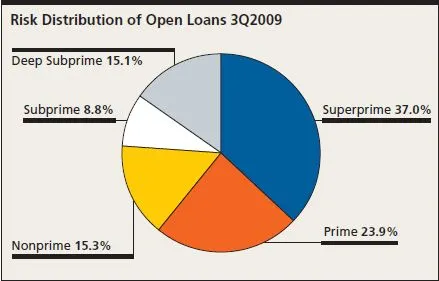
Providing a barometer of the overall health of the automotive finance market, Experian’s analysis of current risk distribution is broken into five consumer loan classifications: superprime (740+), prime (680-739), nonprime (620-679), subprime (550-619) and deep subprime (<550).
On a year-over-year comparison, the percentage of consumers classified in the superprime risk segment during the quarter held relatively steady, with only a slight decrease of 0.09 percent. This resulted in 37 percent of all open automotive loans falling into the lowest risk segment.
The combined prime and superprime market represented 60.9 percent of all automotive loans, up from 60.3 percent last year (a 0.92 percent increase). However, these risk segments have remained fairly steady throughout 2009. The middle-ground nonprime and subprime segments decreased by 1.2 percent from last year, with both segments representing 24.1 percent of consumers with automotive loans.
Meanwhile, the deep subprime segment continues to decrease, with 15.1 percent of open automotive loans falling into this category — a decrease of 1.3 percent from last year.
[PAGEBREAK]
Delinquency Rate Highest Among Captives
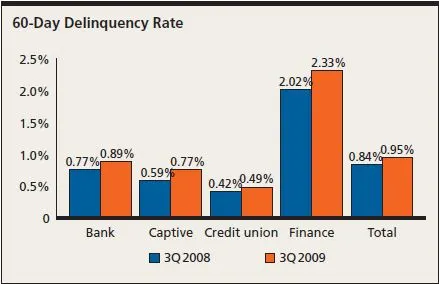
Despite stabilization in portfolio distributions and a shrinking deep subprime population, more consumers within the high-risk segments are experiencing delinquencies, resulting in a continued increase in the 60-day delinquency rate.
On a year-over-year basis, the rate of 60-day delinquent loans increased 13.4 percent. This resulted in 0.95 percent of all automotive loans reported as 60-days delinquent, representing over $6 billion in at-risk loans — a $477 million increase from last year.
The greatest increase in the 60-day delinquency rate was seen in the captive segment, which experienced a 29.2 percent increase. This resulted in 0.77 percent of all captive-held automotive loans reported as 60-days delinquent, representing more than $1.5 billion in at-risk loans — a $99 million increase from last year.
While credit unions had the lowest 60-day delinquency rate, they experienced the second-highest rate increase with 0.49 percent of their loans 60-days delinquent, a 16.7 percent increase from last year.
Credit Scores Continue to Improve
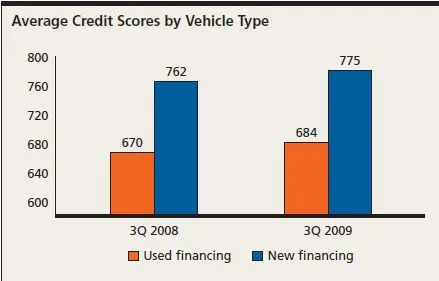
One reason why automotive portfolios have stabilized is the continued increase in credit scores for new-loan originations. Throughout the quarter, credit scores continued to rise for both new- and used-vehicle financing. The average credit score for vehicles financed in the third quarter was 722, an increase of 15 points from last year.
New-vehicle financing experienced a 13-point increase in scores, resulting in an average credit score of 775. Used-vehicle financing saw an increase of 14 points, resulting in an average used-vehicle score of 684 for the quarter.
Lenders Taking Little Risk on New-Vehicle Financing
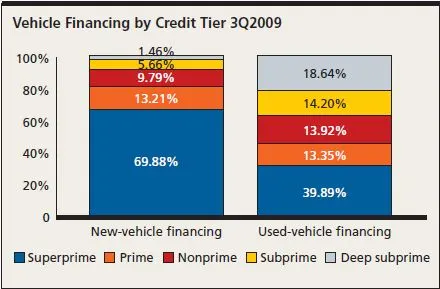
Along with higher credit scores, the overall distribution of vehicle financing continues to shift into the prime and superprime risk segments. Lenders continued to favor these low-risk segments in both new- and used-vehicle financing, while restricting funding for high-risk segments.
More than 66.01 percent of all financing in the third quarter fell into these low-risk segments, up 10.37 percent from last year. The middle tiers — nonprime and subprime — continued to decrease and shrunk a combined 16.78 percent. These two segments now represent 22.7 percent of all automotive loans originated in the third quarter.
New-vehicle financing is significantly geared toward the low-risk consumer, with 83.09 percent of all new vehicles financed in the prime and superprime risk segments during the quarter. This was an increase of 7.08 percent from last year. In contrast, only 1.46 percent of new vehicles were financed in the deep subprime segment.
[PAGEBREAK]
While distributed more evenly across the risk segments, used-vehicle financing experienced a greater shift toward the prime and superprime segments. Of all used vehicles financed in the third quarter, 53.24 percent of them were in the prime and superprime segments, an increase of 12.42 percent from last year. And while 18.64 percent of used vehicles were financed in deep subprime, this segment decreased 8.14 percent.
Cash for Clunkers Leads to Decrease in Amount Financed
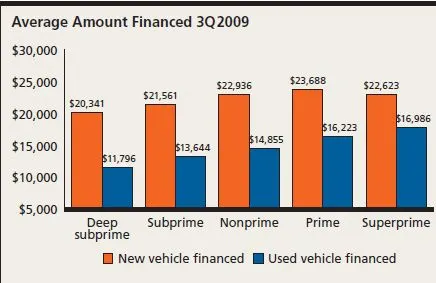
Amount finance for the quarter is where the impact of the government’s Cash for Clunkers program was clearly evident. On a year-over-year basis, financing on new vehicles decreased $1,348 to $22,712 during the quarter. Consumers in the prime risk segment financed the greatest amount on new vehicles at $23,688, a decrease of $1,619 from last year.
The average amount financed on used vehicles was $15,720, a decrease of $263 from last year. Among used-car loans, the superprime segment claimed the greatest amount financed at $16,986, which was $5,190 more than the average amount financed in the deep subprime segment.
Loan Terms Contracting
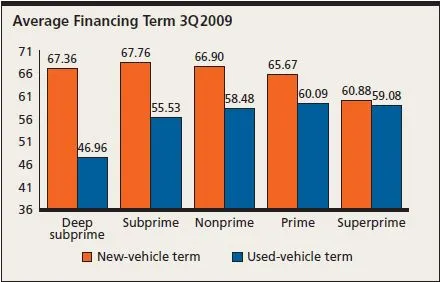
Across all risk tiers, the average loan term for the first half of 2009 was 60 months, down one month from last year. Terms between new and used financing continued to be one of the biggest differentiators across risk tiers, with a more than 20-month gap between new and used financing in the deep subprime segment. While terms vary considerably by credit risk tiers, each risk group saw decreases in monthly terms, with used-vehicle financing experiencing the greatest reductions.
The shortest terms were found on new vehicles financed in the superprime segment, which saw the average term drop by 0.55 months to 60.88 months. The greatest decrease in terms for new-vehicle financing was in the prime segment, which dropped 1.07 months from last year to 65.67 months.
Used-vehicle financing experienced the most significant decreases in terms. The deep subprime segment decreased 4.29 months, bringing the average term on used vehicles in this segment to 46.96 months.
Better 3Q Provides Cautious Optimism
While higher-than-average delinquency rates continued to challenge the industry, the fact that the rate of increase is slowing is definitely positive news for the industry. Slowing delinquency rates, increases in average credit scores for new originations, and portfolio stabilization should provide some cautious optimism for dealers continuing to refine their financing strategies.
More Auto Finance

Interest Rates Further Squeeze Auto Consumers
Last month’s hike and a potential second increase this month add to a growing list of inflation woes that could continue to dent overall car sales.
Read More →
Mind Your Process
Consistent steps taken in various aspects of the F&I office can make valuable differences over time, similar to an outline for a best-selling book.
Read More →
Top Five Credit Application Fraud Flags
Compliance audits regularly reveal bad habits that can lead to fraud charges and should have been stamped out decades ago.
Read More →
More Auto Loans for the Taking in August
Riskier categories were on the uptick for the month as lenders loosened access in several areas while balancing out the exposure in another, Cox Automotive reported.
Read More →
July Was Hot for Auto Borrowers
Credit proved readily available for many, but most loans left buyers in negative territory, Cox Automotive said.
Read More →
Dealer Lender Preferences Revealed
When lenders provide consistent, fast service, their overall satisfaction scores with dealers greatly improve, according to JD Power research.
Read More →
Auto Refi Savings Surge
Consumers with 84-month auto loan terms who refinanced saved the most on monthly payments, according to a new report by auto refinancing provider Caribou.
Read More →
Subaru Enters Lending Business
The automaker follows other brands in adding captive financing in the U.S., and says the move will strengthen its position here.
Read More →
Positive Equity Reaches Record High
Mainstream vehicle owners who bought a car seven years ago are likely to have positive equity when trading in for a new vehicle, according to second-quarter Edmunds data.
Read More →
Dealerships Are Paying the Price for Extended Car Loans
Growing negative-equity scenarios mean such lengthy terms should be addressed in a forward-looking way to make them work for the dealer and the consumer down the road.
Read More →