



Lease-Here, Profit Here
Dealers have found increased cash flow and profitability after moving from a new-car or BHPH/RTO model to lease-here, pay-here. Leasing expert breaks down the advantages of LHPH and discusses the potential risks.
What is lease-here, pay-here? Essentially, it’s an alternative to the buy-here, pay-here and rent-to-own models. However, there are several major differences and a number of advantages — and some disadvantages — for dealers.
LHPH has often been dismissed as too complex for dealers who are accustomed to new-car sales or BHPH. Before you decide whether or not LHPH will work for you and your dealership, let’s break down the basics of such a program and discuss the potential benefits and inherent risks.
Lease-here, pay-here advantages
The biggest attraction to LHPH is the elimination of the upfront sales tax. While the accounting, regulatory and federal taxation differences between LHPH and BHPH programs are identical in all states, there are sales tax and licensing differences dependent upon state rules. Understanding the leasing sales tax rules in your jurisdiction is the first step.
LHPH also can increase profitability. If you’re collecting the same payment amount for the same term amortizing only to residual value, the result is a much higher rate and rental income. When added to the tax savings previously discussed and profits generated from trade-ins, you have the potential for a more profitable business that is easier to sustain through weak demand periods.
That being said, here are the four primary advantages that LHPH holds over BHPH:
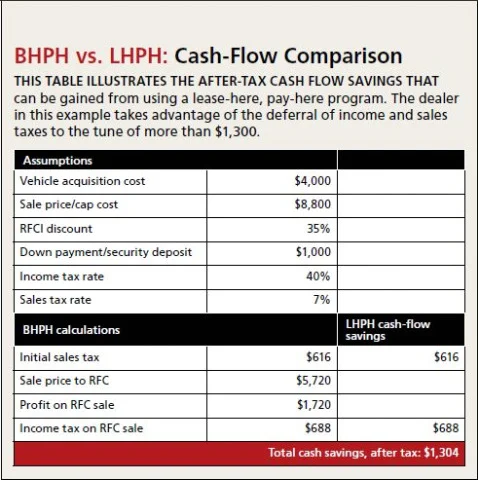
1. Elimination of initial sales tax: In all but 17 states, a LHPH transaction is not subject to the initial sales tax that would be applied to a BHPH transaction. The buyer’s initial cash payment can be retained as a security deposit rather than being paid to the state. For dealers, that means increased cash flow, greater liquidity and reduced borrowing costs.
2. Deferred federal and state income tax liabilities: In a BHPH conditional sale, there is a significant “gain on sale” when the vehicle is sold for an amount that is (typically) 50 to 100 percent greater than the dealer’s tax basis in the vehicle. To reduce the federal and state tax liabilities assessed on this gain, the retail installment sales contract is typically sold to a related finance company (RFC) at a discount. However, there is still upfront net profit that’s subject to federal and state taxation. With LHPH, there is no gain on the sale, because there is no sale! That eliminates the need to move the lease to an RFC in order to book a separate “loss on the sale of the lease.” Since the leased vehicle can be depreciated on an accelerated basis, the transaction starts with a tax loss from the accelerated depreciation, in effect, creating a tax shelter for the dealership.
3. Reduced federal and state regulatory requirements: Experienced BHPH dealers know that compliance is never a sure thing. Regulation Z and the various state regulations impose a highly technical set of requirements. Attorneys are quick to jump on minor technical errors and the courts and regulatory agencies continue to evolve new interpretations of these requirements. On the other hand, LHPH transactions are guided by the much less-onerous Regulation M. Only a handful of states (most notably, California and New York) have state consumer leasing acts that impose added requirements. With no “lease rate” disclosure required (or permitted), not only is customer resistance to the lease rate avoided, there are no usury limits or calculation idiosyncrasies to worry about.
4. Collection of tax-free security deposits: Leasing traditionally includes collection of a refundable security deposit at lease inception instead of a down payment. Unlike a down payment, a security deposit is not taxable, and is retained throughout the transaction as an offset against default liability. It’s also collectible at any point in the lease.
In addition to the primary benefits listed above, other benefits to LHPH include reduced consumer disclosures, bankruptcy protection, reduced monthly payments, and, in most states, no loss of prepaid sales tax in case of default.
What Are the Risks?
As with any other tool, there are also some disadvantages to implementing a lease-here, pay-here program. Here are the five primary risks inherent to LHPH:
1. Vicarious liability exposure: In some states, lessors have been held responsible for injuries caused by negligent lessees simply because the lessor owned the leased vehicle. Federal law has now virtually eliminated this risk, but lessors should still obtain contingent and excess liability insurance coverage to defend against nuisance suits.
2. Lease accounting and data processing complexity: LHPH programs cannot be accounted for and managed properly on BHPH accounting and data processing systems. A specialized system is required. However, LHPH programs can be structured similarly to BHPH programs with payments in arrears and use of the “interest rate implicit in the lease” to calculate payments.
3. New terminology and “true lease” compliance: Leasing has its own terminology, legal requirements and customer rights and duties. The BHPH sales and finance terminology your staff is accustomed to can confuse customers and potentially violate federal and state lease advertising rules and regulations. Such language may also inadvertently create a conditional sale with the related disclosure requirements.
4. General unfamiliarity with leasing: Even with compliance training, an internal program handbook and customer outreach, it is likely that staff will make mistakes in trying to answer customers’ questions about leasing. The ongoing training and supervision of your staff must include continued development of accurate answers to frequently asked questions from both sides of the transaction.
5. Third-party sale/funding limitations: Some BHPH dealers sell their loan portfolios to third-party finance companies. Others operate on lines of credit with lenders who are familiar with the program. A change to LHPH may limit the salability of your assets or require increased due diligence from the purchaser, especially considering the risk to residual value.
Lease-here, pay-here does have complexities and potential liabilities that you won’t find in buy-here, pay-here, and there is no cookie-cutter solution to turn a BHPH program into an LHPH overnight. It will take careful planning and you will incur some initial expense. However, investing the time and effort to understand the operational and compliance differences can pay huge dividends in profitability.
More F&I

AI: Facilitator, Not Fixer, in F&I
The dealerships that thrive in the years ahead will be those that embrace technology while continuing to invest in the people who make customer interactions count.
Read More →
Modern Technology Objection Handling
In this video, Trent White shares how to confidently handle technology-based objections by helping customers understand the value of protection, even with modern vehicle technology.
Read More →
Consistency at Scale: Driving F&I Performance
With 75 rooftops across the Sunshine State, Morgan Auto Group has proven to Floridians that it knows a thing or two about driving performance in a competitive market. But it didn’t start at the top.
Read More →
Gitty Up on GAP
The foundational finance-and-insurance product hasn’t kept up with the latest conditions for auto dealers. Is the time ripe?
Read More →
How AI-Powered Coaching Is Transforming F&I Performance
See how AI-powered coaching can turn F&I customer conversations into actionable insights that support compliance, performance and profitability
Read More →
Sell Value, Build Trust
In this video, Trent White explains why selling on value, not fear, builds lasting customer trust, reduces cancellations, and drives long-term success.
Read More →
F&I Sales Give Dealers First-Half Lift
Product business shored up total profits to avoid an overall revenue tanking as product penetrations held steady, StoneEagle reported.
Read More →
Targeted Training Drives Results
Today’s technology, instead of threatening F&I managers, can actually make them better, according to an industry veteran who’s watched market setbacks roil the unprepared.
Read More →
Double the Change, Double the Chance
When an F&I manager gets a customer refusal, it’s a wise move to tweak more than one thing in the product offering.
Read More →
Just Do It
F&I managers need training, but instead of resisting application or expecting perfection, they should improve by simply acting on what they learn.
Read More →