



Menu Selling
The one tool that's revolutionized the F&I office in the automotive industry is the menu. Now it's time for powersports dealers to reap the benefits. F&I expert shows you how to make the transition.

If you’re closing with lines such as, “What do you think?” or “Would you like to go ahead with it?” the response you can expect is, “I’d like to think about it” or “I’m not interested.” The best way to get the “yes” answer you’re looking for is to ask customers an alternative closing question like, “Would you like to pay cash or finance?” An even better one is, “Do you prefer option one, two, three, or four?” The alternative close is probably the biggest advantage of what many refer to as menu selling, or as I prefer to call it, menu closing.
Many F&I managers in the powersports field are considering a move from step selling to the consumer-friendly, profit-driven menu-selling approach. Some, like Ryan Beckers, have already made the switch.
“I increased my dollars per unit by $100 since I started using a menu,” said Beckers, who works at the Minnesota-based Hitching Post Hopkins. “I have found it quite a bit easier to make sure that my clients have all of their choices to protect themselves presented in a clear and non-threatening environment. I think a menu makes it easier for customers to choose the product that is right for them.”
Ryan Rebollar, who works for Imperial Valley Cycle Center in California, was sold on menu selling when he saw his product penetration rates increase. “Selling with an electronic menu increased my per retail average at least $75 per unit sold,” he said. “It gives me the opportunity to offer all back-end products all of the time. In doing this, my product penetration went up dramatically.”
The Evolution of Menu Selling
If we take a glance back to the roots of F&I, we’d probably start with the selling system developed by Pat Ryan. Considered one of the trailblazers of the automotive industry’s F&I segment when he founded Pat Ryan & Associates (now known as AON Corporation) in 1964, he designed a system around what was referred to as step selling.
The system required that F&I managers present and close on a single product before moving onto the next. Back then there were only three products to present: service contracts, credit life and disability insurance. With only three products, step selling could be done fairly effectively, but it’s not the most effective way to sell. Today, step selling serves its purpose after the customer has made his or her initial choice; that is, to get them to take one or two additional products after they have selected an option from the menu.
[PAGEBREAK]
Another F&I selling system (I’ll not give anyone direct credit for this one) was designed around assumption. The F&I professional (I use this term lightly) would print the contract with all the products included and begin disclosing. Did this work? Yes, but only until customers figured out that dealers were taking advantage of them.
Today, most customers wouldn’t fall for this approach, which makes it as ineffective as a mainstream selling system. This approach would also be highly volatile to opportunistic attorneys. The good news is that 95 percent of automotive F&I departments have sent this system to the scrap pile that it deserves.
The bad news is that some secondary finance departments still say, “This is the way the bank approved the loan.” Typically, nonprime lenders will approve up to a maximum payment. However, problems arise when the F&I department uses those approvals in a manipulative manner.
Menu selling is today’s mainstream approach. If you asked most people in the F&I business what is their primary reason for using a menu, they would probably say compliance. That’s not how it started, however.
Menus were first touted as an excellent way to get the customer to make a decision. It’s a natural alternative close. I believe this still should be the primary reason to use a menu in the F&I office. Compliance should be a unilateral benefit to closing when using the menu. Finishing your presentation with, “Mr. Doyle, which option do you prefer?” is an excellent way to get a customer to make a favorable decision. You can always step sell from that point.
Choosing the Best Menu
Many dealers tell me, “We need to menu sell in the F&I department.” When I ask them why, their response always centered around compliance.
While a menu should be used, compliance isn’t necessarily the reason why. You can’t be any more compliant than making sure retail installment contracts follow Regulation Z and the Truth in Lending Act. A menu can reinforce compliance if used properly, but it can also promote payment packing if it’s not.
Is profit and compliance better served with an electronic or handwritten menu? If I were a dealer I would definitely invest in an electronic menu. It reinforces compliance and gives F&I managers the flexibility they need to maximize profits. Why? F&I sales are subject to change when the customer arrives and during the presentation. The options you offer a customer when menu closing will depend on the customer’s responses to the features-and-benefits presentation. For example, if the customer doesn’t want the service contract after you have handled their objections, you would be better served adjusting the options you are showing them. In other words, you might offer them 30-day and 14-day retroactive accident-and-health options.
The flexibility of an electronic menu allows you to change options on the fly. A handwritten menu doesn’t. The right menu will also provide several menu templates that can accommodate different situations. The electronic menu also gives the F&I professional the ability to create a new menu when customers change the amount of their down payment at the time of delivery.
[PAGEBREAK]
From a compliance
perspective, a handwritten menu can expose a dealer to payment packing. This
happens when F&I managers give themselves
a
cushion on the base payment to make it look like the products don’t cost as
much as they actually do. An electronic menu eliminates this from happening
because the software always determines the exact base payment.
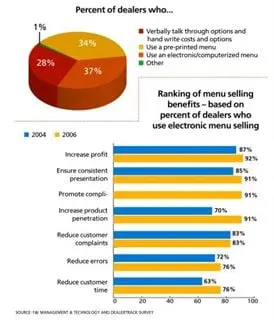
An article that appeared in F&I Management and Technology magazine for our counterparts in the automotive niche highlighted a study on the benefits of using an electronic menu. Increased profit was the primary reason given by dealers, followed by presentation consistency and compliance.
F&I managers who used an electronic menu also cited other advantages, such as increased product penetration, reduced customer complaints, reduced errors and a reduction in the time a customer spends in the F&I office. That last reason will certainly make the sales department happy.
Staying Ahead of the Curve
Early adaptors in the auto industry reaped the benefits of menu selling, with some touting increases in profit of $100 per unit sold. Now most have caught on, with the menu becoming a staple inside the F&I office.
We are seeing the same thing happen now in powersports F&I. The question is, will you be one of the early adopters.
“Our profits
definitely went up significantly, because we’re not step selling anymore,” said
Stacy Dancer, who works at PCP Motorsports in
California. “We’re selling packages rather
than products. I think going to a menu made my presentation much better,
because I now have a routine to follow instead of just selling off the top of
my head.”
Ron Martin is the president of VisionMenu Inc. and The Vision of F&I Inc. He provides F&I sales and compliance training, as well as electronic menu solutions to powersports dealers. He can be reached at ron.martin@bobit.com.
More Digital

AI: Facilitator, Not Fixer, in F&I
The dealerships that thrive in the years ahead will be those that embrace technology while continuing to invest in the people who make customer interactions count.
Read More →
Simple But Effective Hacking Surges
Data from the past year at U.S. auto dealerships finds that email and identity phishing are growing threat sources that can dispense with malware by exploiting trust.
Read More →
The Future of Car Dealerships
Artificial intelligence is reshaping the service-drive experience and will help retailers stay competitive.
Read More →
Structure Leads to Optimized Auto Listings
As the average car-buying journey has shifted to a blend of digital and retail, a dealership’s vehicle listings must be optimized to answer shoppers’ questions clearly and accurately.
Read More →
Real Intelligence
AI, though it presents many opportunities for productivity, efficiency and more, isn’t a one-for-one stand-in for people. It can augment human capital but not replace it altogether.
Read More →
Zurich Launches Advisor IQ for F&I Manager Coaching
The new platform uses real transaction data and artificial intelligence-driven insights to help car dealerships improve consistency and performance.
Read More →
F&I in the Digital Age
Digital retailing has not made the F&I manager obsolete. If anything, it has revealed how valuable the role can become when technology is used correctly.
Read More →
Need for Speed: EV Apps Lack Consistency
Fifty-five percent of surveyed EV owners said their mobile applications had a major or moderate impact on their purchasing decisions, but connectivity issues remain a problem.
Read More →
Four Keys to Your Digital Trail Defense
Federal regulators are cracking down on hidden fees. This protective measure could mean the difference between winning and losing a lawsuit or surviving a duel with the Dark Side.
Read More →
Hyundai Hosts Tech Talent Forum
Technology leaders from Hyundai Motor Group will have open discussions at the inaugural HMG Tech Talent Forum on topics ranging from autonomous driving to 'smart' manufacturing.
Read More →