



Reaching the Peak
F&I insider says producers can only reach a level of production and success that they persistently and actively pursue. So to reach your peak, you need to set your sights higher, and you need to develop the following five traits.


If you are faced with a mountain, you have several options: You can go around it, dig under it, fly over it, conclude it is too high to climb and go back the way you came, or you can climb it. When we are challenged to increase our production levels, the expected numbers can appear to be insurmountable. That’s not the case for top F&I performers, who separate themselves from the rest by methodically taking daily steps to meet the challenge of reaching top levels of production.
I recently spent a day in a room full of F&I managers who climb the production mountain every day. The question on their minds was: “What enables top performers to pull away from rest and lead their respective group?” The short and simple answer is they are better prepared when they meet a customer. See, natural talent and charisma are rarely attributable to top performance. They help, but most top performers reach the top through disciplined practice and an insatiable desire to research their craft. Let’s delve into the five characteristics of these mountain conquerors.
1. They Have Attitude
Top performers have a positive attitude that compels them to believe every customer objection can be answered effectively and every process problem can be resolved to the benefit of all. They also believe every customer needs some of the products they offer. Their job is to help the customer see that need. That’s not the case with average producers, who are like pointer dogs to the hunter. They like to point out problems but are less enthusiastic when it comes to finding solutions. Top performers approach every challenge with a positive mindset. Their goal is to find a solution, and they’re laser-like when it comes to uncovering a need or discovering a problem their products can solve for the customer.
2. They Have the Facts
Top performers provide a fact-based presentation, which means they consistently spend time listening and updating the information they share with their customers. To effectively sell environmental protection, for instance, you must be able to articulate the differences in pearl coat and metallic paint, and you must be able to share firsthand knowledge of the cost to repaint a vehicle’s quarter panel.
Here’s a hint: Pearl coat and metallic paint are special mix paints that are costly to duplicate. Unfortunately, instead of providing a specific cost example, an average performer might simply state, “It is expensive to match these specialty paints on a vehicle today.” When an F&I manager provides general information in an attempt to sell a product, the customer either feels like the producer is exaggerating or lying, and either one is a deal killer.
3. They Practice Self-Discipline
Top performers know they can deliver consistent improvement because they have committed to two nonnegotiable disciplines. First, they practice their skills regularly with others. As a child I played Little League baseball. One of my coaches used to have a saying that he drilled into us: “You play like you practice.” It’s a tough thing to do, especially after suffering through a string of tough customer interactions. When that’s happened to me, I admit I’ve stopped practicing. I either thought I didn’t need to or I was just too busy.

Top performers practice their skills, roleplay their presentation with others and even record live deals to identify areas where focus and improvement are needed. Second, they actively seek the input of others. S. Truett Cathy, founder of Chick-fil-A, lives by this principle. In fact, he attributes his success to aggressively asking everyone from customers to co-workers to tell him one thing he could do better. Aggressively seeking the input of others will enable you to identify “blind spots” in your performance. Top performers do so because they know they can see clearer when they occasionally look through someone else’s eyes.
4. They Start With Facts and Close With Emotion
The order of this is critical, because a presentation that excludes one of these factors will always produce less than desirable results. All facts and little or no emotion make for a low closing percentage. Conversely, all emotion and little or no facts will provide an exciting yet unproductive effort. After we have shown why a product has value, we must close by helping the customer see why it is critical for them in their situation.
Bottom line, we have to paint a picture and put the customer in it so they can see and feel the need for the product. Top performers know customers have little interest in why we like the product or why it worked great for others; customers only buy when it’s clear the product makes sense for them.
5. They Do the Right Thing Consistently
Top performers have learned you can adhere to ethical standards and aggressively present products at the same time. Remember, we were placed in the F&I office to help customers make great buying decisions. Top performers attempt to sell the products that a customer needs, not the ones they make the most money on. Furthermore, they provide compelling, interactive and visual presentations that make the products come alive.
See, top performers adhere to every ethical standard and feel it is unethical to let a customer leave their office without purchasing GAP unless a compelling presentation was made. A needs-based process leads the F&I manager to do what is right for the customer. And that makes it right for everyone else.
The climb to the top of the mountain requires discipline. We’ll slip along the way, which means we have to regroup and continue our climb to a level of production and success that we persistently and actively pursue.
When sales guru Zig Ziglar was about to make one of his inspiring presentations, he revealed that he had practiced for three hours the night before. He was a natural on stage and could move a crowd “on the fly.” But that’s not how he operated. His mantra was: “You were born to win, but to be a winner you must plan to win, prepare to win and expect to win.”
Professionals practice, have a positive and balanced attitude, load themselves up with facts that support their efforts, and then close with the emotion of why “this is critical for you.” They are self-confident because they have prepared to win and they have an unwavering commitment to doing what is right for the customer while they aggressively pursue the sale of products their customers need. It’s a steep and difficult climb to the top, but the rewards are worth it. Keep climbing!
Rick McCormick is a national account development manager for Reahard & Associates Inc., an F&I training company providing classes, workshops, in-dealership and on-line training. Email him at rick.mccormick@bobit.com.
More F&I

AI: Facilitator, Not Fixer, in F&I
The dealerships that thrive in the years ahead will be those that embrace technology while continuing to invest in the people who make customer interactions count.
Read More →
Modern Technology Objection Handling
In this video, Trent White shares how to confidently handle technology-based objections by helping customers understand the value of protection, even with modern vehicle technology.
Read More →
Consistency at Scale: Driving F&I Performance
With 75 rooftops across the Sunshine State, Morgan Auto Group has proven to Floridians that it knows a thing or two about driving performance in a competitive market. But it didn’t start at the top.
Read More →
Gitty Up on GAP
The foundational finance-and-insurance product hasn’t kept up with the latest conditions for auto dealers. Is the time ripe?
Read More →
How AI-Powered Coaching Is Transforming F&I Performance
See how AI-powered coaching can turn F&I customer conversations into actionable insights that support compliance, performance and profitability
Read More →
Sell Value, Build Trust
In this video, Trent White explains why selling on value, not fear, builds lasting customer trust, reduces cancellations, and drives long-term success.
Read More →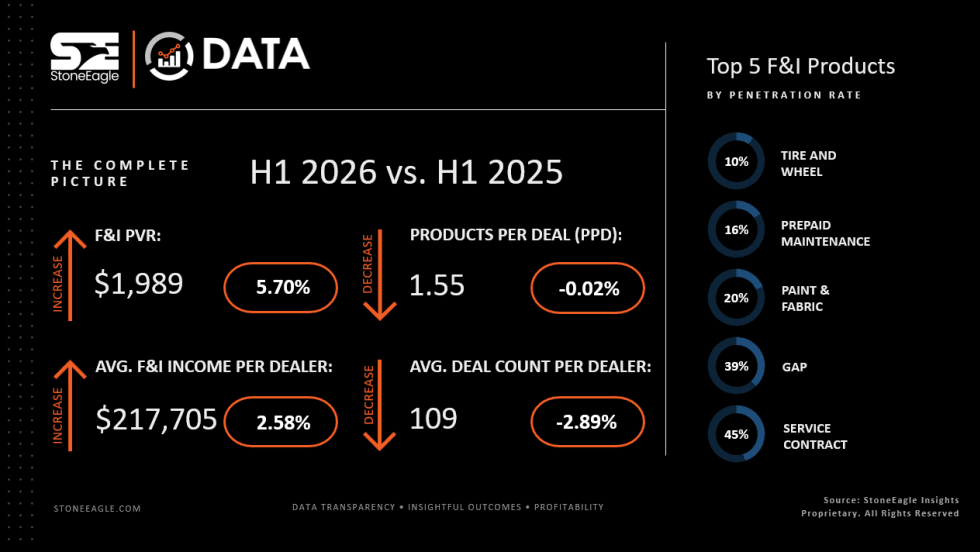
F&I Sales Give Dealers First-Half Lift
Product business shored up total profits to avoid an overall revenue tanking as product penetrations held steady, StoneEagle reported.
Read More →
Targeted Training Drives Results
Today’s technology, instead of threatening F&I managers, can actually make them better, according to an industry veteran who’s watched market setbacks roil the unprepared.
Read More →
Double the Change, Double the Chance
When an F&I manager gets a customer refusal, it’s a wise move to tweak more than one thing in the product offering.
Read More →
Just Do It
F&I managers need training, but instead of resisting application or expecting perfection, they should improve by simply acting on what they learn.
Read More →