



You Know What They Say About Assumptions…
Assumptions are a dangerous byproduct of our industry and we all need to check ourselves when it comes to stopping an idea in its tracks based on emotional biases and unsupported knee-jerk reactions.
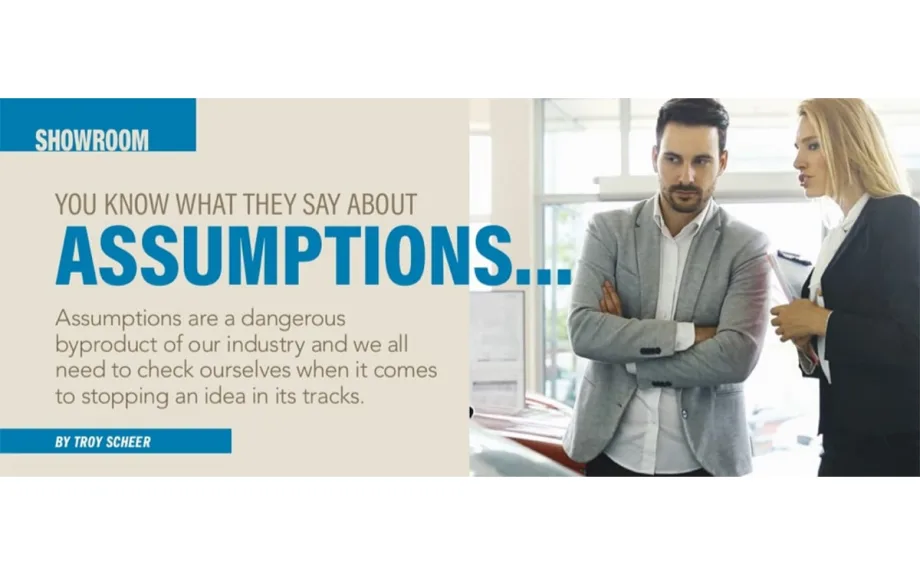
Assumptions are a dangerous byproduct of our industry and we all need to check ourselves when it comes to stopping an idea in its tracks based on emotional biases and unsupported knee-jerk reactions.
IMAGE: Gilaxia via GettyImages.com
Recently, I’ve had the honor of interviewing some of our industry’s most trusted advisors on everything from marketing and social media, to selling to millennials, to making more money in the service drive on the Culture of Value podcast. As I edit the podcast shows for posting each week, one theme continues to come out loud and clear. Regardless of what the expert is speaking about, they all touch in some way on their experience with assumptions in the auto industry.
How often have we all missed a golden opportunity wrapped up in an assumption?
While companies like Vroom and Carvana have been vilified for their portrayal of car dealers, there are just as many assumptions made among auto insiders. The same dealers who are taking offense at customers who portray them as snake oil salesmen, many times view vendor partners the same way. Generally speaking, making those assumptions end up causing more harm than good.
It’s a dangerous byproduct of our industry, and we all need to check ourselves when it comes to stopping an idea in its tracks based on emotional biases and unsupported knee-jerk reactions. Below are a few other assumptions dealerships are making when it comes to their operations and employees.
Assumption 1: Employee Social Media Promotion Doesn’t Work
Melanie Borden, vice president of marketing for LotLinx, came on the podcast to share what dealerships can be doing to rock their social media plans and gain more engagement in 2021. One item she touched on in our interview is the assumption that the dealership’s staff won’t want to promote the brand on their personal social channels. Borden says most employees would actually be happy to post, they just don’t know how. She directs each dealership to encourage their employees to promote the brand and themselves. Afterall, Borden reasons, what’s good for your employees is also what’s good for your brand.
Assumption 2: All Millennials Want to Buy Online
Ilana Shabtay, director of marketing at AutoLeadStar, and I had a great discussion on the assumption that all millennials want to buy a vehicle entirely online. Shabtay, who is herself a millennial, discussed how she wants to visit the dealership and test drive a vehicle before spending money on the second largest purchase of her life. She cautions against a one-size-fits-all model for digital buyers and instead encourages dealers to watch their buyer behaviors offline and then try to mimic the experience online.
Assumption 3: Customers are No Longer interested in F&I after First Visit
Christine Mitchell, known as the Canadian Car Lady, teaches women across Canada (and now in the U.S.) how to take care of their new cars by providing female-based car care classes through the dealership. Mitchell has seen time and again the dealership assuming both that women know the inner workings of their car, and that they are no longer interested in F&I products once they leave the dealership. Both assumptions have proven incorrect — her classes are packed, and she regularly sells F&I products post-sale.
I share these examples with you as a way to point out the danger of assumptions in our industry. As a part of Binary Automotive Solution’s customer loyalty program, we offer lifetime powertrain warranties. As soon as we walk in the door, we’re dealing with a number of assumptions right out of the gate.
Assumption 4: Lifetime Powertrain Warranties are Too Expensive and Won’t Work
We’ve been told the warranties won’t work. We’ve been told the cost of the program is more than the dealer will make from it, that it will hurt F&I sales, and that the promotion costs alone will outweigh the benefits of the program.
The truth is the dealerships we work with actually see a $600-$800 increase in front end gross. As for the assumption that the program hurts F&I sales, we generally see a 10% F&I increase in dealerships rocking their F&I department, while those who don’t have a strong F&I process see a 30% increase. We also handle and supply all of the promotions for the dealership as a part of our package, so the marketing around the program costs the dealership no additional fees.
Next time you find yourself making an assumption, stop and think through some of the examples above. How often have we all missed a golden opportunity wrapped up in an assumption?
More Showroom

New Cars Less Affordable
Buying conditions eroded for American shoppers last month due to inflation and interest rates, though they fared better than a year ago.
Read More →
October Sales Divided
Inventory trends split between the new- and used-vehicle markets, though prices continued to rise for both in October.
Read More →
Auto Transaction Prices Hit New Height
October sales of big, pricey models push up the average, even as budget-conscious consumers snag more economical options.
Read More →
Making the Safe Choice
Kelley Blue Book has turned households with teen drivers onto safe and affordable options for their vehicles of choice
Read More →
Inventory Holds Steady
September new-vehicle inventory rose slightly month-over-month, but dealer lots are laden with MY2026 vehicles as the typical model year changeover trudges along.
Read More →
October Auto Sales Fall With the Leaves
A forecast anticipates retail deliveries are down this month as consumers continue to face cost challenges, though more are tapping long loans in order to buy.
Read More →
California Sees Quarterly Gains
California’s new-vehicle market saw a boost in hybrids in the third quarter and its first overall quarterly market gain of the year.
Read More →
New-Vehicle Prices Stay Put
Affordability pressures and model availability shaped new-vehicle sales in September, according to an analysis by Kelley Blue Book.
Read More →
EV Buyer Consideration Shifts
What drives American consumers to purchase an electric vehicle is shifting as the question moves away from Should I?' to 'Which features and experience do I want to have?'
Read More →
Year-to-Date Auto Sales Holding Their Own
A forecast through August shows that automakers have shifted strategies to keep deliveries and revenues up despite tariffs and other economic challenges.
Read More →