



Attractive Financing Options Contribute to Increased Sales Satisfaction; Drop in Leasing
Low interest rates and manufacturer-sponsored
financing incentives have fueled a jump in the number of consumers who finance their vehicle and raised the overall satisfaction of new-vehicle buyers with the sales process, according to the J.D. Power and Associates
2002 Sales Satisfaction Index (SSI) StudySM released Aug. 15.
The percentage of respondents financing their vehicles increased from 48 percent in 2001 to 54 percent in 2002, and leasing dropped from 27 percent to just 20 percent - leasing's lowest rate in nearly a decade.
While favorable pricing has helped to increase consumer satisfaction with the automotive
sales process overall, it is more apparent among those who finance their purchase than among those who lease or pay cash. The average interest rate among those who finance is 5.5 percent, down from 7.1 percent in 2001.
The study also finds that consumers continue to prefer a hassle-free new-vehicle sales experience that features non-negotiable retail pricing. Saturn, the only automotive brand to offer non-negotiable pricing since the brand was introduced in the early 1990s, tops the study's satisfaction index for the third consecutive year.
"With the help of their one-price, low-pressure sales approach, Saturn's salespeople receive the highest marks in the industry," said Todd Wilson, director of retail distribution research at J.D. Power and Associates. "What
makes Saturn's performance so exceptional is that it achieves this high level of sales satisfaction selling non-luxury vehicles."
After Saturn, eight of the next 10 makes in the sales satisfaction ranking are luxury brands. Following Saturn are Cadillac, Lincoln, Lexus, and Jaguar and Mercedes-Benz (tied), respectively.
The study, now in its 16th year, reveals that the speed with which a customer is able to complete their transaction is directly linked to
satisfaction. In particular, buyers are most frustrated with wasted time, such as waiting to enter the business office to finalize the paperwork. The average customer spends nearly three hours at their selling dealer.
"The single biggest process-related improvement a dealership can make to increase sales satisfaction is to minimize the number of employees a customer must work with to complete their transaction," said Wilson. "Turning a customer over from one salesperson to another in an attempt to close the deal frustrates the customer and prolongs the process. Consumers
report higher levels of sales pressure and lower levels of satisfaction overall when subjected to this 'turnover' approach."
Influence of September 11
Sales satisfaction scores were also influenced by the way Sept. 11 affected auto sales. The very attractive financing incentives that began as many manufacturers responded to the events of September 11 created a highly price-competitive environment that has benefited the consumer.
"Even many brands that did not offer special financing rates discounted the price of their vehicles considerably compared to the same time period the year before," said Wilson. "Consumers are certainly the winners, and sales satisfaction scores are up because of it."
The 2002 Sales Satisfaction Index Study is based on more than 39,000 responses from buyers and lessees of new 2001 and 2002 model cars and light trucks. The study, which was fielded in January and February of 2002, provides the automotive industry with a comprehensive analysis of the new-vehicle purchase experience and gives vehicle manufacturers an understanding of customer needs and insights into improving the sales process.
About J.D. Power and Associates
Headquartered in Westlake Village, Calif., J.D. Power and Associates is a global marketing information services firm operating in key business sectors including market research, forecasting, consulting, training and customer
satisfaction.
The firm's quality and satisfaction measurements are based on responses from millions of consumers annually.
More F&I
Why Your F&I PVR Is Misleading You
Here’s a handy checklist of the numbers to track in 2026 instead.
Read More →
Auto Consumer Anxiety Presents Opportunity
A survey of U.S. drivers found the majority are concerned about finances and the economy, but those fears make many ready to buy vehicle-protection products.
Read More →
Humble and Hungry: 12 Rules for an F&I Life
Dustin Gingerich, with a decade in the F&I business under his belt, shares his thoughts on leadership, building trust with customers, and the importance of learning and innovation.
Read More →
Focus on the Opening
F&I managers must learn as much as possible about their customers, starting before they walk into their offices. The bulk of today’s consumers expect that, and good results will follow.
Read More →
F&I Reaches for the Sky
The increasingly important profit center continued making gains in the first quarter, according to StoneEagle data, ancillary products proving more popular as consumers hold onto their buys longer.
Read More →
Timing the Market Can Hurt Long-Term Program Performance
For dealer-owned reinsurance entities, avoiding volatility entirely can mean falling behind inflation and missing market rebounds that drive long term surplus growth. Missing just a handful of strong market days can materially impact cumulative returns—an important reminder for long horizon trust and investment strategies.
Read More →
The 90/10 Rule
In this video, Ryan Ruff explains the rule that elite sales professionals use to turn ordinary conversations into unforgettable customer experiences.
Read More →
Your Office Is Talking
What’s the atmosphere saying about you to your customers? You can make minor adjustments and additions that transform your space into one that creates trust with the people on the other side of the desk.
Read More →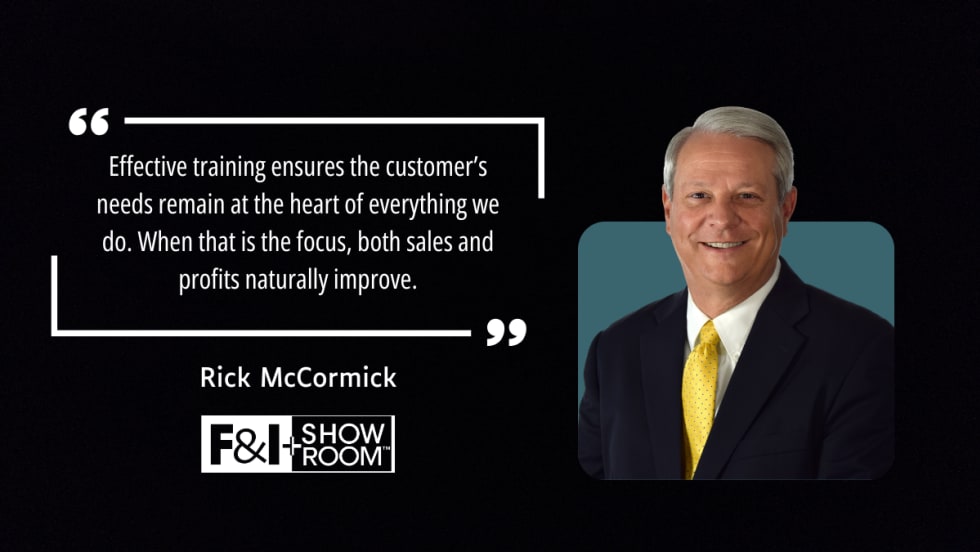
F&I Training Fundamentals
How can auto dealerships help F&I managers fulfill their vital role in the most effective ways? Industry expert Rick McCormick shares his insights on the best ways to train these professionals and help them maintain good habits.
Read More →
Not Just Any Tire Will Do
More consumers and businesses are opting for all-season options for various reasons as safety, sustainability and convenience push practical change.
Read More →