



Automakers Expand Leasing, FICO Scores Drop
As the economy continues to improve, more vehicle manufacturers are restarting their subvented leasing program. In the first quarter, the reintroduction of these programs led to an influx of lessees and a significant decline in FICO scores, according to CNW Research.
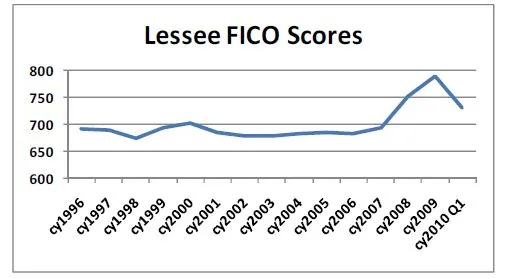
As the economy continues to improve, more vehicle manufacturers are restarting their subvented leasing program. In the first quarter, the reintroduction of these programs led to an influx of lessees and a significant decline in FICO scores, according to CNW Research.
Aside from leading to a drop in the credit score demographic, the Bandon, Ore.-based research firm said the recent expansion of leasing has impacted other industry trends, such as consumers’ age and household income.
The average age of lessees is now 51, compared to 58 a year ago. Overall, the average age of car buyers has dropped 4.6 percent from 49.5 year to 47.3 years.
Household income data has also declined for lessees and the industry as a whole. The average HHI for lessees was $93,700 in May, compared to $121,000 in the year-ago period. The average HHI for new-car buyers was $63,400 in May, down from $66,500 in the year-ago period.
Leasing is now at roughly 23 percent, which is significantly less than the 38 percent high registered in the mid-to-late 1990s. The growth, however, is apparent.
“Automakers are hoping to crack the 12 million [seasonally adjusted annual rate], even in a shaky economy, on the back of consumer leases. And it’s likely to happen,” CNW’s Art Spinella wrote.
Besides the prospect of overcoming this year’s SAAR, Spinella cited five reasons for the return of leasing programs.
First, leasing programs generate shorter trade cycles. According to CNW data, the average lease is about 41 months compared to more than 80 months for conventional acquisition methods, such as cash or finance.
The shorter trade cycles mean customers return to dealerships more frequently, either to replace the lease vehicle with a new one or buy the existing lease vehicle. The thought is that as a customer becomes more exposed to new vehicles, the more likely he or she is to purchase a new car.
Short-term leases also generate owner loyalty among lessees because their vehicles are likely to be trouble free, creating a highly positive experience for the drivers, Spinella wrote. The lessees also become more comfortable with the brand and tend to replace the leased vehicle with the same brand.
Leasing’s end-of-term replacement scheme also flattens out the peaks and valleys of the cyclical car-sales environment. “Regardless of the economy … up, down, flat … the car contractually has to be given back or purchased,” Spinella wrote.
Lastly, leasing programs offer lower monthly payments, which in bad economic times encourage consumers to lease. In good economic times, consumers are encouraged to lease two vehicles instead of just one.
More F&I

AI: Facilitator, Not Fixer, in F&I
The dealerships that thrive in the years ahead will be those that embrace technology while continuing to invest in the people who make customer interactions count.
Read More →
Modern Technology Objection Handling
In this video, Trent White shares how to confidently handle technology-based objections by helping customers understand the value of protection, even with modern vehicle technology.
Read More →
Consistency at Scale: Driving F&I Performance
With 75 rooftops across the Sunshine State, Morgan Auto Group has proven to Floridians that it knows a thing or two about driving performance in a competitive market. But it didn’t start at the top.
Read More →
Gitty Up on GAP
The foundational finance-and-insurance product hasn’t kept up with the latest conditions for auto dealers. Is the time ripe?
Read More →
How AI-Powered Coaching Is Transforming F&I Performance
See how AI-powered coaching can turn F&I customer conversations into actionable insights that support compliance, performance and profitability
Read More →
Sell Value, Build Trust
In this video, Trent White explains why selling on value, not fear, builds lasting customer trust, reduces cancellations, and drives long-term success.
Read More →
F&I Sales Give Dealers First-Half Lift
Product business shored up total profits to avoid an overall revenue tanking as product penetrations held steady, StoneEagle reported.
Read More →
Targeted Training Drives Results
Today’s technology, instead of threatening F&I managers, can actually make them better, according to an industry veteran who’s watched market setbacks roil the unprepared.
Read More →
Double the Change, Double the Chance
When an F&I manager gets a customer refusal, it’s a wise move to tweak more than one thing in the product offering.
Read More →
Just Do It
F&I managers need training, but instead of resisting application or expecting perfection, they should improve by simply acting on what they learn.
Read More →