



Black Book: Weekly Market Update
The full-size luxury crossover/SUV segment had the largest decline at 1.99%, setting a record as its largest single-week decline.

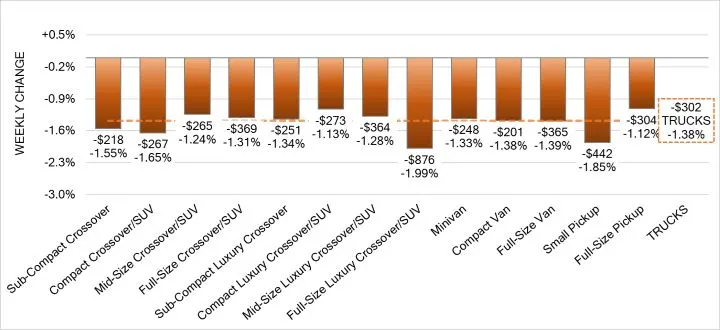
Wholesale Prices, Week Ending Sept. 2
The market continues to depreciate at an accelerated rate, despite increased auction activity last week. Dealers continue to speculate on the potential United Auto Workers strike that could cost the industry billions and increase demand for used vehicles.
This Week Last Week 2017-2019 Average (Same Week)
Car segments -1.44% -0.83% -0.11%
Truck & SUV segments -1.38% -0.87% -0.12%
Market -1.40% -0.86% -0.12%
Car Segments
On a volume-weighted basis, the overall car segment decreased 1.44%. For reference, in the previous week, cars decreased by 0.83%.
The 0- to 2-year-old segments were down 0.94%, and 8- to-16-year-old cars declined 1.57%.
Eight of the nine car segments decreased, and seven of those had declines exceeding 1%.
Premium sporty car increased 0.70%, compared with the prior week’s increase of 0.46%. The increases continue to be driven by the strength of the prior-generation Chevrolet Corvette by collectors.
Mid-size car had the largest decline last week, down 2.10%.
Compact cars continue to have above normal depreciation, down 1.29%, but the rate of depreciation is slowing from the highs that exceeded 2% the first three weeks of August.
Truck / SUV Segments
The volume-weighted, overall truck segment decreased 1.38%, much more than the depreciation the prior week of 0.87%.
The 0- to 2-year-old models declined 1.00%, while the 8- to 16-year-olds declined 1.26%.
All 13 truck segments had declines greater than 1%.
The full-size luxury crossover/SUV segment had the largest decline at 1.99%, setting a record as its largest single-week decline.
The dmall pickup segment saw increased depreciation, down 1.85% compared with the prior week’s drop of 0.62%.
Full-size vans had a large drop of 1.39%, just shy of the record drop in December 2019 of 1.45%.
Weekly Wholesale Index
The graphic below looks at trends in wholesale prices of 2- to 6-year-old vehicles indexed to the first week of the year. The index is computed keeping the average age of the mix constant to identify market movements.
Used-Retail Prices
Used-retail prices are more accessible than in years past due to the proliferation of no-haggle pricing. Transparent pricing upfront makes the car-buying process more enjoyable for customers and allows Black Book to accurately measure retail market trends.
At the onset of the pandemic, in CY2020, used-retail prices increased slightly, following typical seasonal patterns, then began dropping in April, finally hitting a low point in the late spring months. By late summer of CY2020, they increased as supply of new-vehicle inventory started to become scarce, but retail demand slowed at the end of CY2020, resulting in declining retail asking prices for the last several weeks of the year. When CY2021 kicked off, demand rebounded while retail prices lagged slightly behind wholesale prices. March 2021 started the dramatic increases in prices, fueled by stimulus payments, tax season and shortages of new inventory. During the third quarter, retail prices continued to rise at a slower rate but soon picked up again to start the fourth quarter, when they steadily increased. As CY2021 came to an end, the retail listing price index closed 36% above where the year began. The index remained relatively stagnant through most of CY2022. In the fourth quarter of 2022, the Retail Listings Price Index started to decline, but not as steep as the wholesale price index.
This analysis is based on approximately two million vehicles listed for sale on U.S. dealer lots. The graphic below looks at 2- to 6-year-old vehicles. The index is computed keeping the average age of the mix constant to identify market movements.
Inventory
Used Retail
The Used Retail Active Listing Volume Index currently sits at 1.01 points.
The used retail days-to-turn estimate is currently hovering around 49.
Wholesale
Dealers went into the lanes last week with the potential UAW strike on their minds, leading them to make a few purchases in preparation for the likely stop of new production. Between the speculation of a potential strike and a various recent natural disasters around the country, it is surprising that the market is taking such a large downturn; However, industry conversations are viewing this as prices working toward normalization and not due to the sky’s falling.
That’s why here at Black Book, we have our team of analysts focused on keeping their eyes on the market, watching for developing trends and insights.
The estimated Average Weekly Sales Rate increased to 49%.
Originally posted on Auto Dealer Today
More Showroom

New Cars Less Affordable
Buying conditions eroded for American shoppers last month due to inflation and interest rates, though they fared better than a year ago.

October Sales Divided
Inventory trends split between the new- and used-vehicle markets, though prices continued to rise for both in October.

Auto Transaction Prices Hit New Height
October sales of big, pricey models push up the average, even as budget-conscious consumers snag more economical options.

Making the Safe Choice
Kelley Blue Book has turned households with teen drivers onto safe and affordable options for their vehicles of choice

Inventory Holds Steady
September new-vehicle inventory rose slightly month-over-month, but dealer lots are laden with MY2026 vehicles as the typical model year changeover trudges along.

October Auto Sales Fall With the Leaves
A forecast anticipates retail deliveries are down this month as consumers continue to face cost challenges, though more are tapping long loans in order to buy.

California Sees Quarterly Gains
California’s new-vehicle market saw a boost in hybrids in the third quarter and its first overall quarterly market gain of the year.

New-Vehicle Prices Stay Put
Affordability pressures and model availability shaped new-vehicle sales in September, according to an analysis by Kelley Blue Book.

EV Buyer Consideration Shifts
What drives American consumers to purchase an electric vehicle is shifting as the question moves away from Should I?' to 'Which features and experience do I want to have?'

Year-to-Date Auto Sales Holding Their Own
A forecast through August shows that automakers have shifted strategies to keep deliveries and revenues up despite tariffs and other economic challenges.