



Black Book: Weekly Market Update
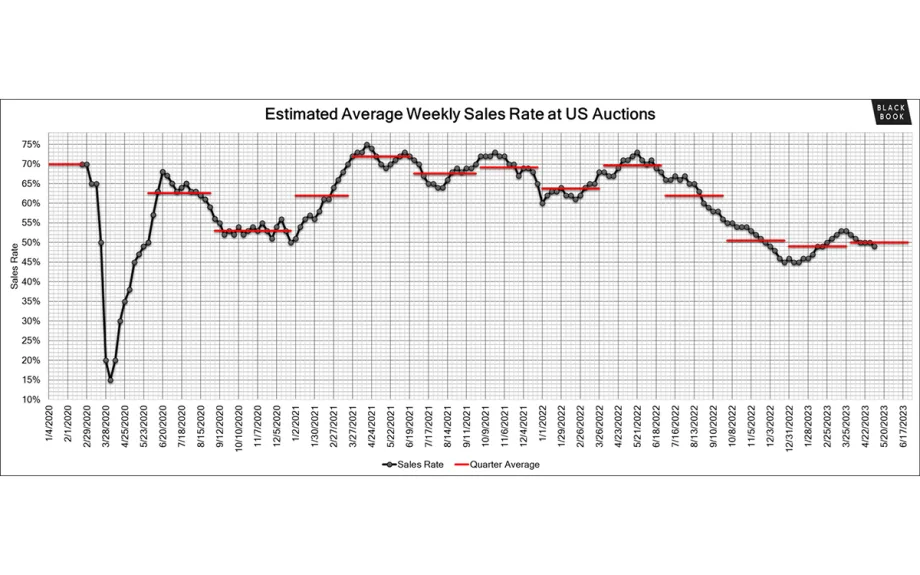
The Estimated Average Weekly Sales Rate dropped to 49% last week.

Wholesale Prices, Week Ending May 6
The market turned last week, with overall declines for the first time since early February. The 8 -to 16-year-old units began to experience softening two weeks ago and continued to speed up their depreciation last week, dropping 0.15%. For reference, the 2- to 8-year-old units dropped -0.10%, and 0- to 2-year-old vehicles were stable.
This Week Last Week 2017-2019 Average (Same Week)
Car segments -0.06% +0.27% -0.14%
Truck & SUV segments -0.12% +0.17% -0.06%
Market -0.10% +0.20% -0.09%
Car Segments
On a volume-weighted basis, the overall car segment decreased 0.06%. For reference, the previous week, cars increased by 0.27%.
Only three of the nine car segments increased last week.
Sporty car continues to climb, but the rate of increase is slowing, with a gain of only 0.39% compared with the average weekly increase of 0.64% over the past 15 weeks.
Prestige luxury (-0.34%) and near luxury (-0.27%) had the largest declines last week, marking the second week in a row of declines for the segments.
Truck / SUV Segments
The volume-weighted, overall truck segment decreased 0.12% compared with the prior week’s increase of 0.17%.
Four of the 13 truck segments reported increases last week, the smallest number of segments reporting an increase since the beginning of February.
Minivans continue to report positive movements, but the rate of increase is slowing, increasing 0.30% compared with the average weekly gain of 0.74% over the past 11 weeks.
Pickup trucks, both small (+0.10%) and full size (+0.09%), continue to increase, but the gains are slowing.
Weekly Wholesale Index
The graphic below looks at trends in wholesale prices of 2- to 6-year-old vehicles, indexed to the first week of the year. The index is computed keeping the average age of the mix constant to identify market movements.
Calendar years 2020 and 2021 ended with used wholesale prices at elevated levels. With economic patterns, including the automotive market, driven by the pandemic, normal seasonal patterns in the wholesale market, e.g., the 2019 calendar year, were not observed for most of the last three years. We saw a similar picture in 2009 at the end of the Great Recession. Calendar year 2021 did not have typical seasonality patterns, as the market had rapid increases in wholesale values for most of the year. The Wholesale Weekly Price Index reached the highest point of the year at the end of December 2021, reporting over 1.51 points. In 2022, the price index was on a mild rollercoaster until July, after which point, prices were on a continuous decline until the end of the year.
Retail (Used and New) Insights
Toyota continues to tease us with images of the redesigned Tacoma. The 2024 redesign is set to be revealed on May 19. Toyota has already confirmed that the midsize pickup will have its hybrid i-Force Max powertrain as an option, the same powertrain already available in the Tundra and Sequoia.
Despite the high interest rates, new-vehicle sales for April were strong, with much of the strength due to fleet sales increasing.
Lordstown Motors made news last week, saying it was facing financial troubles and citing potential resolutions, such as finding a partner, filing for bankruptcy, and stopping production of the Endurance pickup.
Volvo’s 2024 C40 and XC40 Recharge variants will be offered in rear-wheel-drive, charge faster, and have a longer range compared to the current model year. The new models will be available in dealerships in the second half of this year.
Used Retail Prices
Used retail prices are more accessible than in years past due to the proliferation of "no-haggle pricing" for used-vehicle retailing. Transparent pricing upfront makes the car-buying process more enjoyable for customers and allows Black Book to accurately measure retail market trends.
At the onset of the pandemic, in CY2020, used retail prices increased slightly, following typical seasonal patterns, and then began dropping in April, finally hitting a low point in the late spring months. By late summer of CY2020, used retail prices increased as supply of new-ehicle inventory started to become scarce, but retail demand slowed down at the end of CY2020, resulting in declining retail asking prices for the last several weeks of the year. When CY2021 kicked off, demand rebounded while retail prices lagged slightly behind wholesale prices; March of 2021 started the dramatic increases in used retail prices, fueled by stimulus payments, tax season, and shortages of new inventory. During the third quarter, retail prices continued to rise at a slower rate but soon picked up once again to start the fourth quarter, when prices on retail listings steadily increased week after week. As CY2021 came to an end, the retail listing price index closed 36% above where the year began. The index then remained relatively stagnant through most of CY2022. In the fourth quarter, Retail Listings Price Index declines started, but were not as steep as the wholesale price index.
This analysis is based on approximately two million vehicles listed for sale on U.S. dealer lots. The graphic below looks at 2- to 6-year-old vehicles. The index is computed keeping the average age of the mix constant to identify market movements.
Inventory
Used Retail
The Used Retail Active Listing Volume Index reverted back to one at the start of 2023. Currently, the index sits at 0.97 points.
The Used Retail days-to-turn estimate is currently around 50 days.
Wholesale
May began with what seemed to be the tipping point for the market, according to many industry experts; after 12 consecutive weeks of increases, the market turned last week with the first widespread depreciation since early February. Additionally, conversion rates and available inventory, both in OEM and dealer lanes, are also declining. As always, the Black Book team will continue to monitor and report on developing trends.
The Estimated Average Weekly Sales Rate dropped to 49% last week.
Originally posted on Auto Dealer Today
More Showroom

New Cars Less Affordable
Buying conditions eroded for American shoppers last month due to inflation and interest rates, though they fared better than a year ago.

October Sales Divided
Inventory trends split between the new- and used-vehicle markets, though prices continued to rise for both in October.

Auto Transaction Prices Hit New Height
October sales of big, pricey models push up the average, even as budget-conscious consumers snag more economical options.

Making the Safe Choice
Kelley Blue Book has turned households with teen drivers onto safe and affordable options for their vehicles of choice

Inventory Holds Steady
September new-vehicle inventory rose slightly month-over-month, but dealer lots are laden with MY2026 vehicles as the typical model year changeover trudges along.

October Auto Sales Fall With the Leaves
A forecast anticipates retail deliveries are down this month as consumers continue to face cost challenges, though more are tapping long loans in order to buy.

California Sees Quarterly Gains
California’s new-vehicle market saw a boost in hybrids in the third quarter and its first overall quarterly market gain of the year.

New-Vehicle Prices Stay Put
Affordability pressures and model availability shaped new-vehicle sales in September, according to an analysis by Kelley Blue Book.

EV Buyer Consideration Shifts
What drives American consumers to purchase an electric vehicle is shifting as the question moves away from Should I?' to 'Which features and experience do I want to have?'

Year-to-Date Auto Sales Holding Their Own
A forecast through August shows that automakers have shifted strategies to keep deliveries and revenues up despite tariffs and other economic challenges.