



“Cash for Clunkers” Produces 19.6 Million Shopping Rate, Says Edmunds.com
The federal “Cash for Clunkers” program generated a SAAR shopping rate of 19.6 million and boosted the percentage of trade-in vehicles involved in new-car sales, according to Edmunds.com.
SANTA MONICA, Calif. — The federal “Cash for Clunkers” program generated a SAAR shopping rate of 19.6 million and boosted the percentage of trade-in vehicles involved in new-car sales, according to Edmunds.com.
In the months before “Cash for Clunkers” launched, 39 percent of new-car sales involved a trade-in. Since then, 51 percent do. Prior to the program, nearly nine percent of trade-ins were vehicles that would have qualified as “clunkers.” Since the launch, 39 percent of trade-ins qualify.
“There is no question that the program has generated results. The shopping activity we’ve witnessed has generated a SAAR of 19.6 million, remarkable compared with the industry’s sales record of 17.4 million set in 2000,” noted Edmunds.com senior analyst Jessica Caldwell. “Of course, this level of activity will not continue, as it reflects the behavior of those anxious and able to participate in the program – and that is a limited set of people.”
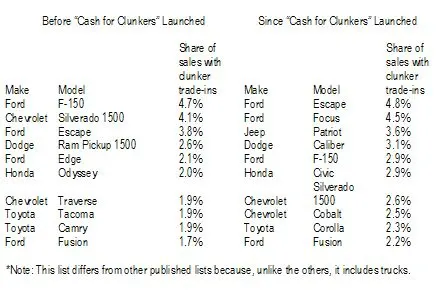
Edmunds.com analysts evaluated which models are typically purchased when clunkers were traded in during May and June of this year, and compared that to the list of most popular models being purchased through the Cash for Clunkers program:
“Participants in the program are choosing more fuel-efficient vehicles. Before, cars were only two of the top 10 vehicles purchased with clunker trade-ins; now, six are cars,” stated Edmunds.com senior analyst Michelle Krebs, who evaluates the data more thoroughly in her report for AutoObserver.com. “Interestingly, all buyers, regardless of trade-in, are opting for smaller, more fuel-efficient cars at a higher than usual rate.”
Next, the team determined which models were typically traded in for new cars or trucks before the program, and how that changed once the program was launched.
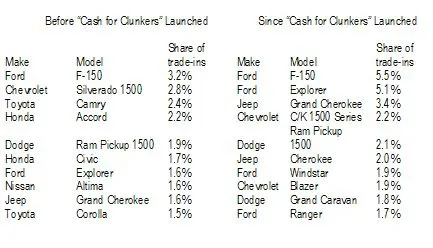
Edmunds.com analysts have determined that in May and June, the average fuel efficiency of recently purchased new cars was 21.8 miles per gallon. Since the program launched, the average has jumped to 23.2 mpg, a 6.1 percent improvement. Those who participated in the program now earn an average of 24.3 mpg with their new purchases. The average fuel efficiency of trade-ins had been 20.0 mpg prior to the program; that number has dropped 9.0 percent to 18.3. The average clunker trade-in earned 16.1 mpg. As mentioned earlier, 39 percent of all recent trade-ins qualified as clunkers.
“Less fuel-efficient vehicles are being traded in at a faster rate now that the program is in effect, and they will be removed from the road permanently,” noted Edmunds’ GreenCarAdvisor.com Editor John O’Dell. “This suggests that some environmental benefit has been gained.”
Consumers who traded in their clunkers through the program also benefitted financially, generally speaking. Based on preliminary data, Edmunds.com estimates that the average cash value of the traded-in clunkers was $1,475. The owners of those vehicles earned rebates for either $3,500 or $4,500, depending on the replacements vehicles they chose. Edmunds.com Senior Analyst David Tompkins, PhD, points out that many will also save money on gas each month, thanks to their more efficient new purchases.
“This is a tremendous opportunity for certain people, but anyone driving a clunker should really evaluate whether he or she can afford a new car payment that will last a lot longer than the clunker cash,” recommends Edmunds.com Senior Consumer Advice Editor Philip Reed.
Car shoppers considering the program can use Edmunds.com’s “Cash for Clunkers” calculator to determine their eligibility and better understand the financial benefits they can gain from participating.
“And now, more than ever, it is important for car-buyers to do their research so that they pay a fair price for their new vehicles,” notes Reed. “Our analysts have determined that dealers are enjoying a 20 percent increase in gross profit per sale involving a clunker trade-in since the program launched.”
More F&I

AI: Facilitator, Not Fixer, in F&I
The dealerships that thrive in the years ahead will be those that embrace technology while continuing to invest in the people who make customer interactions count.
Read More →
Modern Technology Objection Handling
In this video, Trent White shares how to confidently handle technology-based objections by helping customers understand the value of protection, even with modern vehicle technology.
Read More →
Consistency at Scale: Driving F&I Performance
With 75 rooftops across the Sunshine State, Morgan Auto Group has proven to Floridians that it knows a thing or two about driving performance in a competitive market. But it didn’t start at the top.
Read More →
Gitty Up on GAP
The foundational finance-and-insurance product hasn’t kept up with the latest conditions for auto dealers. Is the time ripe?
Read More →
How AI-Powered Coaching Is Transforming F&I Performance
See how AI-powered coaching can turn F&I customer conversations into actionable insights that support compliance, performance and profitability
Read More →
Sell Value, Build Trust
In this video, Trent White explains why selling on value, not fear, builds lasting customer trust, reduces cancellations, and drives long-term success.
Read More →
F&I Sales Give Dealers First-Half Lift
Product business shored up total profits to avoid an overall revenue tanking as product penetrations held steady, StoneEagle reported.
Read More →
Targeted Training Drives Results
Today’s technology, instead of threatening F&I managers, can actually make them better, according to an industry veteran who’s watched market setbacks roil the unprepared.
Read More →
Double the Change, Double the Chance
When an F&I manager gets a customer refusal, it’s a wise move to tweak more than one thing in the product offering.
Read More →
Just Do It
F&I managers need training, but instead of resisting application or expecting perfection, they should improve by simply acting on what they learn.
Read More →