



Cox Automotive’s Ten Predictions for 2022 Miss on Overall Demand, Leasing, New-Vehicle Inventory
Cox Automotive's quarterly review allows us to see how the market has progressed compared to expectations.

Cox Automotive's quarterly review allows us to see how the market has progressed compared to expectations.
IMAGE: Cox Automotive
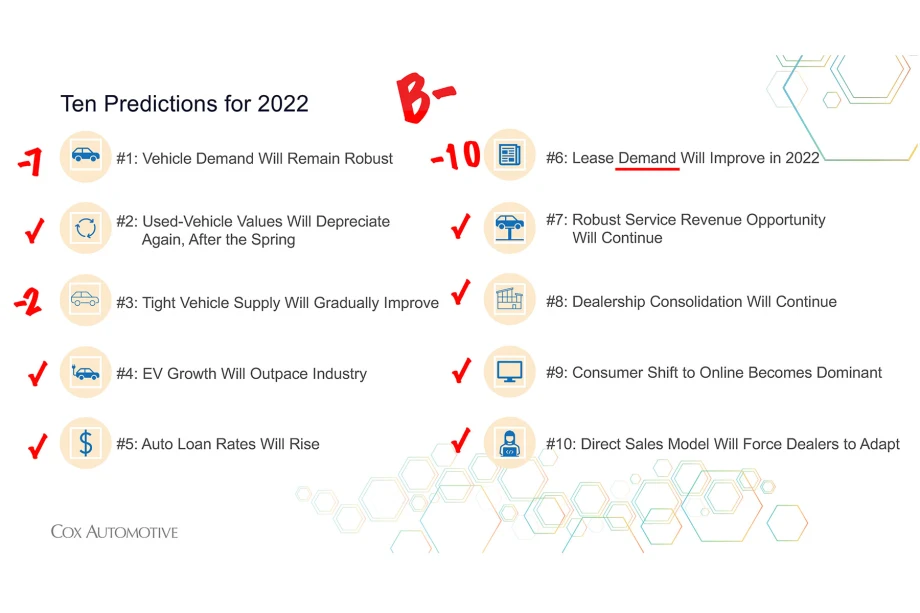
COX AUTOMOTIVE – As we did at the end of the second quarter, our team took a look back at the market predictions we posted in January. This quarterly review is helpful, as it allows us to see how the market has progressed compared to expectations. Forecasting is a tough business, especially in a year with so many changing market dynamics, but many of our initial predictions have held up reasonably well. As was the case at the end of last quarter, we have fallen short in three areas.
1. We predicted vehicle demand would remain robust in 2022 but sales year to date are well off last year’s pace. Total retail sales did not improve in Q3. The third quarter saw the bite of higher rates, particularly in the used-vehicle market. Stubborn inflation has been the headline this year, and the Federal Reserve has moved aggressively to tackle it. We fully expected interest rates to increase in 2022 – as noted in prediction #5 – but the size and rate of the increases have surprised even us.The Fed is aggressively moving to reduce demand, and that’s exactly what the Fed is getting. Higher interest rates have already impacted the housing market, and the auto industry is now feeling that pain as well. We are seeing softening prices, increasing inventory levels, and indications that buyers, particularly those with subprime credit ratings, are falling out of the market. Demand for new and used vehicles is no longer robust. As they say, you can’t fight the Fed. Our #1 prediction was wrong. Points off.
2. We again fully acknowledge that our initial expectation of improving vehicle inventory in 2022 has not materialized as we had thought it would. Yes, used-vehicle inventory is notably higher than in 2021 and, generally, is back above historic norms. New-vehicle inventory, however, remains stubbornly tight. Slower sales and some production improvements are helping, and new-vehicle inventory volume at the end of Q3 is up 40% from the same period in 2021. Even U.S. auto dealers are indicating that inventory is improving. But both new-vehicle inventory volume and days’ supply remain far below historic norms, so we can’t take full points on this prediction, but our score has improved since Q2.
3. Points have to be taken away for expecting leasing demand to improve in 2022. We do think the demand is there, but we can’t take credit for lease demand when lease penetration has fallen further. In this tight-inventory market, automakers are not pushing lease deals, and overall new-vehicle demand is showing signs of waning. In 2019, leasing accounted for roughly 30% of the retail market. In 2022, thanks to a number of factors, leasing will likely account for closer to 20% of retail, well below historic norms. We do believe leasing share will improve at some point, but that is not the case in 2022. On this topic we take all the points away.
Click here to read the full report.
More Showroom

California Sees Quarterly Gains
California’s new-vehicle market saw a boost in hybrids in the third quarter and its first overall quarterly market gain of the year.
Read More →
New-Vehicle Prices Stay Put
Affordability pressures and model availability shaped new-vehicle sales in September, according to an analysis by Kelley Blue Book.
Read More →
EV Buyer Consideration Shifts
What drives American consumers to purchase an electric vehicle is shifting as the question moves away from Should I?' to 'Which features and experience do I want to have?'
Read More →
Year-to-Date Auto Sales Holding Their Own
A forecast through August shows that automakers have shifted strategies to keep deliveries and revenues up despite tariffs and other economic challenges.
Read More →
Slow to Robo
Ten years of polling consumers shows autonomous vehicles’ profiles have risen considerably, but even more people now want at least some level of control if they go that route.
Read More →
Dealers a Little Down
A third-quarter Cox Automotive survey finds them in a mixed mood, bummed by fallen customer traffic but encouraged by better profits, costs and EV interest.
Read More →
European EV Sales Skyrocket
The EV market on the continent held strong in July with almost 25% of new-car sales being fully electric units, a stark contrast to the U.S., where EV sales declined about 42%.
Read More →
Mitsubishi Unveils U.S. Plan
The automaker announced a strategy that includes an expanded lineup and dealership presence, along with more ‘rugged’ and electric models.
Read More →
Used Lots Getting the Business
Many consumers are seeking out the units to save money, and the demand – higher in July than normal – is keeping supply limited and prices up.
Read More →
Used Market Stabilizes
The Carfax Used Car Index noted a major drop in used-vehicle price increases in July after several months of hikes.
Read More →