



Edmunds.com Reviews Trends from 2008, Forecasts 2009
A new report from Edmunds.com highlights trends in the automotive industry in 2008, which saw the collapse of the financial industry and the decline of car sales to levels not seen since the early 1990s.
SANTA MONICA, Calif. — A new report from Edmunds.com highlights trends of the automotive industry in 2008, which saw the collapse of the financial industry and the decline of car sales to levels not seen since the early 1990s.
Used-car sales were down only 8 percent compared to 2007, and certified pre-owned (CPO) sales were flat. During the same period, new-car sales fell by more than 16 percent.
"During the downturn in the economy, many car-shoppers hunted for bargains in the used car lot," said Edmunds.com analyst Joe Spina.
Edmunds.com also found that consumers' vehicle preferences shifted with the rise and fall of prices. "Over the course of the year, gas prices climbed from an average of less than $3.00 per gallon to well over $4.00 before falling back to under $2.00 per gallon," said Dr. David Tompkins, a senior analyst for Edmunds.com. "Car-buyers responded to these price swings by gravitating toward fuel-efficient vehicles when prices were high, and reconsidering bigger vehicles when gas prices fell again."
Hybrid vehicle market share was 2.1 percent at the beginning of the year, peaked at 3.2 percent in April and fell to 2.2 percent in November. Compact car market share was 15.3 percent at the beginning of the year, reached 21.3 percent in June and declined to 16.1 percent in November. Large pick-up truck market share was 12.3 percent at the beginning of the year, dipped to 9.3 percent in May and climbed back to 13.8 percent in November. Midsize SUV market share was 15.3 percent at the beginning of the year, dropped to 11.8 percent in May and rose to 13.7 percent in November.
Automakers eliminated models and sold brands to reduce expenses and raise capital, said Edmunds.com. "The U.S. market has always been a competitive place, and now the economic crisis has made it uninhabitable for certain brands," said Edmunds.com analyst Jessica Caldwell.
Each of the Detroit Three eliminated models or sold brands in 2008. Chrysler discontinued Aspen, Aspen Hybrid and Crossfire. Dodge stopped production of the Durango and Durango Hybrid. Ford sold Jaguar and Land Rover and divested a portion of its Mazda ownership, while General Motors sold its interest in Subaru, put Hummer up for sale and put Saab and Saturn up for review.
Isuzu will discontinue selling vehicles in the U.S. beginning Jan. 31, 2009. Jeep has scheduled Commander production to end in mid-2009.
Edmunds.com also found that increased incentives spending did not boost sales. "Some automakers hit new highs in terms of incentives spending this year, but it seems that they reached the point of diminishing returns," stated Edmunds.com senior analyst Jesse Toprak.
In 2008, domestic automakers spent $3,545 per vehicle sold, up 10.3 percent from $3,212 in 2007. During the same period, market share fell by 3.6 percent.
During the same year, Japanese automakers spent $1,397 per vehicle sold, up 16.4 percent from $1,200 in 2007. During the same period, market share rose by 2.9 percent. Korean automakers spent $2,052 per vehicle sold, up 10.3 percent from $1,861 in 2007. During the same period, market share rose by 0.5 percent. European automakers spent $2,794 per vehicle sold, flat compared to $2,802 in 2007. During the same period, market share rose by 0.5 percent.
Besides taking a look back at 2008, Edmunds.com forecasted automotive trends for 2009.
Edmunds.com expects new light vehicle sales to decrease by almost five percent in 2009. (In 2008, approximately 13.1 million new vehicles were sold, while almost 16.2 million new vehicles were sold in 2007.)
Edmunds.com also made other predictions.
• It will be a car-buyer’s market for essentially every model because of relatively slow sales all year.
• Cash-strapped automakers will be more selective in their use of incentives.
• Factories will have extended shutdowns as automakers seek to match supply with expected minimal demand.
• Transaction prices of certain models might increase as automakers make significant cuts to production, causing decreases in supply.
• Domestic automakers will sell or eliminate brands in an effort to reduce operating expenses.
• Government involvement as a result of the bailout will spur faster development of alternative fuel vehicles.
• Hundreds of dealerships will go out of business.
• More car-buyers will custom-order their vehicles rather than buying dealership inventory.
• Subcompact and compact cars will continue to be popular as consumers expect gas prices to fluctuate.
• The truck market will stay flat despite impressive new model introductions.
"Concessions made by the unions as part of the federal bailout will make it a bit easier for automakers to reap the benefits of factory shutdowns," commented Michelle Krebs, editor of Edmunds’ AutoObserver.com. "Automakers will no longer have to pay workers who are not working, and that quickly adds up to real savings."
More F&I

Why Your F&I PVR Is Misleading You
Here’s a handy checklist of the numbers to track in 2026 instead.
Read More →
Auto Consumer Anxiety Presents Opportunity
A survey of U.S. drivers found the majority are concerned about finances and the economy, but those fears make many ready to buy vehicle-protection products.
Read More →
Humble and Hungry: 12 Rules for an F&I Life
Dustin Gingerich, with a decade in the F&I business under his belt, shares his thoughts on leadership, building trust with customers, and the importance of learning and innovation.
Read More →
Focus on the Opening
F&I managers must learn as much as possible about their customers, starting before they walk into their offices. The bulk of today’s consumers expect that, and good results will follow.
Read More →
F&I Reaches for the Sky
The increasingly important profit center continued making gains in the first quarter, according to StoneEagle data, ancillary products proving more popular as consumers hold onto their buys longer.
Read More →
Timing the Market Can Hurt Long-Term Program Performance
For dealer-owned reinsurance entities, avoiding volatility entirely can mean falling behind inflation and missing market rebounds that drive long term surplus growth. Missing just a handful of strong market days can materially impact cumulative returns—an important reminder for long horizon trust and investment strategies.
Read More →
The 90/10 Rule
In this video, Ryan Ruff explains the rule that elite sales professionals use to turn ordinary conversations into unforgettable customer experiences.
Read More →
Your Office Is Talking
What’s the atmosphere saying about you to your customers? You can make minor adjustments and additions that transform your space into one that creates trust with the people on the other side of the desk.
Read More →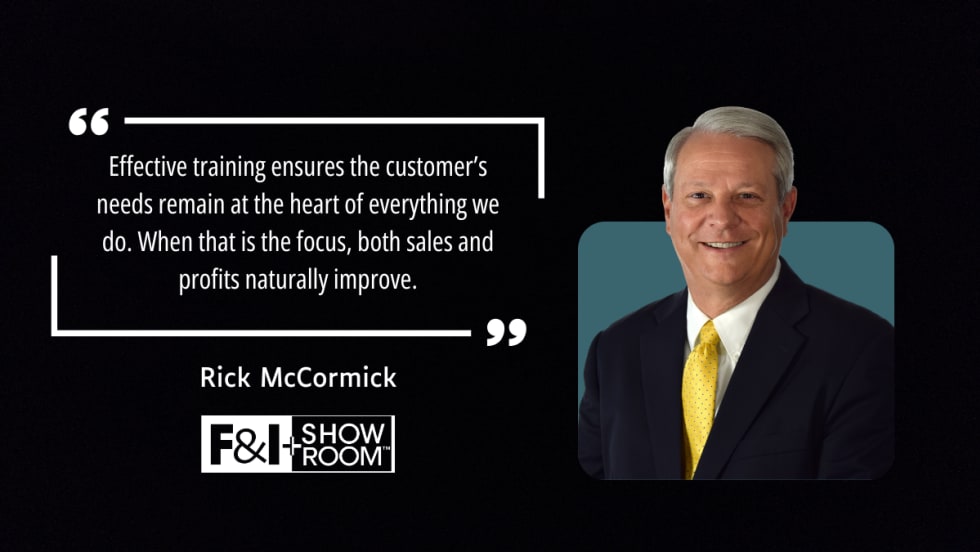
F&I Training Fundamentals
How can auto dealerships help F&I managers fulfill their vital role in the most effective ways? Industry expert Rick McCormick shares his insights on the best ways to train these professionals and help them maintain good habits.
Read More →
Not Just Any Tire Will Do
More consumers and businesses are opting for all-season options for various reasons as safety, sustainability and convenience push practical change.
Read More →