



EVs Pummel Today’s Road Guardrails
Crash tests show today’s barriers are no match for the heavier vehicles.

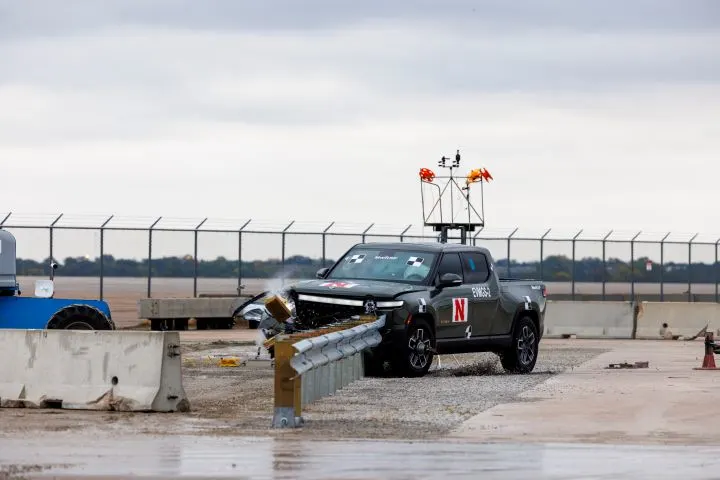
Today's guardrails were designed for lighter vehicles, but EVs are significantly heavier than gas-powered models.
IMAGE: Midwest Roadside Safety Facility
Today’s roadway guardrails don’t appear to be sturdy enough for electric vehicles, according to recent crash tests.
Commissioned by the U.S. Army Corps of Engineers to determine whether guardrails and military barriers can handle “hostile” EVs, the tests were conducted last fall by the Midwest Roadside Safety Facility at the University of Nebraska-Lincoln.
The facility used a 2018 Tesla Model 3 sedan and a 2022 Rivian R1T pickup in the 60-mph crash tests. It said the Tesla lifted the guardrail upon impact and passed underneath it, and the truck tore through it with little loss of speed.
The guardrail was designed for lighter vehicles of up to 5,000 pounds, but EVs are significantly heavier than gas-powered vehicles and can therefore do more damage, having 20% to 50% more energy upon impact, the facility said in a press release on the crash test findings.
The Corps of Engineers wanted to determine whether the proliferation of EVs could break through national safety defenses. It plans more such tests.
Beyond potential hostile vehicle operators who might compromise national security, there is the issue of general public traffic safety. The testing center said there are more than 100,000 off-road crashes in the U.S. each year that lead to thousands of deaths.
“It is going to be necessary to re-examine the designs of roadside barriers even beyond the EVs,” said Cody Stolle, the facility’s assistant director. “It’s a critical and timely need.”
The university, which has led past roadside barrier design projects, will work on a new design to accommodate EVs.
Originally posted on Auto Dealer Today
More Showroom

New Cars Less Affordable
Buying conditions eroded for American shoppers last month due to inflation and interest rates, though they fared better than a year ago.

October Sales Divided
Inventory trends split between the new- and used-vehicle markets, though prices continued to rise for both in October.

Auto Transaction Prices Hit New Height
October sales of big, pricey models push up the average, even as budget-conscious consumers snag more economical options.

Making the Safe Choice
Kelley Blue Book has turned households with teen drivers onto safe and affordable options for their vehicles of choice

Inventory Holds Steady
September new-vehicle inventory rose slightly month-over-month, but dealer lots are laden with MY2026 vehicles as the typical model year changeover trudges along.

October Auto Sales Fall With the Leaves
A forecast anticipates retail deliveries are down this month as consumers continue to face cost challenges, though more are tapping long loans in order to buy.

California Sees Quarterly Gains
California’s new-vehicle market saw a boost in hybrids in the third quarter and its first overall quarterly market gain of the year.

New-Vehicle Prices Stay Put
Affordability pressures and model availability shaped new-vehicle sales in September, according to an analysis by Kelley Blue Book.

EV Buyer Consideration Shifts
What drives American consumers to purchase an electric vehicle is shifting as the question moves away from Should I?' to 'Which features and experience do I want to have?'

Year-to-Date Auto Sales Holding Their Own
A forecast through August shows that automakers have shifted strategies to keep deliveries and revenues up despite tariffs and other economic challenges.